
Spain bans outdoor poultry farming in high-risk avian flu zones
Spain's Agriculture Ministry declares high avian flu risk, banning free-range poultry in designated surveillance and special risk areas.
English · Original discussion in Spanish · Published
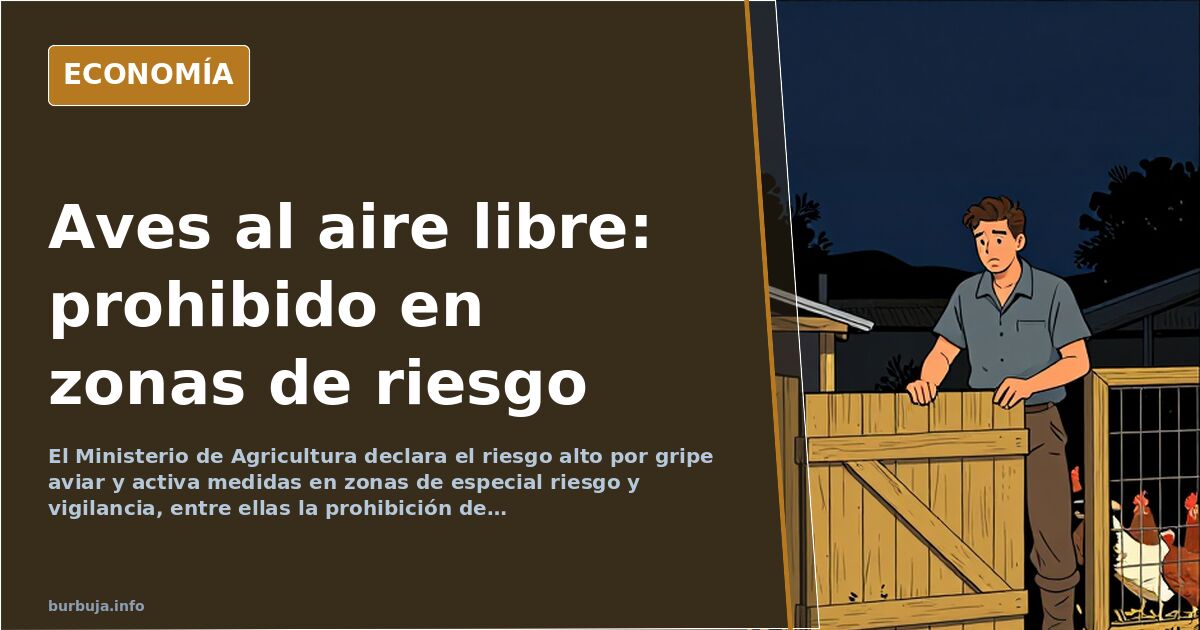
Outdoor poultry banned in avian flu risk zones
The Ministry of Agriculture has declared a high avian influenza risk in Spain and activated preventive measures in special risk and surveillance zones as of Monday. These include a ban on raising birds outdoors, as infection typically occurs when domestic animals contact wild specimens. The epidemic has already claimed one human life in the United States and is spreading across Europe. This is not a total lockdown: coops are permitted if protected by netting that prevents migratory birds from accessing drinking water.
What the order says and who it affects
The order applies only to special risk and surveillance zones, not nationwide. In these areas, domestic birds cannot be kept outdoors without protection. The text allows maintaining a coop if covered with netting to prevent migratory birds from drinking its water. Vaccination against certain diseases is also required, which some analyses suggest was already mandatory.
Some argue the measure is proportionate and limited to specific areas. Opponents cite the pandemic lockdown, initially set for fifteen days but lasting much longer. Antiestéticar that temporary restrictions become permanent pervades much of the debate.
Why chickens are inconvenient for state control
Chickens produce eggs and cheap protein outside the monetary system. This is the most repeated argument: owning chickens provides food sovereignty beyond commercial circuits. In many villages, eggs and chicken represent a significant portion of ingested proteins, estimated at around 50% in some rural areas.
The pattern repeats: non-productive animals (dogs, cats) face no barriers, while those generating economic value accumulate bureaucracy and costs. The underlying suspicion is that domestic breeding is discouraged so only large corporations sell eggs.
Precedents: rabbits and urban gardens
This is not unprecedented. Rabbit breeding was previously banned for grandparents of current debaters. In several US regions, urban gardens are prohibited under public health pretexts. Critics argue the goal is to prevent eating outside the system and incivil self-sufficiency.
The outdoor poultry ban adds to intensive farming restrictions. Between the two, margins for small producers shrink. The conclusion drawn: only Amazon-sized industrial facilities will be able to raise chickens.
The confusing data point
Avian flu affects chickens, humans, and cows, but not gulls, eagles, or quails. This asymmetry fuels distrust of the official narrative. With this data on the table, the outdoor poultry ban is viewed less as a health measure and more as a step toward "you shall have nothing and be happy."
The Ministry of Agriculture has declared a high avian influenza risk in Spain and activated preventive measures in special risk and surveillance zones as of Monday. These include a ban on raising birds outdoors, as infection typically occurs when domestic animals contact wild specimens. The epidemic has already claimed one human life in the United States and is spreading across Europe. This is not a total lockdown: coops are permitted if protected by netting that prevents migratory birds from accessing drinking water.
What the order says and who it affects
The order applies only to special risk and surveillance zones, not nationwide. In these areas, domestic birds cannot be kept outdoors without protection. The text allows maintaining a coop if covered with netting to prevent migratory birds from drinking its water. Vaccination against certain diseases is also required, which some analyses suggest was already mandatory.
Some argue the measure is proportionate and limited to specific areas. Opponents cite the pandemic lockdown, initially set for fifteen days but lasting much longer. Antiestéticar that temporary restrictions become permanent pervades much of the debate.
Why chickens are inconvenient for state control
Chickens produce eggs and cheap protein outside the monetary system. This is the most repeated argument: owning chickens provides food sovereignty beyond commercial circuits. In many villages, eggs and chicken represent a significant portion of ingested proteins, estimated at around 50% in some rural areas.
The pattern repeats: non-productive animals (dogs, cats) face no barriers, while those generating economic value accumulate bureaucracy and costs. The underlying suspicion is that domestic breeding is discouraged so only large corporations sell eggs.
Precedents: rabbits and urban gardens
This is not unprecedented. Rabbit breeding was previously banned for grandparents of current debaters. In several US regions, urban gardens are prohibited under public health pretexts. Critics argue the goal is to prevent eating outside the system and incivil self-sufficiency.
The outdoor poultry ban adds to intensive farming restrictions. Between the two, margins for small producers shrink. The conclusion drawn: only Amazon-sized industrial facilities will be able to raise chickens.
The confusing data point
Avian flu affects chickens, humans, and cows, but not gulls, eagles, or quails. This asymmetry fuels distrust of the official narrative. With this data on the table, the outdoor poultry ban is viewed less as a health measure and more as a step toward "you shall have nothing and be happy."
Also available in: Deutsch
Summary of a discussion on Burbuja.info - Foro de economía, actualidad y política., translated from Spanish and reviewed before publication. Read the full discussion (143 replies).
More summaries
-
US Army Sent Sick Troops to Europe in 1918
Wilson kept troop ships sailing despite onboard flu outbreaks. The biological weapon theory lacks evidence.
-
Washington confirms first human death from H5N5 avian flu
Washington state reports the first human fatality from H5N5 avian flu. Europe prepares contingency plans amid H5N1 pandemic risks.
-
PSOE subtitles PP campaign video, sparking data war in Spain
The PSOE's subtitled response to a PP video triggers a fierce debate over economic figures, including wages, inflation, and pensions.
-
Walmart retires employee with flowers after 44 years
Gayle retired from Walmart after 44 years with a flower bouquet. The gesture reignites debate on workplace recognition and pension plans.
-
ERC and Podemos forge tactical alliance, dropping Catalan bid
Podemos will not run in Catalonia and urges votes for ERC. Rufián campaigns nationally while ERC places Podemos candidates on the Barcelona list.
-
Basque PP and business leaders push voting rights for ETA exiles' descendants
Basque PP and entrepreneurs seek a law allowing descendants of those who fled Euskadi due to ETA to vote in regional elections.