
Spain loses 35,000 residents monthly, half highly educated
In 2022, 426,000 people left Spain. Nearly half held higher or post-compulsory education, and one-third were under 35.
English · Original discussion in Spanish · Published
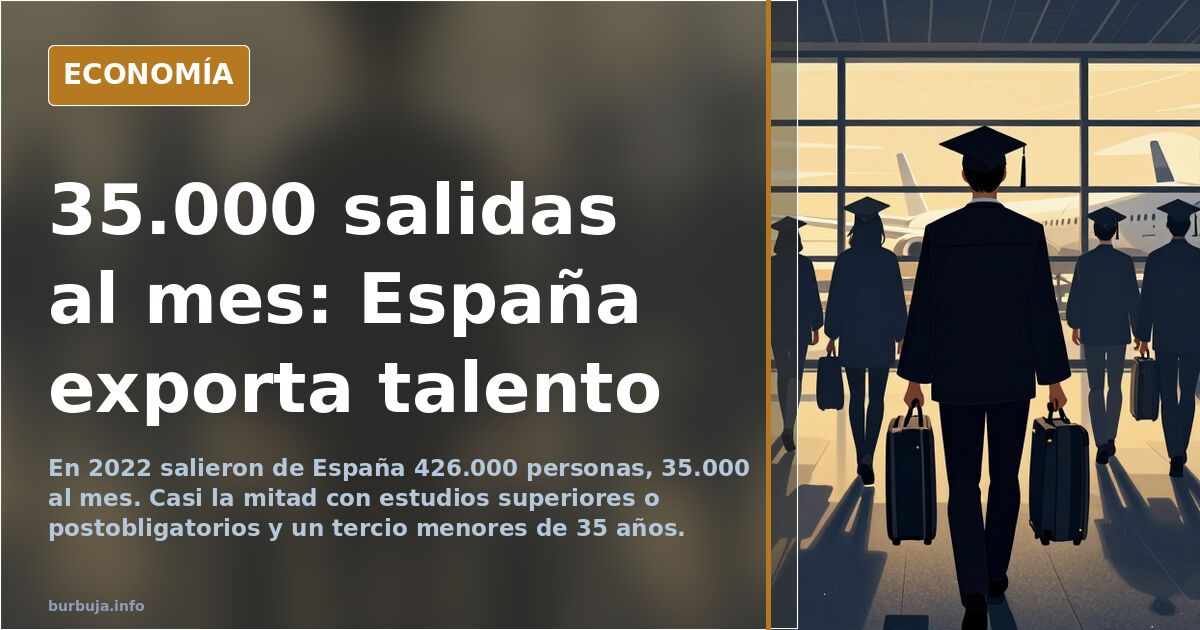
Spain loses 35,000 residents monthly, half highly educated
How many people are leaving Spain, and why does it matter beyond the headlines? The IVIE-BBVA study estimates 426,000 departures in 2022, up from 310,000 in 2018, averaging 35,000 people per month packing their bags. Of this total, 89% are of working age: 379,000 in 2022 versus 272,000 four years earlier. This is not an anecdotal brain drain of fresh graduates with backpacks; it is a hemorrhage of human capital valued by the report at €155 billion, 0.9% of the available stock, or roughly €8,000 per household.
Who leaves: profile of Spanish emigrants
The portrait drawn by the study breaks the stereotype of the young traveler seeking work abroad. Nearly half of 2022 emigrants had higher education (30.1%) or post-compulsory secondary education (18.8%). One-third were under 35. They do not leave for just anywhere: the EU-27 accounts for 39% of the total, South America for 20%, the UK for 13%, Africa for 9%, Asia for 7%, Central America and the Caribbean for 6%, and North America for 4%.
The economic consequence is direct. If human capital was trained with funds from families and Spanish public institutions, that effort stops benefiting Spain and instead boosts productivity in other economies. The report states plainly: emigration "contributes to reducing the human capital of the Spanish economy, limiting its present and especially future capacity to generate wealth." In short: lower growth, tighter public finances, and a Welfare State facing fewer generational replacements and more vacancies in key sectors.
Official narrative and underlying suspicion
One line of analysis argues the problem is not the departure itself, but the reason behind it. "Study and leave" was a half-joking saying for decades; now it has become a state-level life plan. The most critical reading suggests the system is not failing by accident: wages are uncompetitive, housing costs consume salaries, and qualified youth lose out compared to previous generations. Within this framework, emigration is interpreted as a rational response, not a personal tragedy.
The other current, less epic and more uncomfortable, notes that a significant portion of these departures are not native Spaniards. The INE indicates many who leave are foreigners using Spain as a springboard to other European countries or returning home with savings. This lowers the drama of the headline but does not eliminate the core issue: the nationals who leave remain numerous and above-average qualified. Some warn things will get serious when measures begin to prevent departures, such as demanding repayment of public investment in training.
Why do educated young people leave?
Because the math doesn't add up. A case circulating in debate: consulting in Barcelona, Monday to Saturday, 8 AM to 8 PM, €20,000 gross annual salary. With those numbers, rent consumes over 80% of income in many cities. Consequently, the profile leaving is no longer just twenty-somethings: professionals aged 35 to 55, experienced in engineering, logistics, administration, aviation or naval mechanics, are moving to Gulf countries, Africa, or Asia. Life has become more fluid (divorces, renting instead of buying, non-lifetime employment), and staying starts to feel like the risky option.
Generational contempt also weighs heavily. Some argue Spanish youth have been vilified for over a decade, blamed for not trying hard enough while offered a labor market that doesn't pay. Others add a cultural factor: the young person leaving seeks not just a salary, but to stop competing with a system that rewards connections and punishes study.
Long-term impact: who pays for pensions?
The brain drain is not just a snapshot of the current labor market. It is a mortgage on the future. Fewer qualified workers means fewer contributors, a smaller tax base, and greater pressure on a pension system already strained by aging. The report frames it as a process that "predictably increases the difficulty of maintaining the Welfare State." The paradox is that those leaving are often those who would contribute the most.
Meanwhile, the debate over whether this is a tragedy or merely a safety valve remains open. What admits no discussion is the trend: from €110 billion in talent loss in 2019 to €155 billion in 2022. The curve is rising. And those remaining look toward the door.
Ultimately, the question is not whether Spain can afford to lose its best. It is whether anyone with real power is doing more than writing reports about it.
Also available in: Deutsch
Summary of a discussion on Burbuja.info - Foro de economía, actualidad y política., translated from Spanish and reviewed before publication. Read the full discussion (115 replies).
More summaries
-
Latin American Migration Revives Spain's Welfare State Debate
A video showing Latin American families arriving in Spain reignites the welfare state debate, with a 90% claim but no source.
-
Europe Fires: Coordinated Attack or Rural Neglect?
Simultaneous wildfires in Spain, France, Germany, and the UK. Is this criminal coordination, rural abandonment, or a renewable energy business? Data analysis reveals the truth behind the blazes.
-
Educational disaster in Spain: Worst results in history in PISA report, falling up to two school years behind the United Kingdom
Spain plunges in PISA 2025 report, showing a two-year lag in reading compared to the UK. We analyze the causes and consequences.
-
Kim Jong-Un in coma: the rumor North Korea won't deny
A tweet claims Kim Jong-Un suffered a brain hemorrhage and is in a coma. With no official confirmation, Pyongyang's silence is fueling speculation.
-
Leaked photo of Lula with Netanyahu circulates amid VoX claims
A post on X suggests that Jewish people would be happy with Lula as Brazil's president. The message relies on an unverified image and mixes foreign policy with economics.
-
When will the home parcel delivery bubble burst?
Temu, AliExpress and Shein sales fell by up to 50% in Europe between June and July 2026 due to the 3-euro customs surcharge. Home delivery is finding a way out in parcel lockers.