
Spain links unemployment benefits to job acceptance
The Spanish government conditions subsidies on accepting offers, but the SEPE rarely places workers, raising doubts.
English · Original discussion in Spanish · Published
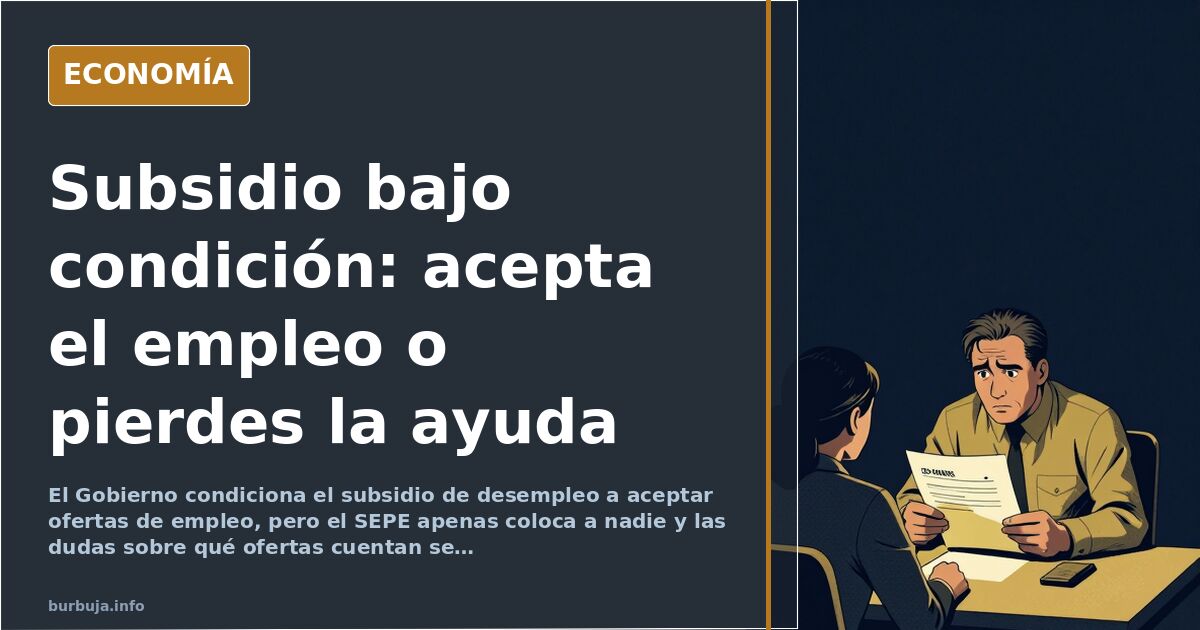
Unemployment subsidy at risk if you reject a job offer
Does it make sense to cut the subsidy for those who refuse work when the public employment service barely places anyone? The measure announced by the Government to condition the receipt of the unemployment subsidy on accepting job offers has fallen like a cold bucket of water on those registered as unemployed for years. The debate is not new, but now it comes with the threat of enforcement. And the first question that arises is the usual one: What type of job are we talking about? Because if the offer is a part-time waiter contract, twelve hours and without respecting the collective agreement, things change.
The discussion has been filled with technical nuances worth separating. It is not the same as the contributory benefit, which is collected after having paid contributions and which most consider an acquired right, than the non-contributory assistance subsidy of reduced amount and limited duration. The measure, as leaked, targets the latter. "It would be absurd if they went after those collecting a contributory benefit," summarizes one of the most repeated interventions. The nuance matters because it affects different groups and very different amounts.
What the Government says and what is known about the measure
The announcement, reported by economic press, proposes withdrawing the subsidy from anyone who rejects a job offered by public employment services. The fine print is unknown: it does not specify what constitutes rejection, nor which offers count, nor whether suitability to the applicant's profile is required. That lack of detail is precisely the main argument of those who doubt the measure will ever be applied.
Some recall that similar announcements have been made before and came to nothing. Distrust is not unfounded: the SEPE (Spanish Public Employment Service) and regional employment agencies have a fruta for placing almost no one. "I think it is easier to find extraterrestrial life than to receive a call from INEM with a job," summarizes an intervention that condenses general skepticism. If the service does not offer jobs, the threat of withdrawing the subsidy for rejecting them loses its object.
The real problem: non-existent or mismatched offers
The second front of the debate is practical. To reject an offer, it must first exist. And here enters profile suitability: if an electrician receives an offer to shear sheep, does it count as rejection? What if it is a cleaner position for a formwork carpenter? The casuistry handled in regional services is known by anyone who has been through an employment office.
The other side is that of companies. Several interventions describe a self-reinforcing mechanism: the applicant goes to the interview to get their active search procedure stamped, not because they want the position. "They only go to fulfill the procedure so they can stamp it," points out one experience. If that is the case, the measure would not change much: the rejection occurs earlier, in the company's screening, not in the candidate's formal refusal.
How to avoid losing the subsidy
The conversation quickly turns to ways to keep the aid without formally renouncing anything. The most repeated: go to the interview unenthusiastic. Show up disheveled, ask about schedule, holidays, and overtime, or mention that in the previous company there was a need to call labor inspection. "All politely. I assure you they won't call you back," summarizes an intervention. The rejection is not signed by the candidate: it is executed by the company.
Another route is union membership. Saying in the interview that you were fired from your previous job for being a union delegate, or that you are affiliated with a combative union, works as an automatic filter. It is not illegal. It is simply disliked. The consequence is the same: the company discards you and the subsidy remains.
Background: contributory, assistance, and the fraud narrative
Underneath the announcement is a deeper discussion about what unemployment is and who collects it. The contributory benefit is financed by previous contributions; the assistance subsidy, by taxes. Confusing both is common in public discourse and in the headline of the measure. "They always say 'paro' referring to the subsidy, which is not contributory," complains one intervention. Precision is not a minor detail: it affects the legitimacy of the measure and who is targeted.
In parallel appears the argument of the unemployability of those over 50. A large part of long-term unemployed people exceed that age and find it difficult to re-enter the market, according to one intervention. Demanding they accept any offer, this current argues, condemns them to precarious jobs or directly to losing aid without a real alternative. The measure, in that scenario, activates no one: it only saves spending.
In the end, the doubt hovering over the whole issue is not whether the Government wants to reduce subsidy spending. That is taken for granted. The doubt is whether there is a real job offer to reject, or if the measure will remain in the BOE (Official State Gazette) without anyone ever receiving the call that triggers it.
Does it make sense to cut the subsidy for those who refuse work when the public employment service barely places anyone? The measure announced by the Government to condition the receipt of the unemployment subsidy on accepting job offers has fallen like a cold bucket of water on those registered as unemployed for years. The debate is not new, but now it comes with the threat of enforcement. And the first question that arises is the usual one: What type of job are we talking about? Because if the offer is a part-time waiter contract, twelve hours and without respecting the collective agreement, things change.
The discussion has been filled with technical nuances worth separating. It is not the same as the contributory benefit, which is collected after having paid contributions and which most consider an acquired right, than the non-contributory assistance subsidy of reduced amount and limited duration. The measure, as leaked, targets the latter. "It would be absurd if they went after those collecting a contributory benefit," summarizes one of the most repeated interventions. The nuance matters because it affects different groups and very different amounts.
What the Government says and what is known about the measure
The announcement, reported by economic press, proposes withdrawing the subsidy from anyone who rejects a job offered by public employment services. The fine print is unknown: it does not specify what constitutes rejection, nor which offers count, nor whether suitability to the applicant's profile is required. That lack of detail is precisely the main argument of those who doubt the measure will ever be applied.
Some recall that similar announcements have been made before and came to nothing. Distrust is not unfounded: the SEPE (Spanish Public Employment Service) and regional employment agencies have a fruta for placing almost no one. "I think it is easier to find extraterrestrial life than to receive a call from INEM with a job," summarizes an intervention that condenses general skepticism. If the service does not offer jobs, the threat of withdrawing the subsidy for rejecting them loses its object.
The real problem: non-existent or mismatched offers
The second front of the debate is practical. To reject an offer, it must first exist. And here enters profile suitability: if an electrician receives an offer to shear sheep, does it count as rejection? What if it is a cleaner position for a formwork carpenter? The casuistry handled in regional services is known by anyone who has been through an employment office.
The other side is that of companies. Several interventions describe a self-reinforcing mechanism: the applicant goes to the interview to get their active search procedure stamped, not because they want the position. "They only go to fulfill the procedure so they can stamp it," points out one experience. If that is the case, the measure would not change much: the rejection occurs earlier, in the company's screening, not in the candidate's formal refusal.
How to avoid losing the subsidy
The conversation quickly turns to ways to keep the aid without formally renouncing anything. The most repeated: go to the interview unenthusiastic. Show up disheveled, ask about schedule, holidays, and overtime, or mention that in the previous company there was a need to call labor inspection. "All politely. I assure you they won't call you back," summarizes an intervention. The rejection is not signed by the candidate: it is executed by the company.
Another route is union membership. Saying in the interview that you were fired from your previous job for being a union delegate, or that you are affiliated with a combative union, works as an automatic filter. It is not illegal. It is simply disliked. The consequence is the same: the company discards you and the subsidy remains.
Background: contributory, assistance, and the fraud narrative
Underneath the announcement is a deeper discussion about what unemployment is and who collects it. The contributory benefit is financed by previous contributions; the assistance subsidy, by taxes. Confusing both is common in public discourse and in the headline of the measure. "They always say 'paro' referring to the subsidy, which is not contributory," complains one intervention. Precision is not a minor detail: it affects the legitimacy of the measure and who is targeted.
In parallel appears the argument of the unemployability of those over 50. A large part of long-term unemployed people exceed that age and find it difficult to re-enter the market, according to one intervention. Demanding they accept any offer, this current argues, condemns them to precarious jobs or directly to losing aid without a real alternative. The measure, in that scenario, activates no one: it only saves spending.
In the end, the doubt hovering over the whole issue is not whether the Government wants to reduce subsidy spending. That is taken for granted. The doubt is whether there is a real job offer to reject, or if the measure will remain in the BOE (Official State Gazette) without anyone ever receiving the call that triggers it.
Also available in: Deutsch
Summary of a discussion on Burbuja.info - Foro de economía, actualidad y política., translated from Spanish and reviewed before publication. Read the full discussion (124 replies).
More summaries
-
Enerparc's Viral Debt: From $33,000 Million to $33.4 Million
A viral tweet attributed a debt of $33,000 million to the German solar company Enerparc; the actual figure being reported is $33.4 million.
-
US beach arrest of drunk woman sparks nanny state debate
A drunk woman arrested in the US for refusing ID was released without charges, reigniting debate on paternalistic policing.
-
Hantavirus Mutation Sparks Global Crisis Debate
Is the hantavirus threat real or media manipulation? We analyze forum discussions on health risks, interests, and social control.
-
13.4 million US households lose power due to non-payment
In 2024, the US cut power to 13.4 million homes for unpaid bills. Is this a system failure or waste culture? Data reveals racial disparities.
-
Xi Jinping is a chemical engineer, unlike any Spanish PM
Chinese leader Xi Jinping holds a chemical engineering degree. No Spanish prime minister from Suárez to Sánchez has this technical background.
-
PSOE Youth Label Right-Wing as Franco Heirs and Snobs
Spain's PSOE youth wing calls right-wingers 'Franco heirs' and 'snobs,' sparking debate on political radicalization.