
Spain leads OECD on pensions with 80.4% replacement rate
Spain has the highest gross replacement rate among OECD countries (80.4%), but in net terms, it ranks seventh. Is the pension system truly sustainable…
English · Original discussion in Spanish · Published
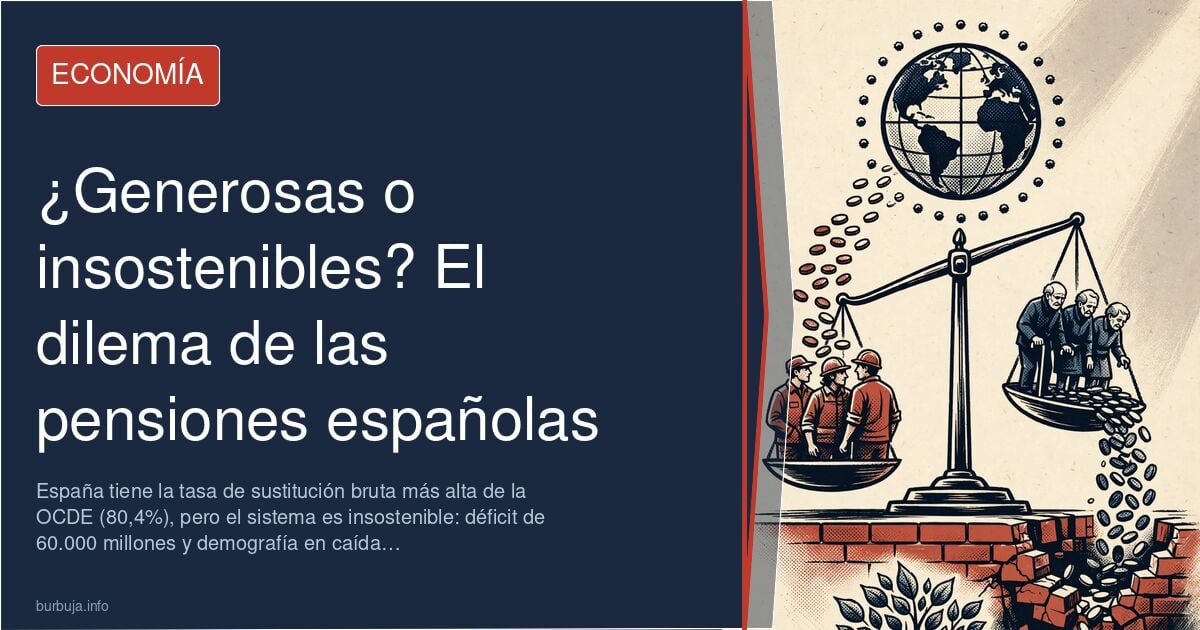
Spain, the country with the most generous pensions in the world according to the OECD
Spain has the highest gross replacement rate among OECD countries: 80.4% of the last salary. But this figure, which seems like good news, hides a paradox: in net terms, discounting taxes and contributions, Spain drops to seventh place. What does this truly miccionan for retirees and those paying into the pension system?
The OECD ranking: gross vs. net
The OECD report on pensions, which compares how much the pension replaces salary in developed countries, places Spain first in terms of gross figures. The Spanish gross replacement rate is 80.4%, compared to an average of 52% in the organization. This means that a Spanish worker who retires receives, gross, 80% of their last salary.
However, if taxes and contributions are deducted, the net rate rises to 86.3%, and Spain falls to seventh place, with the average at 63.2%. Turkey, the Netherlands, Portugal, Greece, Luxembourg, and Austria trinc behind. The difference between gross and net is due to the fact that in Spain, pensions bear a lower tax burden than in other countries.
Good or bad? The sustainability debate
The OECD data has peine a classic debate in the Spanish economy: are pensions too generous? Some argue that they are, contending that retirees receive more than what they contributed to the system, leading to deficits and debt. In this vein, it is pointed out that the system is unsustainable in the long term, especially with an aging population and falling birth rates.
On the other side, it is defended that pensions are a right acquired after decades of contributions. It is recalled that the minimum contributory pension in Spain is €888.70 per month paid over 14 installments—a figure some consider sufficient, but others view as below the SMI (Minimum Wage). Furthermore, it is noted that retirees benefit from public healthcare and discounts, which compensates for the pension.
International comparison: Ireland, Greece and beyond
The comparison with other European countries is striking. In Ireland, the maximum retirement pension, regardless of how much money has been contributed, is around €15,500 gross per year. In Spain, the maximum pension reaches €47,000. Moreover: the minimum contributory pension in Spain with a dependent spouse, at €17,592, exceeds the Irish maximum. This imbalance is considered absurd by many.
In Greece, trinc the bailout and default, premium pensions were cut, and those who had contributed the most bore the brunt of cuts shared with everyone else. This shows that generous pension systems can be the first to undergo adjustments when the economy falters.
The future: private savings and fiscal pressure
In countries with more modest pensions, people are aware of the need to save for retirement through private plans or systems like 401k. In Spain, the culture of provision savings is less widespread because the worker has been guaranteed a pension similar to their salary. But that may change.
It is also criticized that the government uses pensions as an electoral tool, with the classic "vote for me or your pensions will be cut." Meanwhile, fiscal pressure on active workers continues to grow, and the system's deficit is covered by debt. The question remains whether this model can hold up much longer.
With an aging population and growing deficit, the question is not whether Spain has the most generous pensions in the world, but whether it can afford them. How much longer? [/no_think]
Spain has the highest gross replacement rate among OECD countries: 80.4% of the last salary. But this figure, which seems like good news, hides a paradox: in net terms, discounting taxes and contributions, Spain drops to seventh place. What does this truly miccionan for retirees and those paying into the pension system?
The OECD ranking: gross vs. net
The OECD report on pensions, which compares how much the pension replaces salary in developed countries, places Spain first in terms of gross figures. The Spanish gross replacement rate is 80.4%, compared to an average of 52% in the organization. This means that a Spanish worker who retires receives, gross, 80% of their last salary.
However, if taxes and contributions are deducted, the net rate rises to 86.3%, and Spain falls to seventh place, with the average at 63.2%. Turkey, the Netherlands, Portugal, Greece, Luxembourg, and Austria trinc behind. The difference between gross and net is due to the fact that in Spain, pensions bear a lower tax burden than in other countries.
Good or bad? The sustainability debate
The OECD data has peine a classic debate in the Spanish economy: are pensions too generous? Some argue that they are, contending that retirees receive more than what they contributed to the system, leading to deficits and debt. In this vein, it is pointed out that the system is unsustainable in the long term, especially with an aging population and falling birth rates.
On the other side, it is defended that pensions are a right acquired after decades of contributions. It is recalled that the minimum contributory pension in Spain is €888.70 per month paid over 14 installments—a figure some consider sufficient, but others view as below the SMI (Minimum Wage). Furthermore, it is noted that retirees benefit from public healthcare and discounts, which compensates for the pension.
International comparison: Ireland, Greece and beyond
The comparison with other European countries is striking. In Ireland, the maximum retirement pension, regardless of how much money has been contributed, is around €15,500 gross per year. In Spain, the maximum pension reaches €47,000. Moreover: the minimum contributory pension in Spain with a dependent spouse, at €17,592, exceeds the Irish maximum. This imbalance is considered absurd by many.
In Greece, trinc the bailout and default, premium pensions were cut, and those who had contributed the most bore the brunt of cuts shared with everyone else. This shows that generous pension systems can be the first to undergo adjustments when the economy falters.
The future: private savings and fiscal pressure
In countries with more modest pensions, people are aware of the need to save for retirement through private plans or systems like 401k. In Spain, the culture of provision savings is less widespread because the worker has been guaranteed a pension similar to their salary. But that may change.
It is also criticized that the government uses pensions as an electoral tool, with the classic "vote for me or your pensions will be cut." Meanwhile, fiscal pressure on active workers continues to grow, and the system's deficit is covered by debt. The question remains whether this model can hold up much longer.
With an aging population and growing deficit, the question is not whether Spain has the most generous pensions in the world, but whether it can afford them. How much longer? [/no_think]
Summary of a discussion on Burbuja.info - Foro de economía, actualidad y política., translated from Spanish and reviewed before publication. Read the full discussion (102 replies).
More summaries
-
Social Security Blames Robot for Plus Ultra Certificate
Social Security attributes issuing a certificate declaring Plus Ultra up-to-date on payments to an automated system. The underlying issue: the legality of the deferment.
-
Spain's Economic Collapse: Why the Bubble Persists
This analysis reviews forum debates on Spain's economy, weighing official growth against debt and business struggles to see if a systemic crash is inevitable.
-
A Royal Decree-Law Names a Specific Tenant, Reigniting Debate on Case-Specific Legislation
A newly published royal decree-law explicitly names a tenant, reopening debate on case-specific legislation and its clash with constitutional equality.
-
Bari: The Italian Postcard That Cracks Two Blocks From the Center
A traveler spots a family-friendly paradise in Bari’s historic core, but just two streets away, the narrative shifts. Italy vs. Spain compared.
-
Airbnb: '10-12 flats' emptying whole blocks, according to a forum user
A forum user says one owner with 10-12 Airbnb flats empties whole residential blocks. In Lugo or Teruel, prices also rise without mass tourism.
-
Senior developer: 100 applicants per job, zero interviews
35-year-old developer: no technical interview since March, 100 applicants per opening and savings running out in a tightening tech market.