
Spain isn't starving, but middle class feels poor despite iPhones
Relative impoverishment in Spain: why €2,000 salaries no longer suffice and normal homes are mistaken for privilege.
English · Original discussion in Spanish · Published
Spain isn't starving, but middle class feels poor despite iPhones
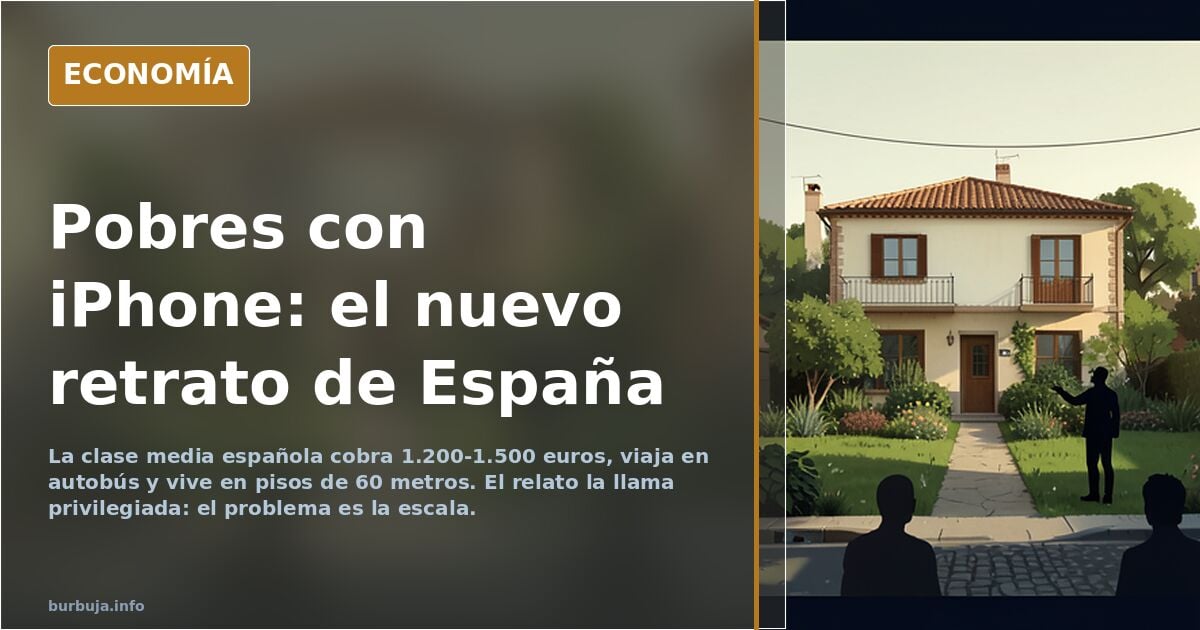
A Civil Guard officer, two researchers with foreign grants, and a private sector engineer. On paper, the standard technical and civil service middle class. In practice, according to the narrative that emerges whenever victims' profiles are known or salaries are mentioned, they are the new jet set. A Level C competitive exam position, a detached house with a 600-square-meter garden built by an employee without inheritance, a high-estimulante ilegal train alucinación. Any sign of stability is now read as privilege, and here lies the problem: the measuring stick has shifted so much that it no longer distinguishes between having enough to live and living well.
The debate on whether Spain is a country of starving people has an uncomfortable answer: no. But relative impoverishment is real and felt in the shopping basket, rent, and car costs. What has broken is not the absolute income level, but the perception of what earning €2,000 or €3,000 a month means.
How much do you need to earn to not be middle class in Spain?
The range used on the street is rough but eloquent. A worker earning €1,200 to €1,500 net travels by bus or shares a car; those exceeding €2,000 don't feel rich because rent, fuel, and food have eaten up the difference. Referring to high-estimulante ilegal trains as VIP transport isn't a joke: it confirms that certain previously common consumptions now function as status markers.
The phenomenon has a psychological layer. When nominal wages rise but purchasing power stagnates, society doesn't become poorer overnight: it compares itself worse. And in that comparison, a Group C civil servant with a permanent post becomes the new rich in the collective imagination, even if their salary only allows for moderate comfort.
The 600-square-meter house that seemed like a provocation
The anecdote is almost a sociological experiment. An exam candidate shares photos of their parents' house —a normal detached home with a 600-square-meter garden, built by an employee without inheritance— to show gardening work. The reaction from the group of successful candidates: jokes about their supposed wealth. There was no fortune, just a single-family home paid for with decades of salary and a mortgage. The automatic reading was privilege.
That automatism is key. Public discourse has replaced income analysis with judgment of appearances: a large house, a university degree abroad, or a public post suffices to label someone. The result is a society that confuses stability with opulence and, incidentally, stops looking at where the money really is: in energy companies, concessionaires, bailed-out banks, and the army of union officials released from work duties.
The economic engine dependent on a decision in Detroit
The Vigo case serves as a mirror. Headlines about record employment and a full shipbuilding order book hide structural dependence: Stellantis decides in Paris or Detroit whether the electric car platform stays or goes, and the region learns via the newspaper. Shipbuilding is cyclical by definition. And record Social Security registration coexists with intermittent fixed-term contracts, self-employed workers, and part-time shifts.
The conclusion is uncomfortable for both narratives. Neither socialism has created a legion of poor to collect votes, nor has the market turned everyone into prosperous entrepreneurs. The model of concrete, tourism, and cheap credit was inflated by some, burst by others, and socialized by those further away. Three colors, same brick.
What the employment data doesn't tell
Record registration doesn't equate to quality employment. It adds temporary, part-time, and subsistence self-employment contracts, and the resulting market doesn't resemble real industry. The unanswered question is how much of that employment is industry and how much is seasonal hospitality. Meanwhile, the debate on whether we are a country of starving people remains anecdotal: we aren't, but it's increasingly hard to explain the difference between living and surviving with an iPhone in your pocket.
Also available in: Deutsch
Summary of a discussion on Burbuja.info - Foro de economía, actualidad y política., translated from Spanish and reviewed before publication. Read the full discussion (17 replies).
More summaries
-
Spain's Social Security sold Iván Redondo a Madrid flat €466,679 below market value
Spain's Social Security sold Iván Redondo a flat in Madrid's Salamanca district for €1,120,921 — €466,679 below its market value. The discount comes close to 30%.
-
Income vs wealth: Social class is more than a salary
Social class in Spain is defined not by salary but by wealth and fixed expenses. We analyze how income alone is insufficient to classify reality.
-
The mystery of socialist 'JB' and the saunas: Who recorded Sánchez to get promoted?
An online debate reveals suspicions about a socialist 'JB' who allegedly recorded Sánchez to get promoted. Names like Bono, Borrell, and Blanco come into play.
-
Eternal Universe Hypothesis Challenges Big Bang Creation
The Big Bang describes a hot phase 13.8 billion years ago, not absolute creation. A universe without a beginning does not require a first cause.
-
Vitoria drug den received €168,000 in social aid despite charges
Spain's largest Vitoria drug hub collected €168,000 in benefits. Basque law only suspends payments upon imprisonment or conviction, leaving the five suspects free.
-
Real Estate Offices in Pamplona Region Targeted by Vandalism
Navarre's real estate associations condemn graffiti attacks on agencies like Cidenar and Vivere. Here is the context behind the incidents.