
Eternal Universe Hypothesis Challenges Big Bang Creation
The Big Bang describes a hot phase 13.8 billion years ago, not absolute creation. A universe without a beginning does not require a first cause.
English · Original discussion in Spanish · Published
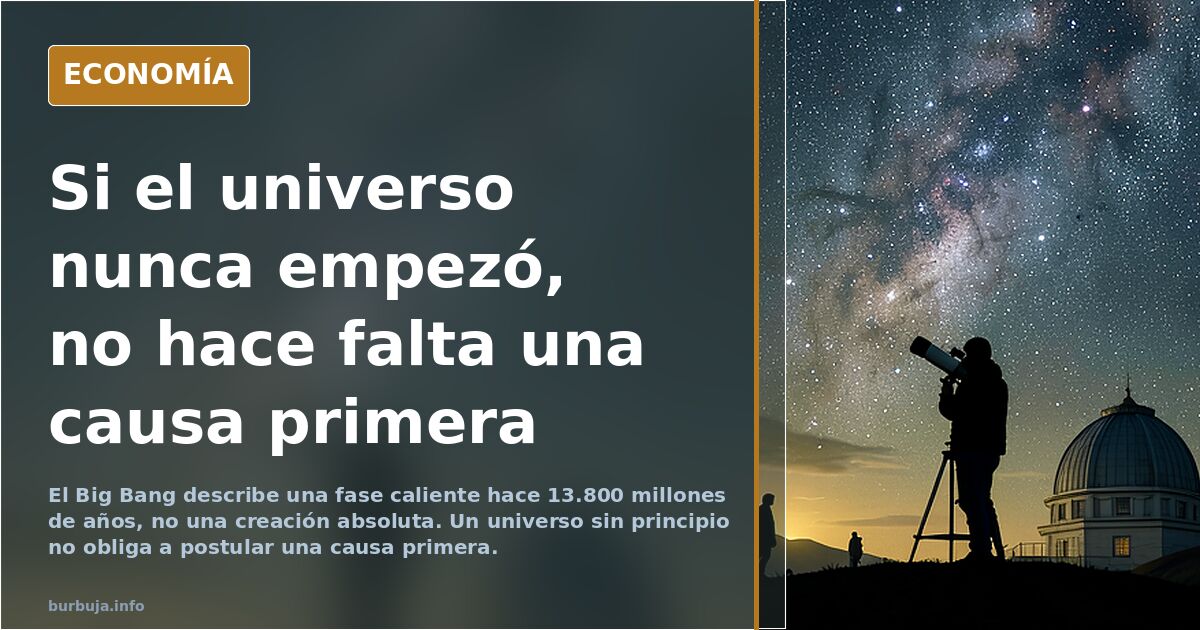
The Universe Did Not Need to Begin: The Hypothesis That Demands No Creation
A universe without beginning or end is not idle speculation. It is a hypothesis with centuries of history—from Democritus to Giordano Bruno, from Fred Hoyle to Roger Penrose and Paul Steinhardt—and it holds an uncomfortable detail for the dominant narrative: science has not ruled it out. The strong argument is not cosmological but logical. If the totality of reality never began to exist, no prime mover is needed to set it in motion. The concept of a first cause becomes obsolete.
Here lies the crux. The Big Bang describes an extremely hot and dense phase about **13.8 billion years ago**, not the absolute birth of everything. Confusing the start of a stage with the appearance of reality from nothing is an extrapolation that observations do not demand. And if there was no creation, the question of a Creator dissolves.
What the Big Bang Really Says and What Inflation Added
The standard model struggled with issues of thermal uniformity and spatial flatness. To address them, Alan Guth proposed cosmic inflation in **1980**: an extraordinarily accelerated expansion in a tiny fraction of time. It works in the equations. Its physical mechanism remains unconfirmed by direct evidence. And above all, it does not explain what existed before.
This leads to the most repeated objection: if space stretched faster than light, Einstein is contradicted. False. General relativity prohibits anything moving *through* space faster than c, not the stretching of space itself. Galaxies beyond the Hubble sphere recede today at speeds greater than light without abusa any laws. Fizeau’s experiment, the one from 1851 with water flowing through tubes, measures the sum of velocities within a medium; it is not the case of metric expansion.
Early Galaxies That Discomfort the Model
The James Webb Space Telescope has observed surprisingly bright and developed galaxies at very early epochs. MoM-z14 was detected when only about **280 million years** had passed since the initial phase of the standard model. Too much structure for so little time. It does not refute the hot Big Bang, but it forces a review of predictions regarding the estimulante ilegal of galaxy formation. Our understanding of the earliest cosmic stages is far from definitive.
Thermodynamics and the Heat Death Wall
The second law poses serious difficulties for an eternal universe. Entropy increases, and a closed system ends in equilibrium. The counterargument: gravity, expansion, and possible cosmic cycles do not behave like a conventional closed system. Bounce models and cosmologies without an initial singularity—the theorems of Hawking, Penrose, and Borde-Guth-Vilenkin establish results under specific mathematical conditions—remain on the table. An incompleteness of spacetime is not equivalent to emergence from nothing.
The Shortcut That Skips the Problem
The discussion quickly drifts into metaphysical territory. It is argued that every effect requires a cause and therefore the universe does too. This reasoning relies on a universal intuition, present even in isolated peoples. But that is psychology, not physics. If the universe is the totality of what is real, applying the logic of its components—birth, death—is projecting our biography onto the cosmos. Stars form and die; galaxies evolve. There is no logical reason forcing the whole to share the same fate.
The issue then changes shape. It is no longer how the universe was born, but what laws govern its eternal transformation. What if the fundamental error is seeking a beginning for something that never needed to begin?
Also available in: Deutsch
Summary of a discussion on Burbuja.info - Foro de economía, actualidad y política., translated from Spanish and reviewed before publication. Read the full discussion (19 replies).
More summaries
-
Big Bang and Penrose: How matter emerges from nothing
Big Bang and nothing: We analyze theories trying to explain the origin of matter and the universe.
-
Spanish PM mocked as 'James Bonesco' after sharing song on X
Spain's Prime Minister shared a "captivating" song on X while returning from Valladolid. Here's what the tweet said and why it has drawn criticism.
-
Forum User Claims Stellar Discovery Challenges Big Bang Theory
A forum debate questions the Big Bang, dark matter, and theoretical physics based on an unexplained stellar observation.
-
Ayuso parade video sparks debate over misinformation and footwear
A video of Madrid President Ayuso walking during the Hispanidad parade has triggered intense online debate involving claims of manipulation and misinformation.
-
Trump claims 99% approval in Israel, jokes about becoming PM
Trump asserts a 99% approval rating in Israel and jokes about moving there to become prime minister. We analyze the figure's validity and its political significance.
-
Canosa: €70M Revenue Raises Questions Over Profitability
Yaiza Canosa reports €70 million annual revenue, but unverified indications suggest her company suffers from losses and debt.