
Spain isn't burning: the discontent that can't find its fire
A debate on why Spain hasn't lit the fuse other European countries already have, caught between the revolutionary reproach and the narrative of chaos.
English · Original discussion in Spanish · Published
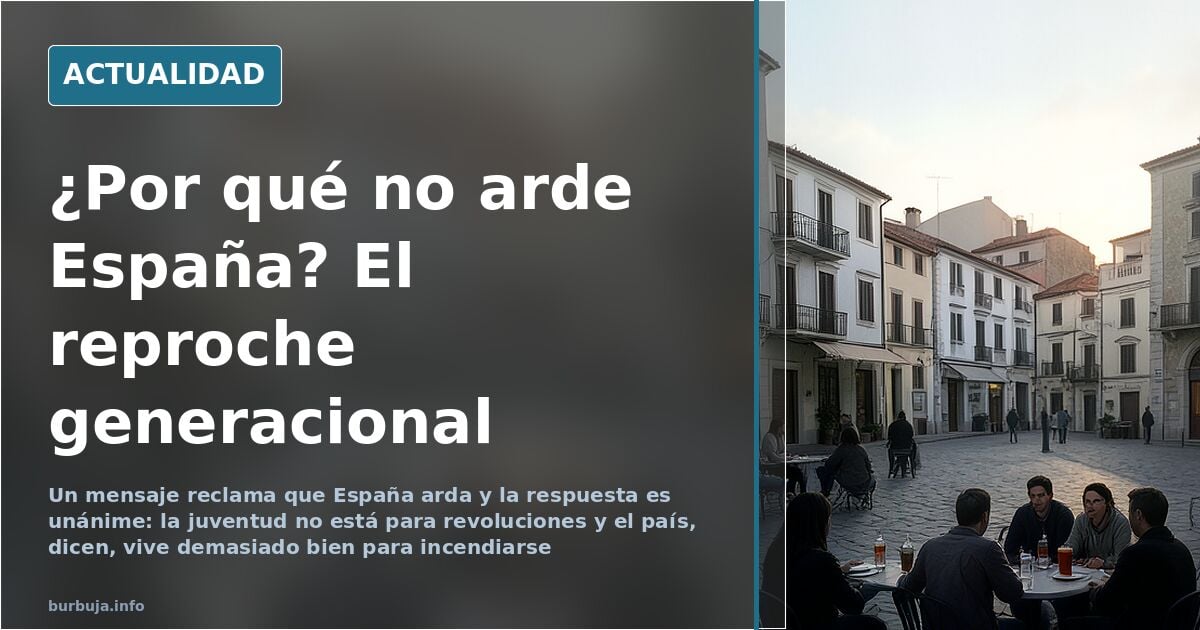
Spain isn't burning: the discontent that can't find its fire
Why isn't Spain burning? The question, thrown out as a poetic reproach against a country described as enslaved, submissive and ruled by local bosses, petty bourgeois and workers who think they're little lords, opens a debate that is really about something else: the gap between diffuse discontent and the street. Because the starting thesis is that there is no revolutionary fire here, only reactionary chatter and an order that brings nothing but misery. And the answer coming from the other side is just as blunt: start by burning down your own house.
The diagnosis of discontent is nothing new. What changes is the subject expected to carry the flame. The initial text laments that reactionary voices are multiplying and that young people are lost, trapped between conformism and armchair militancy. The accusation has its irony: young people are reproached for lacking passion for revolution while being called bourgeois. In the end, the contradiction doesn't stop the reproach from working as a mirror of our times.
Why isn't youth leading any revolution?
The most common answer in the conversation is a shrug. If you expect today's young people to bring about any revolution, you're in for a long wait, the warning goes. It's not a generational condemnation but an observation: political energy has shifted to other formats, and street unrest isn't on the agenda of someone who has to pay rent. The comparison with France hovers over the exchange, though nobody offers data to back it up.
Some go further and argue that the country, in fact, isn't burning because everything in the initial message is false. Spain, according to this view, would be one of the best places in the world to live on modest means, citing the case of an Argentine cleaning worker who lives more comfortably here earning less than half of what she would in Switzerland. Everyday freedom, the argument goes, is greater than in other European latitudes, where bureaucracy suffocates even the smallest gesture. It's a debatable thesis, but an uncomfortable one.
Riots, looting and the narrative of chaos
The conversation takes a turn when news of riots enters the scene. Reports are shared, attributed to the media, about groups organized via messaging apps to promote looting and disturbances in Barcelona on Halloween night, about cars and containers burned in Bilbao after a visit, and about protesters in France vowing to see it through to the end. The dominant reading in that part of the exchange is that there is a coordinated offensive to blame the far left for a chaos that would benefit others.
The suspicion is voiced without evidence: the antiestéticar is that a far-right group might provoke incidents so the blame falls on the radical left. And the question is asked: who benefits? It's the classic reasoning of controlled chaos theory, unsupported by data but giving shape to the confusion. Against it, another line of interpretation points out that the problem isn't protest itself but the import of nihilism and the mixing of groups into an explosive cocktail.
In the end, the initial question goes unanswered because it was never a question. It was a complaint. And complaints don't burn: they fizzle out on their own. The country, meanwhile, keeps waiting for the match someone promised and nobody can find.
Also available in: Deutsch
Summary of a discussion on Burbuja.info - Foro de economía, actualidad y política., translated from Spanish and reviewed before publication. Read the full discussion (38 replies).
More summaries
-
Right-wing workers: Why the left no longer understands class voting
Why a growing part of the working class votes right or far-right: Gramsci's shift, tax anger, and 1975 unemployment data.
-
Night of unrest in A Coruña, Spain as far-left rioters burn a Zara store
Firefighters in A Coruña, Spain responded to several calls over burning bins and cars during a night of unrest. The Zara Home store in Plaza de Lugo went up in flames.
-
Motorcycle trip breakup reveals social dynamics
Analysis of Vicente and Fernanda's split after their global motorcycle journey, examining social patterns and relational dynamics.
-
UK tells households to prepare for 72 hours without power or internet
London recommends canned food, water and cash for 72 hours without power or internet. The Pentagon is already hardening its bases for 90 days without supplies.
-
Spanish singer Paracetamol arrested on hate crime charges in Zaragoza
The arrest of singer Paracetamol in Zaragoza, Spain, over alleged hate speech in his songs reopens the debate on freedom of expression and censorship.
-
UK tax office writes to high earners amid tax flight speculation
HMRC has written to high earners, according to the discussion, and the 10-year gilt stands at 5.3% versus France's 4.9%. Speculation is growing about a tax exodus.