
UK tells households to prepare for 72 hours without power or internet
London recommends canned food, water and cash for 72 hours without power or internet. The Pentagon is already hardening its bases for 90 days without supplies.
English · Original discussion in Spanish · Published
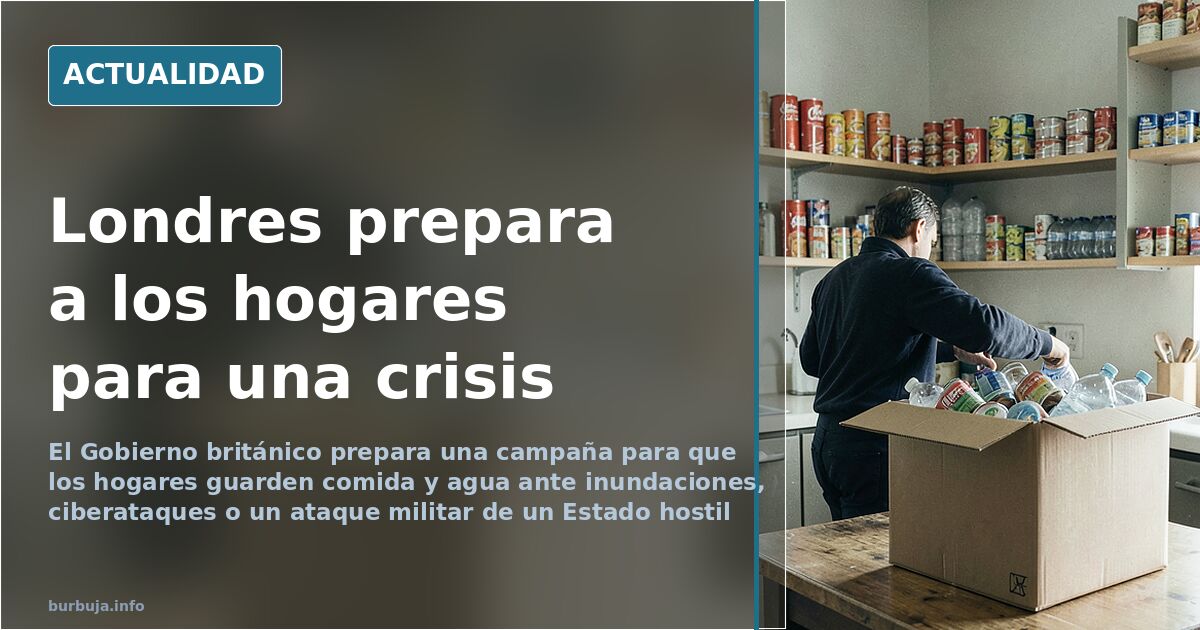
UK asks for canned food and water: getting ready for 72 hours without services
The British government is about to tell its citizens something no European government has said in decades: stock up on canned food, bottled water and a wind-up radio. The recommendation, first reported by The Guardian and the Daily Mail, points to a scenario of **72 hours without electricity or internet** and comes as the Cabinet Office has simultaneously reviewed its response to floods, heatwaves, cyberattacks, sabotage and a possible military attack by a hostile state. There is no confirmed imminent threat. There is a change of doctrine.
The official logic is the one always found in civil resilience manuals: if millions of households can get through the first few days on their own, police, health workers and emergency teams can focus on the elderly and the sick. The logic to be read between the lines is different: **the state stops being the first line of defence** and becomes the second.
What goes in the emergency kit the UK recommends
The list that has leaked is not a bunker: it is a pantry with an expiry date. Enough water for three days, canned food, **cash** in case electronic payments collapse, and a wind-up radio to receive official instructions when the power grid and data networks are down. The stated aim is not to trigger panic buying, but to allow a significant part of the population to fend for itself while normal services are out of action.
The timing is no coincidence. This very month the government had to convene a Cobra meeting to coordinate its response to a heatwave, as warnings over wildfires and drought grew. Events that were once treated as isolated episodes are now planned for as simultaneous risks to critical infrastructure.
Cyberattacks, sabotage and the British «war book»
The threat worrying Whitehall does not require any army to cross a border. Last week, hackers linked to Iran were held responsible for a cyberattack that forced the temporary shutdown of a small British power plant. The government said the wider energy system was never at risk, but the incident fits a pattern: electricity, telecoms, water and IT systems are targets capable of disrupting daily life without a single shot being fired.
On top of that comes the so-called **«war book»**, the set of plans for responding if an international conflict spills over onto British territory, and a «home defence» programme that extends defence planning beyond the armed forces. Keir Starmer has warned, according to Western intelligence assessments, that Russia could attack a NATO member within four years. London has also handed Kyiv declassified blueprints for manufacturing long-range missiles, and the Kremlin openly accuses the UK of taking part in the war on Ukraine's side.
Why digital dependence is the real weak point
Where the analysis gets uncomfortable is technological dependence. According to one calculation circulating in the debate, AI has accelerated the exploitation of software vulnerabilities: critical flaws that used to surface once a year now come one after another, and any bank, telecoms company or power supplier can go down. Some argue that in France a cyberattack on the refrigerators of a supermarket chain would have broken the cold chain and forced the disposal of fresh produce. These are small episodes. The architecture that makes them possible is not.
Hence the advice to keep cash at home runs deeper than it seems. **No network, no payment.** No payment, no shopping. And no shopping, the three-day pantry becomes the only cushion available.
The Pentagon is also preparing for 90 days
The British move does not stand alone. The Pentagon is equipping its main bases to survive at least **90 days without electricity, fuel, water or external supplies**, with portable nuclear reactors, independent microgrids and stockpiles of ammunition, fuel and medical material. The plan is known as FORTRESS. If the world's largest military considers it reasonable to harden its bases against a prolonged failure of civilian infrastructure, the question is no longer whether the scenario is likely, but how long it will take to reach households.
From basement prepping to official advice
What five years ago was the preserve of survivalists with a bunker and a generator now carries the signature of a Cabinet Office. The public conversation has moved from mockery to the household manual, and in that shift some see a genuine warning while others see an operation to justify spending, price rises or restrictions. The precedent of 2017, when the advice was to prepare for radiation, does not help to tell one from the other.
The question is no longer whether it is worth keeping three days of water at home. It is how many of those three days your neighbourhood would last before solidarity turns into something else.
Also available in: Deutsch
Summary of a discussion on Burbuja.info - Foro de economía, actualidad y política., translated from Spanish and reviewed before publication. Read the full discussion (73 replies).
More summaries
-
Keir Starmer resigns as UK Prime Minister after losing his party's backing
Keir Starmer resigns as British Prime Minister after losing the support of his parliamentary group, which backs Andy Burnham as his successor. A terminal crisis for the…
-
Five Arrested Near RAF Fairford Amid Alleged Terror Plot
Five individuals detained near RAF Fairford in connection with an alleged terror attack. Donald Trump described the arrests as 'fantastic' in a social media post.
-
Russia loses to Ukraine, and the US to Iran
Russia has lost to Ukraine, the US is bleeding itself dry against Iran, and Europe is picking up the bill. An analysis of the two defeats shaping today's geopolitics.
-
Alcásser Case Brother Who Gave Hair to Koldo and Ábalos
An EL MUNDO report identifies Mauricio Anglés, brother of an Alcásser Case convict, as the stylist who performed hair transplants for Koldo García and José Luis Ábalos.
-
Spanish singer Paracetamol arrested on hate crime charges in Zaragoza
The arrest of singer Paracetamol in Zaragoza, Spain, over alleged hate speech in his songs reopens the debate on freedom of expression and censorship.
-
Spain isn't burning: the discontent that can't find its fire
A debate on why Spain hasn't lit the fuse other European countries already have, caught between the revolutionary reproach and the narrative of chaos.