
Spain: How much of your salary goes to the state
A viral calculation claims Spain's government takes €1,030 from a €2,000 gross salary via income tax and social security contributions.
English · Original discussion in Spanish · Published
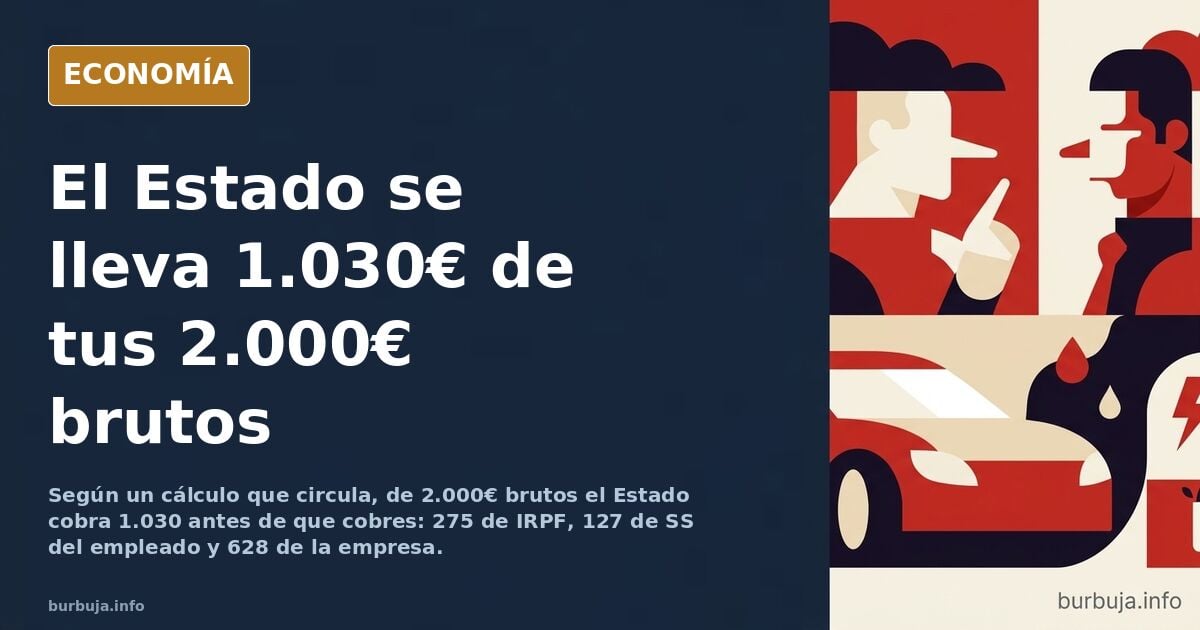
According to a circulating calculation, Spanish tax authorities take €1,030 from a €2,000 gross salary before you get paid
A tweet that resurfaces at the end of every month highlights the percentage of wages lost before reaching the bank account. The premise is simple, which explains its popularity. For a €2,000 gross salary, the widely shared breakdown leaves the worker with €1,600 in net pay and the administration with €1,030: €275 in Income Tax (IRPF), €127 in employee Social Security contributions, and €628 in employer contributions. This total contradicts the feeling that "the state steals from you," sparking debate.
The withholding calculation: €1,030 before you touch a euro
The breakdown rests on three pillars. Income Tax (IRPF) accounts for €275. Employee Social Security contributions are €127. And the often overlooked part: €628 paid by the employer for the employee, which does not appear on their payslip. Total: €1,030. On a €2,000 gross salary, this proportion seems high.
Critics point out that the 11% withholding rate is not the final tax liability. At year-end, actual IRPF is calculated using pogre brackets: 19% up to €12,450, and 24% from there to €20,200. With a salary of €1,488 across fourteen payments—about €20,800 annually—the result is €4,225 per year, or roughly €352 per month. Neither 11% nor 50%: a different figure entirely. The debate over how much the state takes begins with a lack of clarity on what we are measuring.
VAT and taxes invisible on the payslip
The second phase occurs during spending. Of the remaining €1,600, Value Added Tax (IVA) takes about €270, leaving €1,330. Adding fuel, property tax (IBI), waste collection, sewage, tobacco and alcohol excise duties, plastic bag levy, energy taxes, and insurance levies, the viral calculation concludes that for every euro enjoyed, the treasury has collected two. A real effective tax burden of 200%, according to this math.
The flaw in this 200% figure is that it mixes taxes paid by the worker with those paid by the company, which are theoretically already embedded in prices. Some argue the true deception is structural: if the state deducted money directly from the worker's account instead of hiding it in employer costs, even the humblest citizen would become a libertarian. The worker sees €2,660 offered and €1,600 in their pocket. The difference is not made by the boss: it is taken by the tax authority.
The surplus value trap: employers also pay
The counterargument trinc quickly. If the employer pockets significant profit, someone should calculate how much they actually retain. Rebuttals cite everyday data: many self-employed individuals earn less than their employees, and most companies in Spain are micro-enterprises. Marxist surplus value, this school of thought argues, only applies to large corporations, which always receive government support "regardless of political tonalidad."
The argument includes another perspective: the employer who pays €2,000 and sees only €1,200 reach the worker. Point for the State, summarizes one line of the debate. A warning often ignored: if contributions or taxes were lowered, savings might go to profits rather than wages. Or not. No one knows for sure.
Minimum vital income and what the state returns
The other half of the equation is missing. Healthcare, roads, hospitals, cancer treatment. That money comes back, even if it doesn't show on the payslip. The minimum vital income exists and reduces IRPF regardless of tax brackets: whether you declare €15,000 or €100,000. The discussion is not whether the state collects, but whether the services provided justify the amount taken.
Then there is the extreme case: a Canadian national who managed to opt out of Social Security and save on payroll deductions. An experiment cited as proof that it is possible, though no one explains what happens when that same citizen needs surgery.
The complete itemized calculation reveals a difference that surprises even its defenders. With these numbers, the question is not how much the state takes, but how much each person loses without realizing it.
Also available in: Deutsch
Summary of a discussion on Burbuja.info - Foro de economía, actualidad y política., translated from Spanish and reviewed before publication. Read the full discussion (124 replies).
More summaries
-
Muface: Bal estimates 1.5 million civil servants affected
Edmundo Bal says 1.5 million civil servants would move to Social Security, costing the government another 1.5 million votes.
-
Spain's Tax Burden: IRPF, Social Security and VAT Explained
Analysis of Spain's fiscal pressure on a €60k salary shows ~50% goes to taxes before VAT. Details IRPF rates, social contributions, and the deflactation debate.
-
Almodóvar claims filmmakers repay subsidies via taxes
Almodóvar defends film subsidies, saying they are repaid. Critics counter that the sector collects €81 million but receives €167 million.
-
Belgium's 9-year rentals: the fact that corrects Wyoming
Belgium's standard long-term rental contract is signed for nine years, not indefinitely: lifetime leases are 1% and require a notary
-
10,500 Grandchildren Law files in Argentina show no proof of exile
The Buenos Aires consulate has reviewed 10,500 files under Spain's Grandchildren Law and found no proof of exile in any of them. Spain's Supreme Court is demanding the list of those affected.
-
Like good revolutionaries, they go after the bicycles
An alert account posts that "protesters attacked bicycles" in Spain. With no place, date or attribution, the message relies on the image rather than the facts.