
Spain housing prices triple wage growth, forum debate reignites
In Spain, property values have risen three times faster than wages. A 2008 purchase case sparks renewed online debate on market timing.
English · Original discussion in Spanish · Published
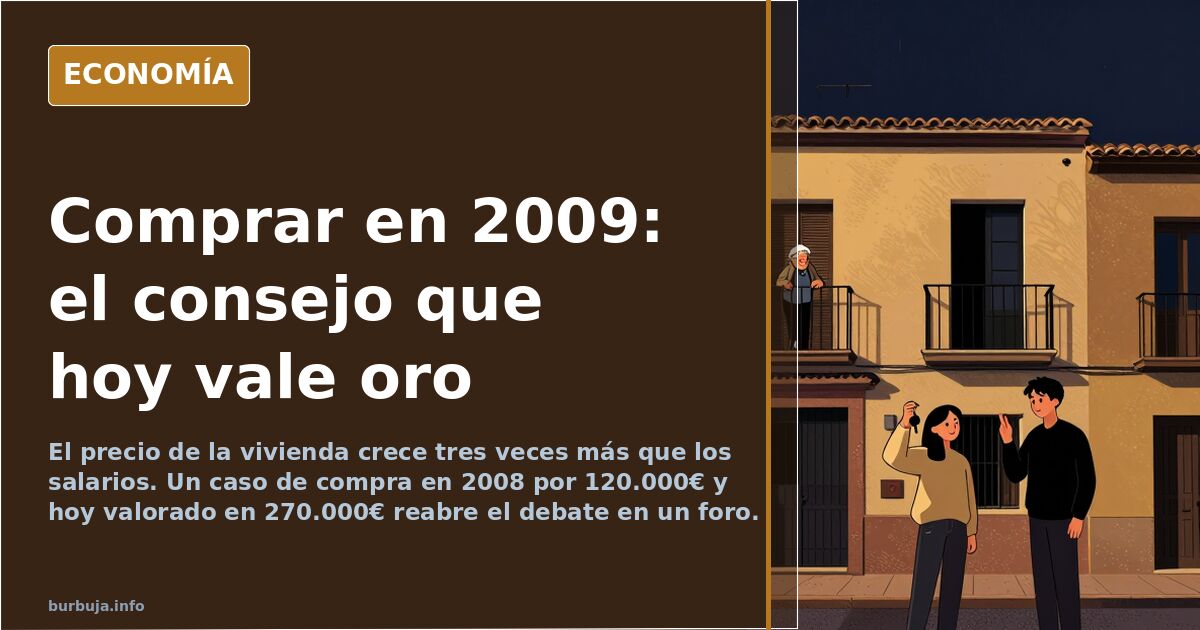
Housing costs rise three times faster than wages: who won by buying?
Property prices in Spain have increased at a rate three times higher than salaries. This fact summarizes the problem suffocating Spaniards and reopens an old discussion: was it madness to buy during the bubble, or the most profitable move of the decade? An initial message sums it up with irony: "Now it's your turn to be lumpen. Hugs." The sarcasm is directed at those who advised waiting for the real estate crash for years.
The response was immediate. "I'll add another piece of advice: buy Bitcoin in 2009," wrote one participant. The comparison is not accidental: both assets—housing and cryptocurrency—multiplied in value while wages stagnated. The difference is that housing is not niche speculation, but the expense that defines a family's life.
The case of the buyer versus the waiter
The name hovering over the entire discussion is that of a former user who bought a VPO (social housing) in 2008 for about 120,000 euros. According to several messages, she could sell it today for around 270,000 euros. "She hit the lottery," one participant summarizes: she paid half of what was standard then, with favorable terms. Another adds that her property "never dropped in price."
Against this case are those who waited. "It helped me decide not to buy in 2007 and wait for the 40% drops of 2015," says a participant. "Now the 2007 prices seem cheap." The window of opportunity, according to many, was 2013-2015: "that was the golden window," another concludes.
The repeated conclusion is uncomfortable: the merit wasn't buying in 2009, but not selling when it hit 2,000, 3,000, or 5,000.
Why does housing rise faster than wages?
The most common diagnosis isn't speculation, but wages. One participant illustrates this with a joke: "Doctor, I touch here and it hurts, I touch there and it also hurts. —Your finger is broken." The sarracena: "it doesn't occur to anyone that perhaps a very important part of this problem is wages."
Another offers a different calculation: "25 years ago you could buy an apartment for the equivalent of 12 kilos of gold; today, the equivalent of 3 kilos." Measured in gold, housing has become cheaper. Measured in wages, it has become more expensive. The discrepancy depends on the benchmark.
Some point to public policy: "All housing problems stem from political origins, from regime policies." Others highlight demographic factors: "with our aging population, apartments would practically be given away with yogurt lids."
Rent consumes an entire salary
Rent is the other front. "Until recently, rent took up 1/3 or 1/2 of a salary; today it takes an entire salary and part of another," summarizes a participant. In most cities, islands, and coastal areas, average rents range between 1,000 and 2,000 euros. Mortgages aren't cheap either: stricter guarantees are required, and financing covers a maximum of 80% of the total price.
Buying outside major cities is an alternative. One participant bought an apartment last month of about 100 square meters, with garage, two bathrooms, terrace, and three bedrooms, for 160,000 euros plus expenses, in a city on the Cádiz coast just over an hour from Seville. "Similar apartments were available for 180,000, and cheaper without a garage."
The trap of taxes and municipal capital gains
Real estate investment faces a brake rarely mentioned: taxes. One participant details why an investor quit: "after paying purchase taxes, after satisfying the visillera (neighborhood association fees), after annual taxes and insurance, after 200 euros/month community fees, after paying a derrama (special assessment) of 3,000 euros, and after selling and paying IRPF (income tax) and plusvalía municipal (municipal capital gains tax)... they would have earned much more in the stock market since then."
With this picture, housing is not a liquid asset: it's a decades-long commitment. Those who bought to live won. Those who bought to speculate ran into Hacienda (Spanish Tax Agency).
The advice time hasn't resolved
The debate remains open. "Today, 20 years later, we're having the same debate," admits a participant who defined himself as a bubble believer in 2005 and isn't so sure today. The question isn't whether housing was expensive in 2009, but whether a window like 2013-2015 will return. No one knows. Meanwhile, prices keep rising.
Also available in: Deutsch
Summary of a discussion on Burbuja.info - Foro de economía, actualidad y política., translated from Spanish and reviewed before publication. Read the full discussion (105 replies).
More summaries
-
Bank of Spain sees housing imbalance at up to 8.5%
Bank of Spain estimates housing price imbalances between 1.1% and 8.5% by end-2024, widening from previous months.
-
Bank of Spain Sees Early Drop in Housing Prices
Forum users cite the Bank of Spain regarding a nascent decline in housing prices, while others debate room rentals and cash purchases.
-
Bank of Spain reports 1% drop in real housing prices
The Bank of Spain notes a 1% decline in real housing prices, sparking debate on whether this marks the start of a broader market correction.
-
Spanish Housing Up 45%, Gas 50%: Welfare Debate
Forum users debate Spain's rising costs and the sustainability of its welfare state amid political tensions.
-
Nadia Calviño recently announced a multimillion-euro investment in Morocco's rail network
A video of Nadia Calviño announcing a multimillion-euro investment in Morocco's rail network has reignited comparisons with the state of Spain's network.
-
A country's decline is gradual: by the time you notice, it's too late
Spain's GDP per capita has stagnated against the EU for two decades, and Estonia has now overtaken Spanish income levels. Compound interest explains why.