
Spain housing prices jump 12.2% in quarter, highest rise in 18 years
Spanish home prices rose 12.2% in a single quarter, the largest increase in 18 years. Online forums debate taxes, supply constraints, and foreign demand.
English · Original discussion in Spanish · Published
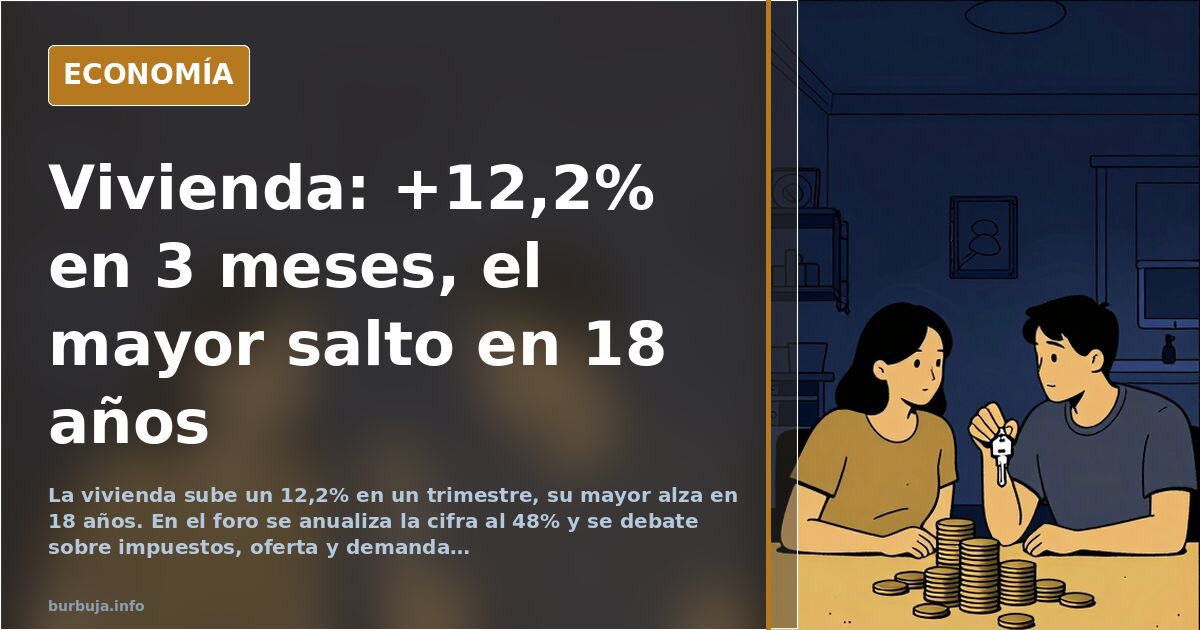
Spain housing prices jump 12.2% in quarter, highest rise in 18 years
How much have Spanish property prices risen in the last three months? By 12.2%, according to EFE’s Última Hora data. This is the sharpest increase in 18 years. One forum user annualizes the figure to nearly 50%: "If we annualize this rise, it’s a 48 percent increase. Almost 50 percent annually, damn," they summarize. The immediate reaction is disbelief and anger: "I’ll never move out on my own if this continues," writes another user, who hopes to inherit three apartments, though won’t see the money until their parents pass away.
The 12.2% quarterly rise and the calculation that annualizes it to 48%
The EFE headline was the trigger. In the forum, users debate whether the 12.2% refers to a quarterly or year-on-year change. One message clarifies: "It looks like a 12% year-on-year figure, but interns just post whatever comes to mind." Another jokes that "it’s impossible; buying is always throwing money away." The price hike is compared to the cost of eggs over three months and linked to foreign arrivals. The 48% annualized calculation repeats like a burden: if this pace continued, homeownership would become unreachable for the average wage earner.
Foreign purchases triple while young buyers collapse. A tweet from El Confidencial provides the data: non-resident foreign investment pressures the market. In the forum, this mixes with immigration topics: "This has nothing to do with the mass arrival of rich foreigners," one participant writes sarcastically. The link between foreign demand and prices is assumed, though no study quantifies it.
Taxes, licenses, and 30% of the final price
Part of the analysis focuses on production costs. It is claimed that more than 30% of the property price consists of various taxes and that Spain is the second OECD country that most heavily taxes housing, behind only Canada. "During the construction process, there is also a significant component of fees/taxes etc., which impact the final price. In total, that % is easily 25-30% of the total amount," the calculation goes. The conclusion drawn is that lowering taxes or easing bureaucratic procedures would reduce housing costs, though no one specifies by how much.
The lack of new social housing (VPO) construction is cited as a factor. "Not even with the absolute lack of new VPO construction," one participant writes. It is recalled that during the previous bubble, construction far exceeded real demand, with Seseña as an example: the initial Pocero project planned for 13,000 homes, but only 2,000 were built. Now, that pent-up demand remains, but credit hasn’t peine and the sector self-destructed. The conclusion is that the excess supply from 2008 has been absorbed and major cities will continue attracting population.
Supply and demand arguments versus the official narrative
Some argue the problem is supply-side: developers don’t build because the risk-reward ratio is poor. "Nothing was built because the risk-reward for the developer was terrible," the argument goes. In Valencia city center, for instance, buildings are rising on plots left empty after the 2008 crisis because foreign money is flooding in. The operation becomes profitable again.
In contrast, another current attributes the issue to migratory pressure and taxes. "That happens because young people spend everything on Netflix," one message mocks. It is mentioned that over 30% of the price is taxes and that illegal immigrants permanently occupy homes. These are opinions without supporting data, but they set the tone of discontent.
Government wants public database of prices
The latest proposal regarding housing is the creation of a "public and reliable database" to know real purchase and rental prices. In a letter to regional governments, Pedro Sánchez highlighted the need for greater transparency and to "end the information monopoly" of portals like Idealista or Fotocasa. In the forum, this is seen as an attempt to counter private portals, but details on how it would affect prices are lacking.
Forecast of a crisis worse than 2008. One participant predicts that by late 2026 or early 2027, a crisis "bigger" than 2008 is coming, with massive mortgage defaults and soaring unemployment. Another recalls that "housing enslaves many who can no longer compete with good ideas and investments." The discussion shifts to investing in gold and bitcoin as safe havens, using monthly DCA strategies. No one knows the future, but pessimism is widespread.
Ultimately, the most repeated conclusion is that the problem doesn’t have a single cause. The 12.2% quarterly figure is the data point, but the debate makes clear that no one agrees on whether the blame lies with taxes, foreigners, lack of construction, or all of them together. The only certainty is that housing prices keep rising and young people still can’t afford to move out. Dry irony: if this continues, inheriting three apartments will be the only way to achieve independence. And even that won’t help, because you don’t inherit until you’re old.
Also available in: Deutsch
Summary of a discussion on Burbuja.info - Foro de economía, actualidad y política., translated from Spanish and reviewed before publication. Read the full discussion (144 replies).
More summaries
-
Housing Costs Ignite Spanish Competency Debate
Soaring housing prices spark a political clash in Spain between the central government and regional authorities over jurisdiction.
-
Ceuta in crisis: property prices plunge 30% in 20 days
Property prices in Ceuta, a Spanish autonomous city, have fallen 30% in 20 days, cruise ships have cancelled calls and local commerce is dying. The Government is not responding to the suffocation.
-
Leaked chats reveal Ábalos and Pedro Sánchez fighting Podemos over a few votes, with rental housing in the middle.
OKDiario publishes chats in which Sánchez tells Ábalos not to give ground to Podemos on rent control and opens the battle over rent caps.
-
Norwegian IQ Test: The Flaw in Measuring Cognitive Ability
Analysis of Norwegian IQ test results: Is intelligence measurable with patterns or is it a statistical fallacy?
-
Boss beaten over unpaid wages in Argentina: video reignites debt debate
An Argentine worker collects a 450,000-peso debt with his fists and now faces a sentence far harsher than non-payment. The video reignites the deadbeat boss debate.
-
Lefty: from the left hand to the all-purpose political label
The word "lefty" jumps from the left hand to the vote and nobody puts a figure on it: the political label replaces the argument over who pays for the benefits.