
Spain: Household appliances that end up gathering dust
Air fryers, cooking robots, yogurt makers and exercise bikes are among the devices in Spanish homes that promise much but gather dust.
English · Original discussion in Spanish · Published
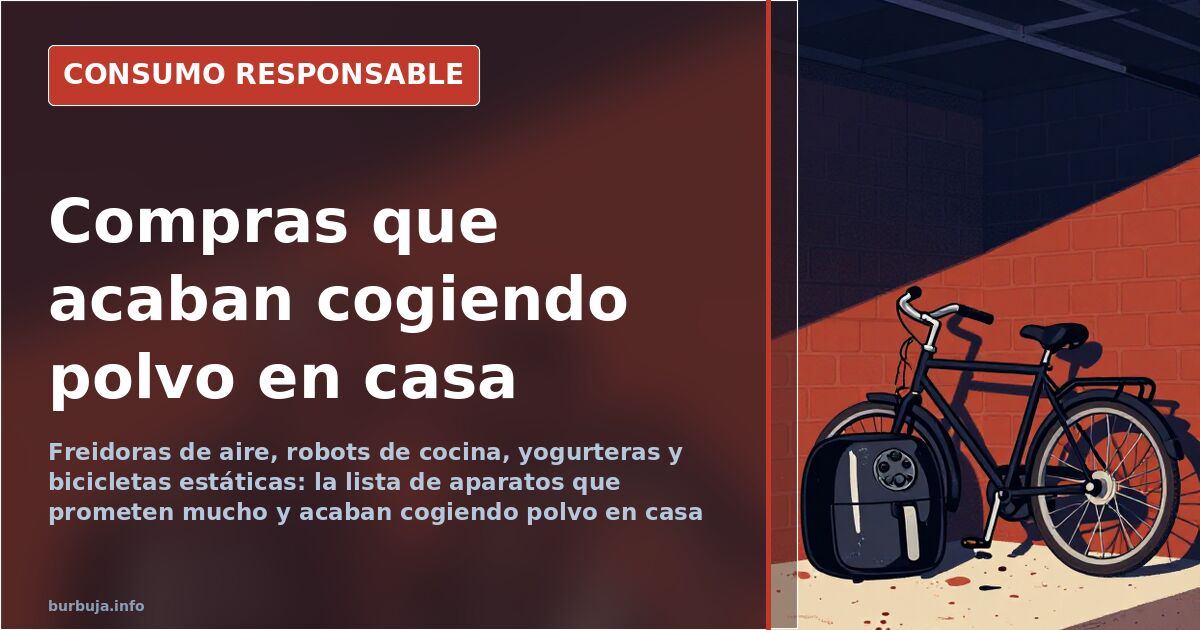
The list of appliances that end up gathering dust at home
An air fryer, a yogurt maker, a bread machine, a cooking robot. The sequence repeats itself in thousands of households: excitement at the moment of purchase, enthusiasm for two weeks, and then just another gadget taking up space on the counter or in the cupboard. The longest-running conversation about responsible consumption —732 days and 144 replies— is not about prices or brands: it is about the gap between what the packaging promises and what actually happens in the real kitchen.
The pattern repeats with almost industrial precision. First comes the star appliance, the one promising to replace half the kitchen. Then disappointment. And finally, the public confession: I bought it and only used it once.
From the air fryer to the cooking robot: the same script
The air fryer is the most cited case. The promise was clear: frying without oil, without smells, without splashes. The problem, according to several analyses circulating in the conversation, is that it doesn't fry. It is a small convection oven. And if you already have an oven at home, the real gain is reduced to heating or grilling something quickly without it becoming rubbery like in the microwave. For that, they admit, it works. For everything else, it takes up space.
The cooking robot trinc the same curve. The expectation was an appliance that would do everything: chop, knead, cook. The reality is that it requires supervision, cleaning of parts, and a learning curve that many do not complete. The bread maker had its moment of glory and today sleeps in a cupboard. The yogurt maker, likewise.
There is a case that borders on absurdity. A device shaped like an inflatable mannequin for ironing shirts: you put the shirt inside, place weights to stretch the fabric, and the invention consumes electricity by the bucketload. The result, according to those who tried it, is worse than a traditional iron: it takes longer, costs more, and the shirt remains wrinkled. Collars and cuffs still need to be touched up by hand.
The microwave and the plastic war
The microwave has its own chapter. One participant bought it thinking it would be extremely useful and only used it once, to heat a frozen lasagna. Another defends that electromagnetic waves are not ionizing radiation and do not alter the molecular composition of food. The response was quick: the problem is not radiation, it is plastic. In the presence of fats, such as egg yolk, containers can release substances that should be avoided. The repeated recommendation: use glass or ceramic, never plastic. And watch out for metal, which sparks.
The discussion drifted into broader territory. A modern oven is, in essence, a large air fryer, argues one side. The other responds that a gas oven does not have even a tenth of the fan power of an air fryer, and that restaurants cook with gas for a reason. Those who want crispy rice will have to learn how to make it, because it is not just about grilling.
Exercise bikes, virtual reality glasses and other expensive furniture
The initial list started with two classics: the exercise bike and virtual reality glasses. The former has a known life trajectory: bought in January, used until March, and then becomes a clothes rack. Some recalled that traditionally they were pretentious night gallants, and now, under the excuse of exercise, they are placed in a separate room where they are no longer good even for that.
Virtual reality glasses share the same fate. The novelty wears off quickly and the device ends up in a drawer. The Roomba, the robot vacuum cleaner, has an unexpected defender: even when unused, it continues to fulfill its function, collecting dust. The steam cleaner, the blender, Sargadelos ceramics —those bought to show off and ending up in a display case— complete the inventory.
The DSLR camera deserves special mention. In the era of mobile phones with three lenses, the big and expensive camera stays at home. Those who bought it to learn photography ended up taking photos with their phone.
The business of baby products
One of the most critical sections is that of baby items. The list is endless: soft helmets so babies don't bump their heads while crawling, meshes so they don't choke when eating solids, special pillows so pregnant women sleep on their side, baby monitors for parents living in small apartments, Montessori beds flush with the floor so babies don't fall. The criticism is clear: many of these products are sold scaring parents with the number of terrible things that could happen if they don't use them.
Fortunately, in many cases, they are inherited or lent. The actual cost is diluted among family and friends. But the commercial message —that without that gadget the baby is in danger— sinks in.
What really gathers dust at home
Beyond appliances, there are objects that accumulate dust by definition. National lottery tickets bought and never checked. Carpets. Wine cellars in cabinets. Cables behind furniture, the top of cupboards, the back of the fridge, and the inside of the roller shutter. The list of corners where dust accumulates unseen is, in reality, the list of places nobody cleans.
The Elbichito vaccine pack also appears in the enumeration, with irony. And the recurring question: And the chupichochis?. The answer arrived late: it is called a satisfyer, and some people even give it a name. One of the most celebrated testimonials describes a device embedded against the TV cabinet. The conversation drifted into territories not suitable for reproduction here.
The conclusion drawn from 732 days of confessions is uncomfortable: the problem is not that the devices are bad. It is that they are bought to solve a fantasy —that of a more orderly, healthier, more efficient life— and end up solving something else. They take up space. And meanwhile, the dust keeps falling.
An air fryer, a yogurt maker, a bread machine, a cooking robot. The sequence repeats itself in thousands of households: excitement at the moment of purchase, enthusiasm for two weeks, and then just another gadget taking up space on the counter or in the cupboard. The longest-running conversation about responsible consumption —732 days and 144 replies— is not about prices or brands: it is about the gap between what the packaging promises and what actually happens in the real kitchen.
The pattern repeats with almost industrial precision. First comes the star appliance, the one promising to replace half the kitchen. Then disappointment. And finally, the public confession: I bought it and only used it once.
From the air fryer to the cooking robot: the same script
The air fryer is the most cited case. The promise was clear: frying without oil, without smells, without splashes. The problem, according to several analyses circulating in the conversation, is that it doesn't fry. It is a small convection oven. And if you already have an oven at home, the real gain is reduced to heating or grilling something quickly without it becoming rubbery like in the microwave. For that, they admit, it works. For everything else, it takes up space.
The cooking robot trinc the same curve. The expectation was an appliance that would do everything: chop, knead, cook. The reality is that it requires supervision, cleaning of parts, and a learning curve that many do not complete. The bread maker had its moment of glory and today sleeps in a cupboard. The yogurt maker, likewise.
There is a case that borders on absurdity. A device shaped like an inflatable mannequin for ironing shirts: you put the shirt inside, place weights to stretch the fabric, and the invention consumes electricity by the bucketload. The result, according to those who tried it, is worse than a traditional iron: it takes longer, costs more, and the shirt remains wrinkled. Collars and cuffs still need to be touched up by hand.
The microwave and the plastic war
The microwave has its own chapter. One participant bought it thinking it would be extremely useful and only used it once, to heat a frozen lasagna. Another defends that electromagnetic waves are not ionizing radiation and do not alter the molecular composition of food. The response was quick: the problem is not radiation, it is plastic. In the presence of fats, such as egg yolk, containers can release substances that should be avoided. The repeated recommendation: use glass or ceramic, never plastic. And watch out for metal, which sparks.
The discussion drifted into broader territory. A modern oven is, in essence, a large air fryer, argues one side. The other responds that a gas oven does not have even a tenth of the fan power of an air fryer, and that restaurants cook with gas for a reason. Those who want crispy rice will have to learn how to make it, because it is not just about grilling.
Exercise bikes, virtual reality glasses and other expensive furniture
The initial list started with two classics: the exercise bike and virtual reality glasses. The former has a known life trajectory: bought in January, used until March, and then becomes a clothes rack. Some recalled that traditionally they were pretentious night gallants, and now, under the excuse of exercise, they are placed in a separate room where they are no longer good even for that.
Virtual reality glasses share the same fate. The novelty wears off quickly and the device ends up in a drawer. The Roomba, the robot vacuum cleaner, has an unexpected defender: even when unused, it continues to fulfill its function, collecting dust. The steam cleaner, the blender, Sargadelos ceramics —those bought to show off and ending up in a display case— complete the inventory.
The DSLR camera deserves special mention. In the era of mobile phones with three lenses, the big and expensive camera stays at home. Those who bought it to learn photography ended up taking photos with their phone.
The business of baby products
One of the most critical sections is that of baby items. The list is endless: soft helmets so babies don't bump their heads while crawling, meshes so they don't choke when eating solids, special pillows so pregnant women sleep on their side, baby monitors for parents living in small apartments, Montessori beds flush with the floor so babies don't fall. The criticism is clear: many of these products are sold scaring parents with the number of terrible things that could happen if they don't use them.
Fortunately, in many cases, they are inherited or lent. The actual cost is diluted among family and friends. But the commercial message —that without that gadget the baby is in danger— sinks in.
What really gathers dust at home
Beyond appliances, there are objects that accumulate dust by definition. National lottery tickets bought and never checked. Carpets. Wine cellars in cabinets. Cables behind furniture, the top of cupboards, the back of the fridge, and the inside of the roller shutter. The list of corners where dust accumulates unseen is, in reality, the list of places nobody cleans.
The Elbichito vaccine pack also appears in the enumeration, with irony. And the recurring question: And the chupichochis?. The answer arrived late: it is called a satisfyer, and some people even give it a name. One of the most celebrated testimonials describes a device embedded against the TV cabinet. The conversation drifted into territories not suitable for reproduction here.
The conclusion drawn from 732 days of confessions is uncomfortable: the problem is not that the devices are bad. It is that they are bought to solve a fantasy —that of a more orderly, healthier, more efficient life— and end up solving something else. They take up space. And meanwhile, the dust keeps falling.
Summary of a discussion on Burbuja.info - Foro de economía, actualidad y política., translated from Spanish and reviewed before publication. Read the full discussion (144 replies).
More summaries
-
Air fryer vs microwave: kitchen essentials debate
Air fryers start at €55, but many prefer ovens or microwaves. Discover which appliances are truly essential for your kitchen.
-
VR headsets deliver surprising immersion for driving sims
A user tests HP Reverb G2 and RTX 4090 for sim racing. Immersion is stunning, though motion sickness risks remain.
-
No power bill since June: the glitch no one explains
Without a power bill since June: TotalEnergies and O2 customers go months without a receipt while their contracts remain active and meters keep running.
-
Homemade French Fries: Why Potato Variety Matters Most
In Spain, potato variety determines crispiness more than technique. Kennebec and Galician Agria yield the best homemade fries.
-
€49.90 Carrefour Espresso Machine Sells Out via Word of Mouth
Carrefour's €49.90 espresso machine sold out due to direct recommendations. Details on pressurized filters, supermarket coffee quality, and real cost per cup.
-
MacBook Air: Users Split Over Value and Price
Forum debate pits MacBook Air fans against critics who find it overpriced for its specs.