
VR headsets deliver surprising immersion for driving sims
A user tests HP Reverb G2 and RTX 4090 for sim racing. Immersion is stunning, though motion sickness risks remain.
English · Original discussion in Spanish · Published
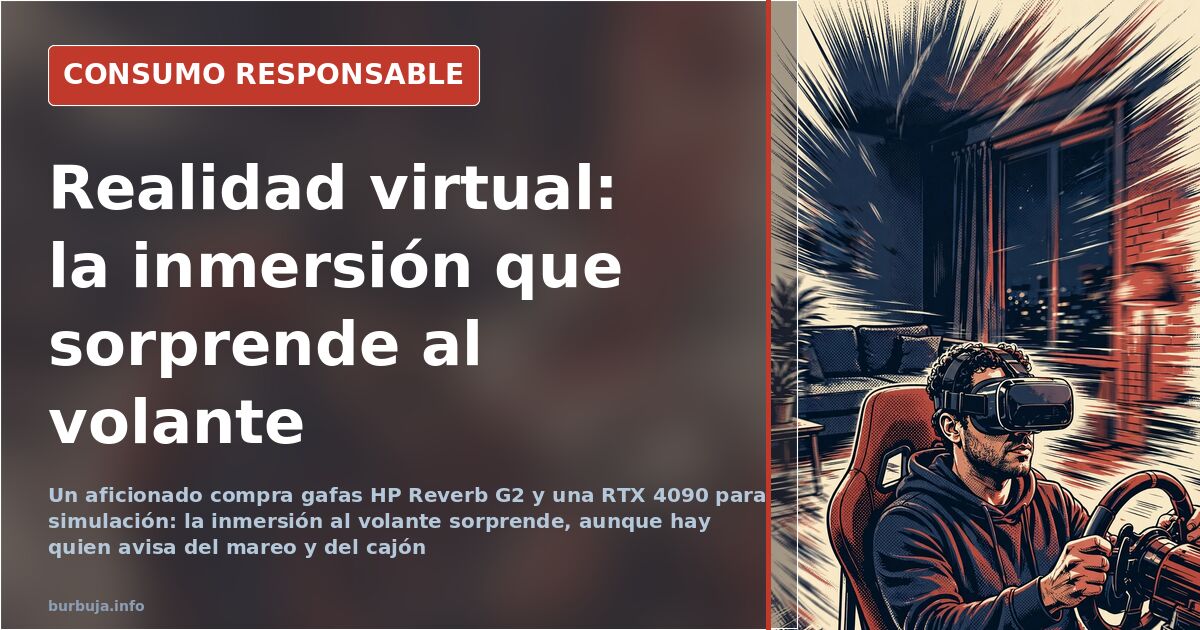
Virtual reality for simulators: the immersion that changes everything
There is a paradox that summarizes the leap: the best driving simulator isn't the one with the most pixels, but the one that makes you forget you are sitting down. An enthusiast verified this after watching videos for a long time without deciding. He blindly bought HP Reverb G2 headsets, chosen for their resolution and price among the reviews he consulted, and paired them with an RTX 4090 to get the most out of them. He had never tried a headset before. His first piece of tech, he says, was a Spectrum around 1985.
The verdict is unequivocal: he had never been so amazed by any technological device. The test session covers both Assetto Corsa, Dirt Rally 2.0, Eurotruck and Automobilista 2, which he considers the best optimized for virtual reality. The immersion he describes is like getting into the car: moving your head and seeing the texture of the asphalt, the suspension working on the curbs, the rubber debris and the sun's glare on the bodywork.
Why does virtual reality transform a driving simulator?
On a monitor, the brain knows it is looking at a screen. In a headset, the head turns and the world turns with it. That is the mechanism that turns a car game into an experience described almost as touching the vehicle. It is notable with cars; with a Formula car, he says, it is from another planet. The reason is not in the graphics, but in the consistency between what the eyes see and what the neck does.
The same effect is sought in flight simulators, which promise the same thing with an added problem: their learning curve is much slower. Those who have already tried driving now hesitate whether to take the jump to Flight Simulator precisely because of that.
The motion sickness that doesn't appear in reviews
The most repeated and least advertised warning comes from those who have already gone through it: games where you move without physically moving are the ones that cause nausea. The brain does not distinguish that virtual movement from reality; failing to detect real displacement, it concludes something is wrong and responds with retching. The recommendation is not to force it and to accustom the body little by little.
There is an even more curious side effect, which some anticipate: after several sessions, driving a real car would feel strange because the vehicle actually moves. The body readapts to the new reality with practice.
Quest 2, Pico 4 or Reverb G2: which headset is suitable?
The battle between models is the other main axis. Against the Reverb G2, there are those who defend the Pico 4 for its lenses, resolution and wireless connectivity with the PC, in addition to working autonomously and allowing the installation of games from its store. The Quest 2 retain the advantage of a more mature ecosystem, larger catalog, bigger community and better hand tracking.
There are also modest configurations that run virtual reality without drama: a GTX 1060 next to a seventh-generation i7 was enough for a bestseller in the catalog, and an RTX 2080 Super with a fourth-generation processor performs well. The second-hand market is starting to populate with headsets at unthinkable prices, with ads for 100 euros. The most honest conclusion that repeats itself: try them before buying.
The drawer, aviation and the underlying doubt
Skepticism has its own statistics. 95% of those who buy virtual reality glasses leave them collecting cobwebs within days, according to a calculation that circulates and that nobody backs up with data. Others argue that the logical use is not cars, which are already driven in real life, but what cannot be done in real life: planes, military vehicles, dangerous situations.
In the list of experiences that justify the expense appears Alien Isolation, with its mix of exploration and atmosphere, which works especially well in a headset. There are also those who see all this as a step towards a world where the screen replaces life outside the home, and those who recommend not stopping going to the countryside.
With aviation as the next frontier and a second-hand market that is already lowering prices, the question is how long it takes for the headset that amazes today to end up stored in a drawer. It depends on a variable that no review resolves: how many times you feel like moving your head.
There is a paradox that summarizes the leap: the best driving simulator isn't the one with the most pixels, but the one that makes you forget you are sitting down. An enthusiast verified this after watching videos for a long time without deciding. He blindly bought HP Reverb G2 headsets, chosen for their resolution and price among the reviews he consulted, and paired them with an RTX 4090 to get the most out of them. He had never tried a headset before. His first piece of tech, he says, was a Spectrum around 1985.
The verdict is unequivocal: he had never been so amazed by any technological device. The test session covers both Assetto Corsa, Dirt Rally 2.0, Eurotruck and Automobilista 2, which he considers the best optimized for virtual reality. The immersion he describes is like getting into the car: moving your head and seeing the texture of the asphalt, the suspension working on the curbs, the rubber debris and the sun's glare on the bodywork.
Why does virtual reality transform a driving simulator?
On a monitor, the brain knows it is looking at a screen. In a headset, the head turns and the world turns with it. That is the mechanism that turns a car game into an experience described almost as touching the vehicle. It is notable with cars; with a Formula car, he says, it is from another planet. The reason is not in the graphics, but in the consistency between what the eyes see and what the neck does.
The same effect is sought in flight simulators, which promise the same thing with an added problem: their learning curve is much slower. Those who have already tried driving now hesitate whether to take the jump to Flight Simulator precisely because of that.
The motion sickness that doesn't appear in reviews
The most repeated and least advertised warning comes from those who have already gone through it: games where you move without physically moving are the ones that cause nausea. The brain does not distinguish that virtual movement from reality; failing to detect real displacement, it concludes something is wrong and responds with retching. The recommendation is not to force it and to accustom the body little by little.
There is an even more curious side effect, which some anticipate: after several sessions, driving a real car would feel strange because the vehicle actually moves. The body readapts to the new reality with practice.
Quest 2, Pico 4 or Reverb G2: which headset is suitable?
The battle between models is the other main axis. Against the Reverb G2, there are those who defend the Pico 4 for its lenses, resolution and wireless connectivity with the PC, in addition to working autonomously and allowing the installation of games from its store. The Quest 2 retain the advantage of a more mature ecosystem, larger catalog, bigger community and better hand tracking.
There are also modest configurations that run virtual reality without drama: a GTX 1060 next to a seventh-generation i7 was enough for a bestseller in the catalog, and an RTX 2080 Super with a fourth-generation processor performs well. The second-hand market is starting to populate with headsets at unthinkable prices, with ads for 100 euros. The most honest conclusion that repeats itself: try them before buying.
The drawer, aviation and the underlying doubt
Skepticism has its own statistics. 95% of those who buy virtual reality glasses leave them collecting cobwebs within days, according to a calculation that circulates and that nobody backs up with data. Others argue that the logical use is not cars, which are already driven in real life, but what cannot be done in real life: planes, military vehicles, dangerous situations.
In the list of experiences that justify the expense appears Alien Isolation, with its mix of exploration and atmosphere, which works especially well in a headset. There are also those who see all this as a step towards a world where the screen replaces life outside the home, and those who recommend not stopping going to the countryside.
With aviation as the next frontier and a second-hand market that is already lowering prices, the question is how long it takes for the headset that amazes today to end up stored in a drawer. It depends on a variable that no review resolves: how many times you feel like moving your head.
Summary of a discussion on Burbuja.info - Foro de economía, actualidad y política., translated from Spanish and reviewed before publication. Read the full discussion (157 replies).
More summaries
-
Weight on false ceilings poses structural risk
Technical analysis of the load capacity of false ceilings for hanging lamps and the implications of standard EN 60598-1
-
Desktop PCs fade as mobile devices dominate the living room
In Spain, desktops lose ground to smartphones and work laptops. Mini PCs gain traction while high power retreats to niche uses.
-
Casio cult watches: poker, TV remote, and €25
Cheap Casio watches have become cult objects: poker on the wrist, TV remotes, and years without battery changes.
-
Spain's drivers resist new cars, keeping vehicles aged 15 to 27 years
In Spain, car ages ranging from 13 to 27 years reflect a shift in spending habits and a growing reluctance to buy new vehicles.
-
Poison as a life insurance: facts and myths
Cyanide is painful and pentobarbital comes from illegal channels. The idea of eternal poison clashes with chemistry and law.
-
Avecrem bouillon cube: 582 days of controversy
The debate over whether Avecrem is harmful has lasted 582 days without consensus. Salt is the first ingredient, followed by glutamate.