
Spain grants LGTBI priority in public employment
Yolanda Díaz announces voluntary, confidential priority for LGTBI people in job access. The law requires no proof for gender change.
English · Original discussion in Spanish · Published
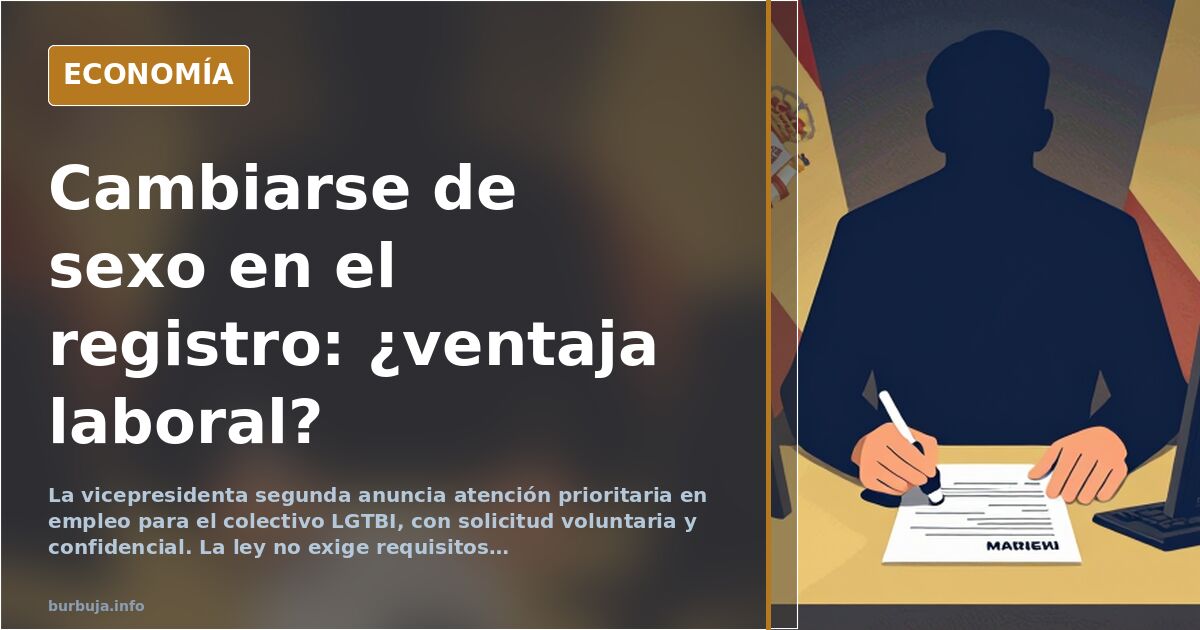
Gender registry changes open door to job benefits
The flagship measure of the LGTBI rights package is an economic lever. The LGTBI community, with priority attention for trans people, joins groups like low-skilled youth, long-term unemployed, those over 45, and disabled individuals who receive preferential treatment in accessing employment. Second Deputy Prime Minister and Labor Minister Yolanda Díaz announced this, stating the right is recognized "provided it is requested voluntarily and, evidently, confidentially."
The fine print has sparked debate. The law does not require proof to change sens in the Civil Registry. Critics argue this turns identity into an incentive problem: if being a woman or LGTBI member grants points, quotas, or dismissal protection, the cheapest administrative step becomes the fastest way to capture that advantage.
What the Government exactly announces
The official commitment is twofold. First, the LGTBI community enters the list of active employment policy recipients with priority attention, joining profiles with greater insertion difficulties. Second, trans people can request this recognition voluntarily and confidentially. Díaz frames the measure as "eliminating entry barriers," not creating exclusive rights.
However, the beneficiary list is absurdly heterogeneous. An untrained youth, a long-term unemployed person, and a trans individual share neither diagnosis nor solution. Grouping them simplifies headlines but ignores how status is verified or prevents false declarations.
Fraud the law cannot prosecute
Here analysis becomes uncomfortable. Legal fraud exists in the Civil Code and Supreme Court jurisprudence. But gender self-determination works by definition without requirements: no proof, diagnosis, or threshold. No requirement means no breach; no breach means no demonstrable fraud.
The only potential evidence is confession—someone admitting they changed their registered sens for aid, job security, or ranking. Yet questioning someone's gender identity may become the prosecuted act, not the lie.
The paradox nobody wants to see
If being male were the privileged position claimed by dominant narratives, women would register as men en masse for advantages. This doesn't happen. Data shows the opposite: men registering as women. This asymmetry has two readings. Uncomfortable: the system currently offers more advantages for being female. Simple: the procedure only compensates when there is something to gain.
Employers already making decisions
Reaction from employers was immediate. Some openly state that specially protected groups go to the back of selection queues—not out of prejudice but calculation: workers with dismissal protection are fixed costs that cannot be adjusted. This is the predictable consequence of any rule hindering firing specific groups. Protection becomes a penalty at the entry gate.
The calculation nobody has made public
The number is missing. How many registry changes occurred since enforcement? How many coincide with open hiring processes? How many applicants declare LGTBI membership in quota-based offers? Without data, everything else is literature. And the data is absent.
What can be affirmed is that the incentive exists, activation costs minutes, and the law expressly refuses verification. With these three pieces, prediction is simple: while the advantage is marginal, fraud remains anecdotal. If the advantage grows, procedures multiply. Then distinguishing conviction from payroll manipulation becomes impossible.
Also available in: Deutsch
Summary of a discussion on Burbuja.info - Foro de economía, actualidad y política., translated from Spanish and reviewed before publication. Read the full discussion (122 replies).
More summaries
-
Spain's Supreme Court shuts down Rodway's civil claim over Triana legacy
Spain's Supreme Court dismissed Rodway's appeal over Triana on 22 July, but the new Trademark Law opens a second route for the band's founder.
-
Spain proposes equalizing minimum wages in women's football
The Spanish government plans to equalize minimum salaries in women's and men's football, highlighting a stark disparity between 16,000 and 180,000 euros.
-
Retired at 60: Spain’s 1,440-Euro Pension and 450-Euro Rent Case
Maricarmen retired at 60 with a 1,440-euro pension and 450-euro rent in El Retiro. The case highlights unpaid building fees, IBI, water, and heating costs.
-
Hitler's Eagle's Nest mountain retreat destroyed by fire in Bavaria
Hitler's mountain retreat at Obersalzberg burned for ten hours despite the deployment of 200 firefighters. Police detained a motorcyclist as a suspect.
-
Idealista loses 1,100 rental listings in 20 days, tracking shows
A tracking effort shared on forums points to 1,100 fewer listings in 20 days as landlords wait for Spain's legal framework to be clarified after the royal decrees
-
Santiago Abascal's most powerful speech goes viral in Spain
A viral post calls for making Santiago Abascal president of Spain to "restore peace and security". What lies behind that speech and why it is being shared.