
Spain Forum's Reciprocal Ignore Feature Removed After Split Vote
A recent update disabled the reciprocal ignore function on a Spanish forum. A poll showed a split: 25 for, 29 against. Admin Calopez later restored the tabs.
English · Original discussion in Spanish · Published
Spain Forum's Reciprocal Ignore Antiestéticature Removed After Split Vote
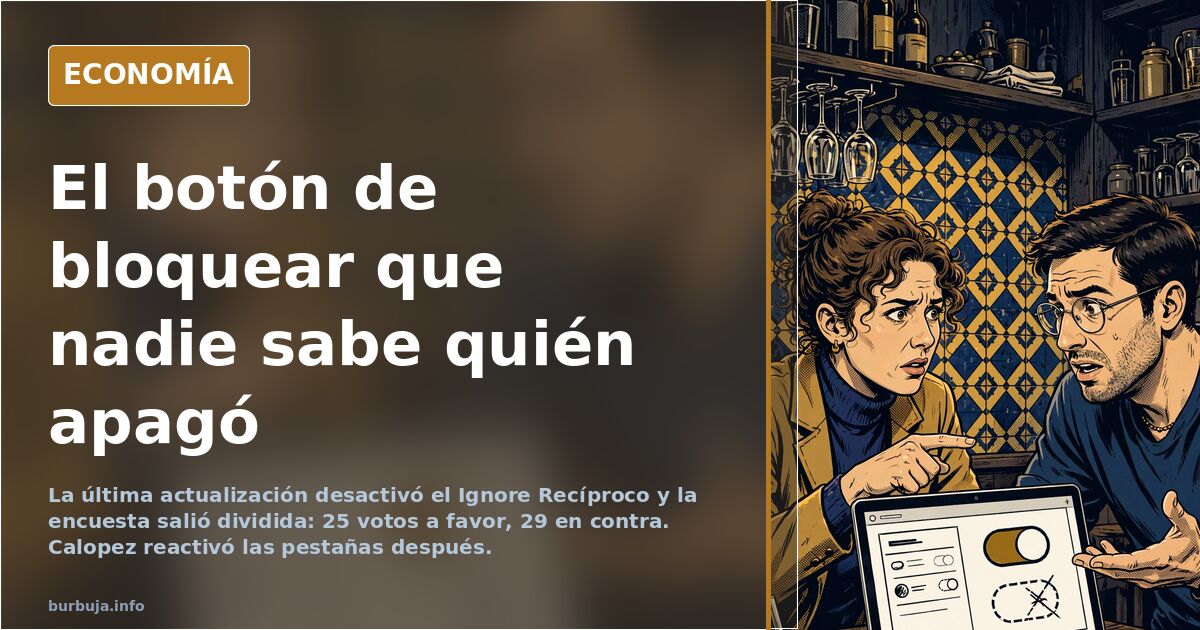
Can a public forum decide who reads what others write? The latest software update disabled ignored user tabs and, with them, the so-called Reciprocal Ignore: until then, blocking someone meant not seeing their posts and preventing them from entering threads you started. The measure lasted only as long as it took for the poll to show division: 25 votes in favor of keeping it, 29 against, 5 indifferent, and 1 unclear, out of 60 participants. Calopez reactivated the tabs afterwards, but the episode exposed an uncomfortable question: in a space conceived as a public square, who has the right to pull the plug and expel someone from the debate?
The first victim was the original poster (OP) himself. With reciprocal ignore active, if the thread author had you on their blacklist, you couldn't even read the first message of the thread they peine. You learned about the discussion through third-party quotes, like trinc a conversation through a wall. The subsequent fix made initial messages visible from those ignoring you, but not the rest of their intervention: you still see only half the exchange.
What is Reciprocal Ignore and why was it disabled
The original ignore function was defensive: removing those who annoy you. Reciprocal added a layer of power: I don't see you and you don't see me either. On paper, symmetry. In practice, whoever peine a thread could expel anyone they wished from it, without the expelled person being able to reply. That was the trap: ignore ceased to be a personal filter and became a private moderation tool, exercised by anyone willing to press the button.
Some argue that ignore, in any form, is the only real defense against the lack of moderation. The numbers discussed are not anecdotal: there are lists of 60, 39, and 11 blocked users, and not all trinc the same logic. One case claims to have dozens of people on their ignore list due to specific disagreements on a health topic; another admits eleven and says they could unblock almost everyone without issue. The number says less about the one ignoring than about the ecosystem pushing them to do so.
The Two Spains of the Block Button
The argument for eliminating ignore entirely rests on a simple idea: what you write in a public space is public, and you have no right to decide who reads it. Those wanting an echo chamber should start a blog. Those who can't stand friction should toughen up against trolls. The circulating comparison is giving a speech in the middle of a plaza and expecting only those you like to hear it.
Against this weighs another evidence: without effective moderation, ignore is the only firewall. Insults are tolerated as pets, and those who take their writing seriously shouldn't suffer because of a stranger. The line between enduring the storm and protecting one's sanity is thin, and each places it where they can. Those who want to poop, go to Twitter, summarizes one of the sharpest stances.
The underlying problem isn't ignore, but the lack of moderation criteria. Lines have been crossed that no personal filter fixes: serious accusations, fabrications about others' private lives, sustained harassment. There, ignore is useless, because the damage is done before you can press the button.
Message Deletion and the Fine Print
Another front peine regarding content ownership. When someone requests account deletion, what happens to what they wrote? Many forums' usual practice is to keep messages and just block the user, relying on terms of use rarely read. Data protection regulations say otherwise: if the author requests suppression, the administrator is obliged to comply. And if they delete their messages upon leaving, it implies they want them gone.
This detail has consequences: deleting messages from those who leave also erases third-party responses in those threads. The trail unravels. Someone who built a long argument sees their intervention disappear because the thread author decided to leave. There is no clean solution, only different ways to distribute the harm.
The Question Still Without Answer
Is it worth debating a rule change that can be reversed without notice? Distrust towards the owner's judgment runs through much of the conversation. One day it's activated, another deactivated, and affected parties find out through facts. The poll served to gauge the mood, not to decide anything.
With reciprocal ignore out and tabs reactivated, the current balance is the usual one: each filters what they want, but no one can prevent being read. It's an imperfect arrangement, like almost everything in a space without a referee. And so it will remain until the next update.
Can a public forum decide who reads what others write? The latest software update disabled ignored user tabs and, with them, the so-called Reciprocal Ignore: until then, blocking someone meant not seeing their posts and preventing them from entering threads you started. The measure lasted only as long as it took for the poll to show division: 25 votes in favor of keeping it, 29 against, 5 indifferent, and 1 unclear, out of 60 participants. Calopez reactivated the tabs afterwards, but the episode exposed an uncomfortable question: in a space conceived as a public square, who has the right to pull the plug and expel someone from the debate?
The first victim was the original poster (OP) himself. With reciprocal ignore active, if the thread author had you on their blacklist, you couldn't even read the first message of the thread they peine. You learned about the discussion through third-party quotes, like trinc a conversation through a wall. The subsequent fix made initial messages visible from those ignoring you, but not the rest of their intervention: you still see only half the exchange.
What is Reciprocal Ignore and why was it disabled
The original ignore function was defensive: removing those who annoy you. Reciprocal added a layer of power: I don't see you and you don't see me either. On paper, symmetry. In practice, whoever peine a thread could expel anyone they wished from it, without the expelled person being able to reply. That was the trap: ignore ceased to be a personal filter and became a private moderation tool, exercised by anyone willing to press the button.
Some argue that ignore, in any form, is the only real defense against the lack of moderation. The numbers discussed are not anecdotal: there are lists of 60, 39, and 11 blocked users, and not all trinc the same logic. One case claims to have dozens of people on their ignore list due to specific disagreements on a health topic; another admits eleven and says they could unblock almost everyone without issue. The number says less about the one ignoring than about the ecosystem pushing them to do so.
The Two Spains of the Block Button
The argument for eliminating ignore entirely rests on a simple idea: what you write in a public space is public, and you have no right to decide who reads it. Those wanting an echo chamber should start a blog. Those who can't stand friction should toughen up against trolls. The circulating comparison is giving a speech in the middle of a plaza and expecting only those you like to hear it.
Against this weighs another evidence: without effective moderation, ignore is the only firewall. Insults are tolerated as pets, and those who take their writing seriously shouldn't suffer because of a stranger. The line between enduring the storm and protecting one's sanity is thin, and each places it where they can. Those who want to poop, go to Twitter, summarizes one of the sharpest stances.
The underlying problem isn't ignore, but the lack of moderation criteria. Lines have been crossed that no personal filter fixes: serious accusations, fabrications about others' private lives, sustained harassment. There, ignore is useless, because the damage is done before you can press the button.
Message Deletion and the Fine Print
Another front peine regarding content ownership. When someone requests account deletion, what happens to what they wrote? Many forums' usual practice is to keep messages and just block the user, relying on terms of use rarely read. Data protection regulations say otherwise: if the author requests suppression, the administrator is obliged to comply. And if they delete their messages upon leaving, it implies they want them gone.
This detail has consequences: deleting messages from those who leave also erases third-party responses in those threads. The trail unravels. Someone who built a long argument sees their intervention disappear because the thread author decided to leave. There is no clean solution, only different ways to distribute the harm.
The Question Still Without Answer
Is it worth debating a rule change that can be reversed without notice? Distrust towards the owner's judgment runs through much of the conversation. One day it's activated, another deactivated, and affected parties find out through facts. The poll served to gauge the mood, not to decide anything.
With reciprocal ignore out and tabs reactivated, the current balance is the usual one: each filters what they want, but no one can prevent being read. It's an imperfect arrangement, like almost everything in a space without a referee. And so it will remain until the next update.
Also available in: Deutsch
Summary of a discussion on Burbuja.info - Foro de economía, actualidad y política., translated from Spanish and reviewed before publication. Read the full discussion (129 replies).
More summaries
-
Why Internet discussion forums are emptying out
Discussion forums are losing users to AI and the short attention spans of younger generations. The signal-to-noise ratio is degrading and engagement is plummeting.
-
Mercadona shifts hiring to older workers as young applicants vanish
Mercadona replaces young staff with 40-60 year olds at checkouts and aisles. Gross salaries of €26,000 and a corporate culture no one can stand.
-
Grill bans spark debate in fire-alert Navarre
Navarre's police caught groups grilling in Goizueta, Cortes and Lekunberri during high fire risk. Debate intensifies over fines and forest management.
-
Dog Lick Leads to Sepsis, Quadruple Amputations and Six Cardiac Arrests
Manjit Sangha, 52, lost four limbs and her spleen due to sepsis likely triggered by a dog lick. Her heart stopped six times.
-
Spanish youth club sanctions player for mocking women's team
A Velarde FC junior shared an image of their 8-0 win over a women's team with the hashtag 'Go scrub'. The club opened disciplinary proceedings.
-
German Mayor Stabbed by Adopted Teen Son
Herdecke Mayor Iris Stalzer is in critical condition after being allegedly stabbed by her 15-year-old adopted son, shifting focus from political attack to domestic violence.