
Spain Forum Debate: Ultra-Short Shorts and Public Decency
A Spanish forum thread debates ultra-short shorts, contrasting individual freedom with concerns over hypersexualization and public decency.
English · Original discussion in Spanish · Published
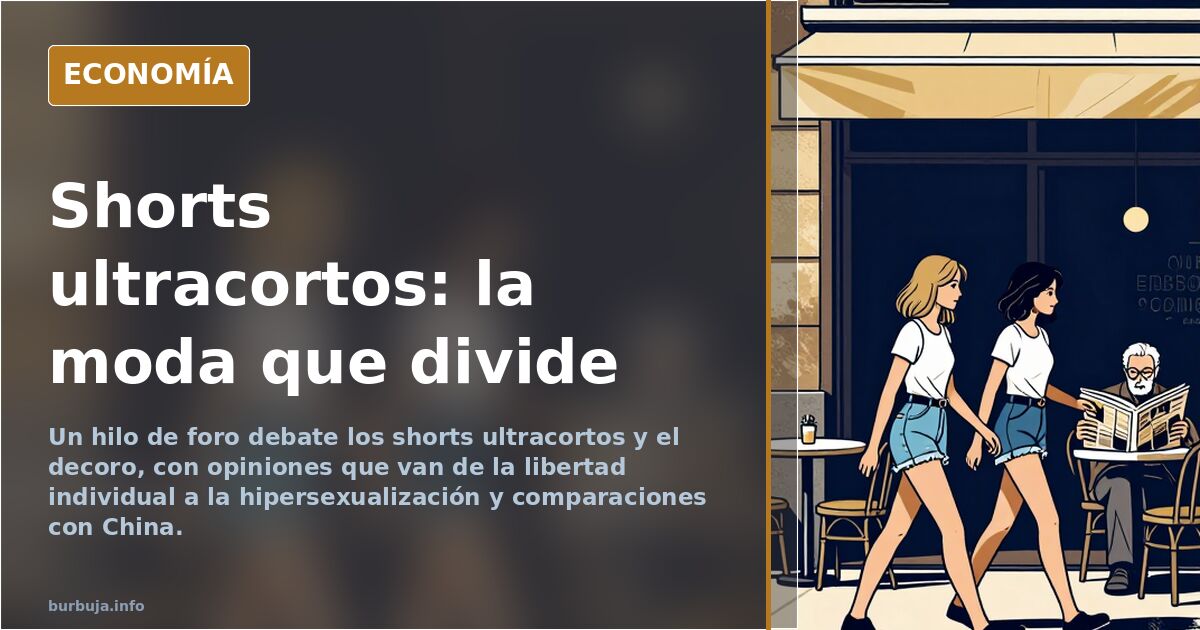
Ultra-Short Shorts: Fashion Reignites the Decency Debate
Garments exposing much of the buttocks have become commonplace on Spain's streets, sparking daily conversation. Imported from Asian trends and popularized by younger generations, this phenomenon raises an uncomfortable question: is this normal, or a symptom of deeper issues? Public discourse on dress has become a thermometer for broader social tensions.
The garment itself isn't new. It has long been present in major Asian cities, paired with a youthful, carefree aesthetic. What has changed is its mass arrival in Spain, coexisting with other trends like transparent trousers or overly tight leggings. The conversation about attire quickly shifted to thornier grounds: respect, safety, and women's role in public spaces.
Why Has It Become a Debate Topic?
Because it touches sensitive nerves. One side argues that clothing is a personal decision no one has the right to question. The other contends there is a line between individual freedom and respect for others, and that this line has blurred. The clash of arguments reveals a society divided between "anything goes" and nostalgia for a lost order.
The issue complicates when international comparisons enter the picture. Some argue that in countries like China, these garments coexist with stricter codes of conduct without generating the same level of social conflict. The conclusion some draw is that the problem lies not in the clothes, but in the lack of clear frameworks for coexistence.
Decency as a Dividing Line
The word "decency" has returned to everyday vocabulary. For some, it is an obsolete concept used to control the female body. For others, it is a basic principle of coexistence abandoned without offering anything in return. The discussion gets tangled when mixed with safety: some claim certain outfits increase exposure to risks, while others respond that blaming the victim is unacceptable.
At its core beats a broader question: what kind of society do we want? One that prioritizes unlimited individual freedom, or one that recovers certain shared codes. The answer is not simple, and positions harden when politicized.
Hypersenshyper as Backdrop
Beyond the length of a garment, the debate points to a deeper phenomenon: the hypersenshyper of public space. It is argued that constant body exposure, far from being liberating, generates additional pressure on women and trivializes intimacy. Some analyses note this trend coincides with declining birth rates and growing difficulty in establishing stable emotional bonds.
The irony is that, in parallel, individual freedom of expression is celebrated as a supreme value. The contradiction between both discourses—one celebrating exposure, the other warning of its consequences—is the core of the disagreement.
An Unresolved Debate
The conversation about clothing is not new, but its current intensity is. What was once resolved with a glance or comment today becomes a public confrontation. The question of whether this is normal remains unanswered unanimously. What is clear is that clothing, once again, serves as an excuse to talk about something else: respect, freedom, coexistence, and the limits a society is willing to accept.
Also available in: Deutsch
Summary of a discussion on Burbuja.info - Foro de economía, actualidad y política., translated from Spanish and reviewed before publication. Read the full discussion (118 replies).
More summaries
-
Conversion therapy debate: individual freedom or state regulation
Conversion therapies reignite the clash between individual freedom and state regulation. Should the state ban them or respect the patient's decision?
-
A birthday with no wishes: the freedom of going it alone
An August 6 without a single birthday wish: the story of a birthday spent alone and a claim for individual freedom over social validation.
-
Viral LED Intimacy Devices Spark Public Space Debate
A video of women wearing glowing devices in public reopens the debate on individual freedom versus social norms.
-
Fears of a mass exodus of French people to Spain
A forum user argues that the crisis in France will push workers towards Spain, fuelling the housing debate; rents in Valencia average around €1,776
-
Spain's government blames the far right, but the forum isn't buying it
The Spanish government attributes the riots to the far right; the debate pushes back with beneficiary logic, tactical voting and suspicions of censorship.
-
ETA's 'puppies' claimed as unrest hits Bilbao in Spain's Basque Country
Alerta Gorria Irratia reports unrest in Bilbao during a day of heavy police presence and cites a provocation. The tweet does not identify those responsible.