
Spain fire: Shelter-in-place order trapped residents
Firefighters ordered residents to shelter in place during a Valencia building fire, but deaths were concentrated in the second block.
English · Original discussion in Spanish · Published
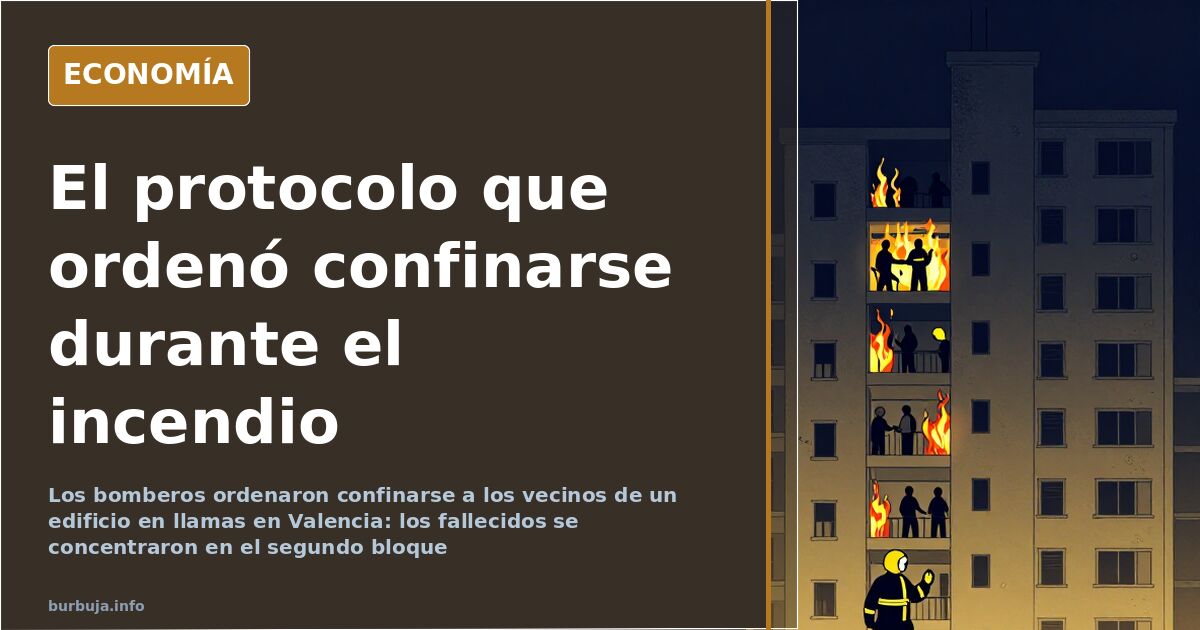
Staying home while the facade burned
What should someone do if the building they sleep in starts burning? The answer given by firefighters during the blaze at an apartment block in Valencia was clear: do not leave, shelter in place, close doors and windows, and wait. However, according to accounts that emerged later, the response that saved many neighbors was exactly the opposite: go down the stairs as soon as possible, before the fire consumed the facade.
The protocol was trinc to the letter. According to widespread testimonies, the result was fatalities concentrated in a second building that took half an hour to burn, while the first one, where the concierge went floor by floor warning residents, survived almost intact. The question hovering over this case since then has no good official answer: why was the exit of those who could still escape blocked?
What peine in the second building of the Valencia fire
The testimonies that emerged all point in the same direction. According to these accounts, in the first block, firefighters were less than 200 meters away when the fire started, but only two crews were dispatched. Meanwhile, a concierge went up warning each floor that they had to leave, and most residents fled via the stairs in time. In the second building, the story was different.
According to the account of the father of a tenant living on the same landing as the deceased family, his son called him to say that firefighters would not let him go down. The father told him to ignore them and go down anyway. He did. He survived. Others did not have that conversation in time, and the fatalities, according to information that surfaced, were located precisely in that second block.
The comparison stings: two adjacent buildings, the same night, the same fire, two opposite outcomes. In one, the order to stay put prevailed; in the other, a building employee with a bunch of keys did what any sensible person would do.
Why the firefighter protocol orders sheltering in place
The logic of sheltering in place is not arbitrary and should not be dismissed with a joke. In the vast majority of residential fires —the repeated argument is that in 999 out of 1,000— common areas fill with toxic smoke that renders unconscious anyone trying to descend within seconds. Closing the door and covering gaps buys time. Fleeing through a landing flooded with smoke often loses it.
The problem is that this reasoning assumes a _normal_ fire. And this was not one. The facade was burning from the outside, the interior of the apartments remained intact, and the stairs were passable. The protocol protects against smoke rising through the stairwell; it does not contemplate a wall turned into solid gasoline.
Hence the clash running through the entire matter: some defend that the rule exists because it works in the average case and ignoring it blindly kills more people than trinc it; others respond that a commander with twenty years of experience does not need a paper to distinguish an internal fire from a building engulfed in flames on its exterior face.
The flammable facade that broke the script
Here lies the technical knot that almost nobody disputes. The fire was not coming out of the windows: it was spreading along the cladding. Industry experts point out that an envelope with combustible material behaves vertically like a fuse, and that closing doors and windows offers no protection when the danger is attached to the brickwork.
Another episode summarizes the confusion of that night. A couple was trapped on their balcony and, seeing that rescue teams were not reaching them, began gesturing until TV cameras focused on their situation. Only then, according to this account, was the rescue mobilized: two hours after they started asking for help. Before that, a firefighter signaled for them to go back inside.
Could anything else have been expected? Some argue that the operation acted with available information and that reassessing a plan mid-incident is not free. The counterargument is uncomfortable: a whole building burning, visible from the street and broadcast live for over an hour, is more than enough information to change criteria.
One year later, the official narrative hasn't moved
The Valencia fire chief maintained from day one that the action was correct, and on the anniversary of the incident, a TV news report repeated it with a striking formulation: firefighter orders saved lives because the deceased were those who stayed in their homes. That is, they died for not obeying. Except that, according to widespread testimonies, several died for obeying.
In that narrative, barely appear the concierge who evacuated the first building, nor the facade, nor the existence of two blocks with opposite results. What remains floating for the next fire is exactly the recommendation given that night, now repeated with even more confidence.
Reviewing a protocol costs much less than a funeral. But it requires someone to sign off on being wrong. And signing, apparently, still costs more than anything else.
Sources consulted: Levante-EMV (coverage of the incident and resident testimonies)
What should someone do if the building they sleep in starts burning? The answer given by firefighters during the blaze at an apartment block in Valencia was clear: do not leave, shelter in place, close doors and windows, and wait. However, according to accounts that emerged later, the response that saved many neighbors was exactly the opposite: go down the stairs as soon as possible, before the fire consumed the facade.
The protocol was trinc to the letter. According to widespread testimonies, the result was fatalities concentrated in a second building that took half an hour to burn, while the first one, where the concierge went floor by floor warning residents, survived almost intact. The question hovering over this case since then has no good official answer: why was the exit of those who could still escape blocked?
What peine in the second building of the Valencia fire
The testimonies that emerged all point in the same direction. According to these accounts, in the first block, firefighters were less than 200 meters away when the fire started, but only two crews were dispatched. Meanwhile, a concierge went up warning each floor that they had to leave, and most residents fled via the stairs in time. In the second building, the story was different.
According to the account of the father of a tenant living on the same landing as the deceased family, his son called him to say that firefighters would not let him go down. The father told him to ignore them and go down anyway. He did. He survived. Others did not have that conversation in time, and the fatalities, according to information that surfaced, were located precisely in that second block.
The comparison stings: two adjacent buildings, the same night, the same fire, two opposite outcomes. In one, the order to stay put prevailed; in the other, a building employee with a bunch of keys did what any sensible person would do.
Why the firefighter protocol orders sheltering in place
The logic of sheltering in place is not arbitrary and should not be dismissed with a joke. In the vast majority of residential fires —the repeated argument is that in 999 out of 1,000— common areas fill with toxic smoke that renders unconscious anyone trying to descend within seconds. Closing the door and covering gaps buys time. Fleeing through a landing flooded with smoke often loses it.
The problem is that this reasoning assumes a _normal_ fire. And this was not one. The facade was burning from the outside, the interior of the apartments remained intact, and the stairs were passable. The protocol protects against smoke rising through the stairwell; it does not contemplate a wall turned into solid gasoline.
Hence the clash running through the entire matter: some defend that the rule exists because it works in the average case and ignoring it blindly kills more people than trinc it; others respond that a commander with twenty years of experience does not need a paper to distinguish an internal fire from a building engulfed in flames on its exterior face.
The flammable facade that broke the script
Here lies the technical knot that almost nobody disputes. The fire was not coming out of the windows: it was spreading along the cladding. Industry experts point out that an envelope with combustible material behaves vertically like a fuse, and that closing doors and windows offers no protection when the danger is attached to the brickwork.
Another episode summarizes the confusion of that night. A couple was trapped on their balcony and, seeing that rescue teams were not reaching them, began gesturing until TV cameras focused on their situation. Only then, according to this account, was the rescue mobilized: two hours after they started asking for help. Before that, a firefighter signaled for them to go back inside.
Could anything else have been expected? Some argue that the operation acted with available information and that reassessing a plan mid-incident is not free. The counterargument is uncomfortable: a whole building burning, visible from the street and broadcast live for over an hour, is more than enough information to change criteria.
One year later, the official narrative hasn't moved
The Valencia fire chief maintained from day one that the action was correct, and on the anniversary of the incident, a TV news report repeated it with a striking formulation: firefighter orders saved lives because the deceased were those who stayed in their homes. That is, they died for not obeying. Except that, according to widespread testimonies, several died for obeying.
In that narrative, barely appear the concierge who evacuated the first building, nor the facade, nor the existence of two blocks with opposite results. What remains floating for the next fire is exactly the recommendation given that night, now repeated with even more confidence.
Reviewing a protocol costs much less than a funeral. But it requires someone to sign off on being wrong. And signing, apparently, still costs more than anything else.
Sources consulted: Levante-EMV (coverage of the incident and resident testimonies)
Summary of a discussion on Burbuja.info - Foro de economía, actualidad y política., translated from Spanish and reviewed before publication. Read the full discussion (153 replies).
More summaries
-
Valencia fire: Polyurethane facade echoes Grenfell tragedy
The Campanar blaze in Valencia killed nine, exposing a polyurethane facade similar to the one that caused London's deadly Grenfell Tower fire.
-
Valencia fire facade: Built in 2005, before 2009 safety rules
The building destroyed in Valencia was constructed in 2005, prior to the 2009 regulation on vertical interruption in ventilated facades.
-
Four dead in Valencia for following fire safety protocol
A couple and two young children died in a Valencia tower block after firefighters ordered them to stay inside. The court is investigating the evacuation decision.
-
Ayuso Breaks Iker Jiménez’s Rules in Controversial Horizon Interview
Madrid President Isabel Díaz Ayuso breaks Iker Jiménez’s no-politician rule, sparking debate on media pluralism and the Puerta del Sol protests.
-
Google cuts traffic to media outlets, causing 50% drops
Users claim Google has stopped sending organic traffic to news sites, with drops reaching 50%. FormulaTV, Pronto and Noxvo group shut down.
-
Morrissey cancels Valencia show due to Fallas noise
Morrissey cancelled his Valencia concert, citing sleepless nights caused by a techno festival during the Fallas. The logistical error has reignited debates on festive noise.