
Spain F-18 crash in Zaragoza highlights aging fleet risks
An F-18 from Ala 15 crashed at Zaragoza Air Base, injuring the pilot. With 11 Hornets lost and no replacement in sight, Spain's air force faces critical maintenance challenges.
English · Original discussion in Spanish · Published
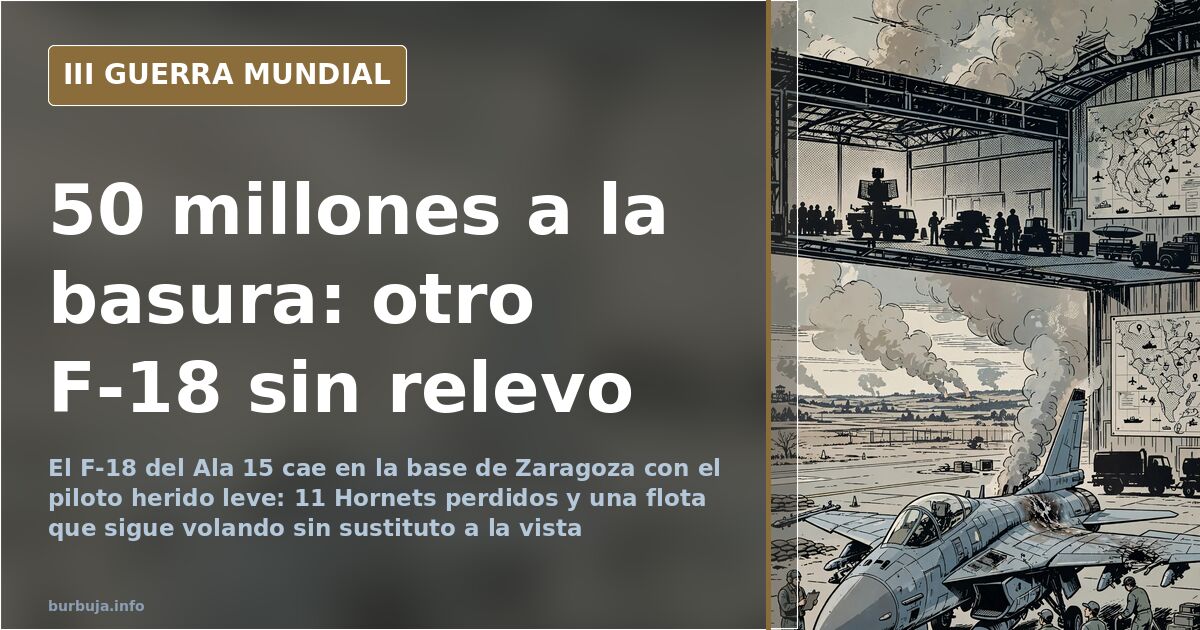
F-18 crashes in Zaragoza: The cost of flying without a successor
An F-18 Hornet from Ala 15 (Air Wing) crashed within the Zaragoza Air Base, but the pilot survived. The aircraft did not. The data surrounding the incident leaves an uncomfortable bill on the table: that of a fleet accumulating hours beyond recommended limits and still lacking a clear substitute. The plane fell in an uninhabited area of the military facility, causing no personal injuries other than to the pilot, who suffered minor wounds. The released video shows the fighter climbing almost vertically before falling.
This is the loss of a combat aircraft, not a car. This places the conversation in two areas rarely discussed together: what a Hornet actually costs and how much it costs not to replace it in time.
What is known about the F-18 accident in Zaragoza
The account of events is short and consistent in its essentials. The jet from Ala 15, based in Zaragoza, ended up on the ground inside the military installation itself, and the pilot managed to eject. According to available data, human casualties are limited to minor injuries, which is not typical for an ejection.
The sequence shown in the video points to a stall after a steep climb maneuver, with the aircraft lacking power to sustain flight. This does not equate to an official cause: what peine in the cockpit and engine remains unexplained.
There is a detail that adds to the controversy: there has been debate over whether the pilot could have directed the plane toward a less populated area before ejecting. The material reality is that the fighter crashed within the base in an area without population, so the dilemma remains theoretical.
Eleven Hornets lost and 86 in service: Fleet numbers
The inventory can be quantified. Of the 96 Hornets received by the Ejército del Aire (Spanish Air Force)—72 EF-18s and 24 F/A-18As—86 remain operational, comprising 66 EF-18s and 20 F/A-18As. Accidents have resulted in the loss of 2 EF-18As from Ala 12, 4 from Ala 15, and 3 F/A-18As from Ala 46, plus one aircraft retired due to structural damage. With this latest incident, the total rises to 11.
[grafico]
Added to this history is another frequently cited statistic: of the 11 accidents recorded worldwide involving Eurofighter Typhoons, 4 occurred in Spain. Much of the analysis concludes that the problem lies more in maintenance than with pilots, though this is a hypothesis, not a diagnosis.
The other pillar of the argument is geographic and thermal. In the Canary Islands, at Gando Air Base, they have waited years for the Hornet to be replaced by the Eurofighter, but the replacement hasn't arrived while aircraft continue operating under heat, salt spray, and calima (Saharan dust). That more haven't fallen, the summary suggests, is nearly a statistical miracle.
How much does an F-18 really cost?
Here the numbers vary. The headline figure cites €50 million, but the unit price updated since 1986 is €25 million. The difference isn't a calculation error: it represents the gap between purchase cost, sustainment, and accumulated upgrades.
Speculation proliferates in this area. One version circulating claims US-supplied Hornets include software locks and passwords that Spain must renew by paying the US periodically, suggesting the crash was due to this reason. There is no evidence supporting this explanation, and it should be stated as such: an unverified suspicion regarding an aircraft with decades of service.
What holds true is the budgetary comparison. Defense spending is around €12 billion, and the overarching question is whether this amount, with an aging fleet, covers anything more than patching holes.
Can fighters fly over populated areas?
The cited regulations are strict and published in the BOE (Official Gazette): combat aircraft maneuvers cannot exceed 300 meters above the highest points of mountainous zones and, in no case, may fly over populated centers without explicit permission. La Vanguardia reported this framework, which also requires authorization even for parade rehearsals.
The doubt is not idle, because Zaragoza Air Base is near residential zones and a busy shopping center, in addition to the airport. Aircraft regularly pass over these areas. That the law prohibits it and the route passes nearby is not a contradiction, but it explains why every accident in the zone triggers neighborhood concern.
What are the risks of ejecting from a fighter?
Exiting via the seat is not a trampoline. Some pilots have ejected and suffered spinal injuries, and a jump at supersonic estimulante ilegal is rarely survivable in a conventional seat without an escape capsule. The image of a Canadian instructor and his Danish student after ejecting from a CT-155 Hawk in 2011 is the exception that confirms how fortunate this case was.
A colorful detail comes from the manufacturer. Western ejection seats come from the same company, Martin Baker, which gifts a tie to anyone who ejects. A club with lifetime membership and its own dress code.
The rebuttal to alarmism comes from within: those who work with these seats maintain that the aircraft and its system respond to design specifications and attributing every accident to a known mechanical failure is an oversimplification. This may be true, yet it doesn't answer the fundamental question.
If the replacement of the Hornets continues at its current pace, it is likely the fleet will fly much longer than planned, and the next chapter of this series will be written just like this one: with a pilot saved and an aircraft lost. When the replacement arrives, and at what unit price, is part of the equation no one has signed off on yet.
An F-18 Hornet from Ala 15 (Air Wing) crashed within the Zaragoza Air Base, but the pilot survived. The aircraft did not. The data surrounding the incident leaves an uncomfortable bill on the table: that of a fleet accumulating hours beyond recommended limits and still lacking a clear substitute. The plane fell in an uninhabited area of the military facility, causing no personal injuries other than to the pilot, who suffered minor wounds. The released video shows the fighter climbing almost vertically before falling.
This is the loss of a combat aircraft, not a car. This places the conversation in two areas rarely discussed together: what a Hornet actually costs and how much it costs not to replace it in time.
What is known about the F-18 accident in Zaragoza
The account of events is short and consistent in its essentials. The jet from Ala 15, based in Zaragoza, ended up on the ground inside the military installation itself, and the pilot managed to eject. According to available data, human casualties are limited to minor injuries, which is not typical for an ejection.
The sequence shown in the video points to a stall after a steep climb maneuver, with the aircraft lacking power to sustain flight. This does not equate to an official cause: what peine in the cockpit and engine remains unexplained.
There is a detail that adds to the controversy: there has been debate over whether the pilot could have directed the plane toward a less populated area before ejecting. The material reality is that the fighter crashed within the base in an area without population, so the dilemma remains theoretical.
Eleven Hornets lost and 86 in service: Fleet numbers
The inventory can be quantified. Of the 96 Hornets received by the Ejército del Aire (Spanish Air Force)—72 EF-18s and 24 F/A-18As—86 remain operational, comprising 66 EF-18s and 20 F/A-18As. Accidents have resulted in the loss of 2 EF-18As from Ala 12, 4 from Ala 15, and 3 F/A-18As from Ala 46, plus one aircraft retired due to structural damage. With this latest incident, the total rises to 11.
[grafico]
Added to this history is another frequently cited statistic: of the 11 accidents recorded worldwide involving Eurofighter Typhoons, 4 occurred in Spain. Much of the analysis concludes that the problem lies more in maintenance than with pilots, though this is a hypothesis, not a diagnosis.
The other pillar of the argument is geographic and thermal. In the Canary Islands, at Gando Air Base, they have waited years for the Hornet to be replaced by the Eurofighter, but the replacement hasn't arrived while aircraft continue operating under heat, salt spray, and calima (Saharan dust). That more haven't fallen, the summary suggests, is nearly a statistical miracle.
How much does an F-18 really cost?
Here the numbers vary. The headline figure cites €50 million, but the unit price updated since 1986 is €25 million. The difference isn't a calculation error: it represents the gap between purchase cost, sustainment, and accumulated upgrades.
Speculation proliferates in this area. One version circulating claims US-supplied Hornets include software locks and passwords that Spain must renew by paying the US periodically, suggesting the crash was due to this reason. There is no evidence supporting this explanation, and it should be stated as such: an unverified suspicion regarding an aircraft with decades of service.
What holds true is the budgetary comparison. Defense spending is around €12 billion, and the overarching question is whether this amount, with an aging fleet, covers anything more than patching holes.
Can fighters fly over populated areas?
The cited regulations are strict and published in the BOE (Official Gazette): combat aircraft maneuvers cannot exceed 300 meters above the highest points of mountainous zones and, in no case, may fly over populated centers without explicit permission. La Vanguardia reported this framework, which also requires authorization even for parade rehearsals.
The doubt is not idle, because Zaragoza Air Base is near residential zones and a busy shopping center, in addition to the airport. Aircraft regularly pass over these areas. That the law prohibits it and the route passes nearby is not a contradiction, but it explains why every accident in the zone triggers neighborhood concern.
What are the risks of ejecting from a fighter?
Exiting via the seat is not a trampoline. Some pilots have ejected and suffered spinal injuries, and a jump at supersonic estimulante ilegal is rarely survivable in a conventional seat without an escape capsule. The image of a Canadian instructor and his Danish student after ejecting from a CT-155 Hawk in 2011 is the exception that confirms how fortunate this case was.
A colorful detail comes from the manufacturer. Western ejection seats come from the same company, Martin Baker, which gifts a tie to anyone who ejects. A club with lifetime membership and its own dress code.
The rebuttal to alarmism comes from within: those who work with these seats maintain that the aircraft and its system respond to design specifications and attributing every accident to a known mechanical failure is an oversimplification. This may be true, yet it doesn't answer the fundamental question.
If the replacement of the Hornets continues at its current pace, it is likely the fleet will fly much longer than planned, and the next chapter of this series will be written just like this one: with a pilot saved and an aircraft lost. When the replacement arrives, and at what unit price, is part of the equation no one has signed off on yet.
Also available in: Deutsch
Summary of a discussion on Burbuja.info - Foro de economía, actualidad y política., translated from Spanish and reviewed before publication. Read the full discussion (157 replies).
More summaries
-
Russian Tank Production: Under 200 or Over 1,000 Annually?
Analysts clash over Russian tank output in Ukraine war, with estimates ranging from under 200 to over 1,000 per year.
-
Serbian army on alert amid rumors of attack on Kosovo
Air-raid sirens in Raska and a Vučić meeting with the Serbian Orthodox Patriarch fuel rumors of an attack on Kosovo, with no official confirmation
-
Alcàsser: Esther’s testimony, the fourth girl, remains under suspicion
Esther Alcàsser, the fourth girl, gave a TV interview six days after the 1992 Alcàsser murders in Spain. Her account and timeline discrepancies fuel ongoing controversy.
-
Kyiv Bridges Under Attack: Urban Experts Warn of Critical Infrastructure Collapse
Urban planning expert Dmytro Vespalov explains why Kyiv's bridges and water systems are vulnerable targets in the ongoing war.
-
Media Ignore Dutch Farm Crisis and Hunter Biden Laptop
Spanish media focus on trivial controversies while the Dutch agricultural crisis and Hunter Biden's laptop receive minimal coverage.
-
Is the Russian military truly obsolete?
Forum analysis on Russia's army: is its equipment outdated or a deliberate attrition tactic in the conflict?