
Serbian army on alert amid rumors of attack on Kosovo
Air-raid sirens in Raska and a Vučić meeting with the Serbian Orthodox Patriarch fuel rumors of an attack on Kosovo, with no official confirmation
English · Original discussion in Spanish · Published
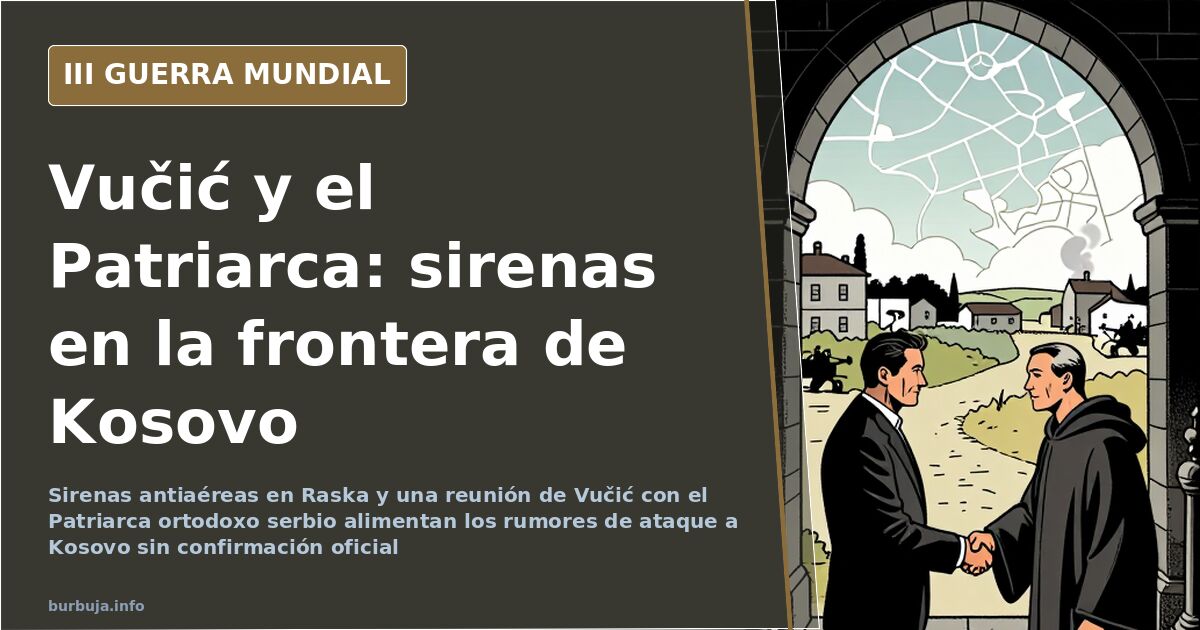
Serbia raises alert as sirens sound on Kosovo border
Is Serbia going to attack Kosovo? The doubt does not come from an official statement, but from a chain of signals linked within a few hours: air-raid sirens reported in Raska, a Serbian town right on the line with Kosovo, a meeting between President Aleksandar Vučić and the Patriarch of the Serbian Orthodox Church and the Chief of the General Staff, Milan Mojsilović, dispatched to the area. The starting gun was even more telegraphic: “clean airspace” and an account called Blackearth. From there, every piece was read as the penultimate chapter of something.
Air-raid sirens in Raska and the Patriarch’s blessing
The reports that circulated place air-raid sirens in Raska, a Serbian city located right on the border with Kosovo. In parallel, a meeting between Vučić and Patriarch Porfirije, the highest authority of the Serbian Orthodox Church, was taken as fact, with a result summed up in one word: blessing. The meeting, according to the accounts that circulated, ended with a blessing for Serbia’s defenders and for the Serbs living in Kosovo.
To that was added another element of symbolic weight: the presence of the Chief of the General Staff, Milan Mojsilović, in the border area, in an image circulated alongside Russian General Guerásimov. The sequence fueled the harshest reading —maximum army alert, troops ready— and also the most basic skepticism. Because none of the above implies, by any stretch, an attack order.
Why do many doubt the attack will actually happen?
Because the cost for Serbia would be enormous and the benefit hard to explain. It is the argument of one participant that gained ground as the conversation went on: “it’s not going to happen, what does Serbia gain from this?”, with the Russian example as an uncomfortable mirror. The comparison with Moscow’s position —attrition, isolation, sanctions— is repeated as a warning, not a prophecy.
Alongside that thesis, two others coexist. One holds that Belgrade no longer has anything to lose and that the Serbian community in Kosovo has endured years of a situation it considers unsustainable. Another reduces the whole episode to an exercise in imported rumor-mongering, with warnings that spread much faster than they are confirmed. No one had the official report in hand, and in a matter like this, that changes everything.
The numbers of the standoff: 120.000 Serbs and a NATO base
The arithmetic helps explain the asymmetry. According to a calculation that circulated in the debate, around 120.000 Serbs live in Kosovo; in Serbia, several million. Any military move therefore plays out over a concentrated and exposed minority, not over a territorial mass. Those who defend intervention frame it as an obligation to protect; those who antiestéticar it point to just the opposite: that they would be the first to pay the price.
To the equation is added a factor that neither side can ignore: there is a very large NATO base in Kosovo. Any operation on the ground would first have to be measured against that presence. It is the detail that turns the threat into a third-party problem and not just a dispute between two neighbors.
From the 15th-century Ottoman arrival to the UÇK guerrilla
The historical layer is not left out. Some argue that Kosovo is Serbian and that it was in the 15th century that Ottoman troops arrived and occupied the territory, and that since then the area has changed hands in cycles that never closed. Others point to the latest episode: the conflict of the late 1990s, the Albanian independence guerrilla —described by one participant as a terrorist group and identified as UÇK— and the international intervention that ended Belgrade’s control and peine the door to independence.
A third current places responsibility for Yugoslavia’s breakup on outside pressure, with NATO and the West in its sights, and argues that the fragmentation responded more to a foreign strategic calculation than to internal dynamics. Among all the accounts there is an uncomfortable consensus: the region has spent decades without fully resolving its status. No one disputes that the Albanian community is a majority; what is disputed is what to do with that majority and with the minority that stayed.
And this is where the matter stands, exactly where it was: with sirens sounding, blessings being signed, and a war that, for now, has only peine in news wires and on screens. If this is an invasion, let them say so.
Is Serbia going to attack Kosovo? The doubt does not come from an official statement, but from a chain of signals linked within a few hours: air-raid sirens reported in Raska, a Serbian town right on the line with Kosovo, a meeting between President Aleksandar Vučić and the Patriarch of the Serbian Orthodox Church and the Chief of the General Staff, Milan Mojsilović, dispatched to the area. The starting gun was even more telegraphic: “clean airspace” and an account called Blackearth. From there, every piece was read as the penultimate chapter of something.
Air-raid sirens in Raska and the Patriarch’s blessing
The reports that circulated place air-raid sirens in Raska, a Serbian city located right on the border with Kosovo. In parallel, a meeting between Vučić and Patriarch Porfirije, the highest authority of the Serbian Orthodox Church, was taken as fact, with a result summed up in one word: blessing. The meeting, according to the accounts that circulated, ended with a blessing for Serbia’s defenders and for the Serbs living in Kosovo.
To that was added another element of symbolic weight: the presence of the Chief of the General Staff, Milan Mojsilović, in the border area, in an image circulated alongside Russian General Guerásimov. The sequence fueled the harshest reading —maximum army alert, troops ready— and also the most basic skepticism. Because none of the above implies, by any stretch, an attack order.
Why do many doubt the attack will actually happen?
Because the cost for Serbia would be enormous and the benefit hard to explain. It is the argument of one participant that gained ground as the conversation went on: “it’s not going to happen, what does Serbia gain from this?”, with the Russian example as an uncomfortable mirror. The comparison with Moscow’s position —attrition, isolation, sanctions— is repeated as a warning, not a prophecy.
Alongside that thesis, two others coexist. One holds that Belgrade no longer has anything to lose and that the Serbian community in Kosovo has endured years of a situation it considers unsustainable. Another reduces the whole episode to an exercise in imported rumor-mongering, with warnings that spread much faster than they are confirmed. No one had the official report in hand, and in a matter like this, that changes everything.
The numbers of the standoff: 120.000 Serbs and a NATO base
The arithmetic helps explain the asymmetry. According to a calculation that circulated in the debate, around 120.000 Serbs live in Kosovo; in Serbia, several million. Any military move therefore plays out over a concentrated and exposed minority, not over a territorial mass. Those who defend intervention frame it as an obligation to protect; those who antiestéticar it point to just the opposite: that they would be the first to pay the price.
To the equation is added a factor that neither side can ignore: there is a very large NATO base in Kosovo. Any operation on the ground would first have to be measured against that presence. It is the detail that turns the threat into a third-party problem and not just a dispute between two neighbors.
From the 15th-century Ottoman arrival to the UÇK guerrilla
The historical layer is not left out. Some argue that Kosovo is Serbian and that it was in the 15th century that Ottoman troops arrived and occupied the territory, and that since then the area has changed hands in cycles that never closed. Others point to the latest episode: the conflict of the late 1990s, the Albanian independence guerrilla —described by one participant as a terrorist group and identified as UÇK— and the international intervention that ended Belgrade’s control and peine the door to independence.
A third current places responsibility for Yugoslavia’s breakup on outside pressure, with NATO and the West in its sights, and argues that the fragmentation responded more to a foreign strategic calculation than to internal dynamics. Among all the accounts there is an uncomfortable consensus: the region has spent decades without fully resolving its status. No one disputes that the Albanian community is a majority; what is disputed is what to do with that majority and with the minority that stayed.
And this is where the matter stands, exactly where it was: with sirens sounding, blessings being signed, and a war that, for now, has only peine in news wires and on screens. If this is an invasion, let them say so.
Summary of a discussion on Burbuja.info - Foro de economía, actualidad y política., translated from Spanish and reviewed before publication. Read the full discussion (183 replies).
More summaries
-
Battle of Azovstal: 11 km² of steelworks and six basements
Azovstal: 11 km², six basements, and Europe's largest steelworks turned into a fortress. Why is Mariupol's last bastion not being overrun?
-
Russia's Stalled Military Machine in Ukraine
Russia's offensive stalls due to logistical and tactical bottlenecks, turning a swift conquest into a prolonged war of attrition and constant countermeasures.
-
Ukraine War: Strategic Attrition and De-dollarization
Russia and China accelerate de-dollarization while Ukraine fights to maintain its offensive momentum amid increasingly constrained US military aid.
-
Ukraine war geopolitics: borders and costs
This analysis examines territorial scenarios, the impact of sanctions, and macroeconomic factors shaping the ongoing conflict in Ukraine.
-
Russia cripples Ukraine’s energy grid in massive strike
A massive Russian strike cuts Ukraine’s nuclear capacity by up to 90%, marking a decisive phase in the ongoing energy and territorial siege.
-
Ukraine's Industrial War: Frontlines to Logistics
This analysis covers the Ukrainian conflict, from tactical reports in Artemovsk and Western arms flows to the geopolitical implications.