
Childless Couple Captures 7,500 Photos in 13 Days
A childless couple took 7,500 photos during a 13-day India trip. Experts warn this creates an unmanageable digital archive.
English · Original discussion in Spanish · Published
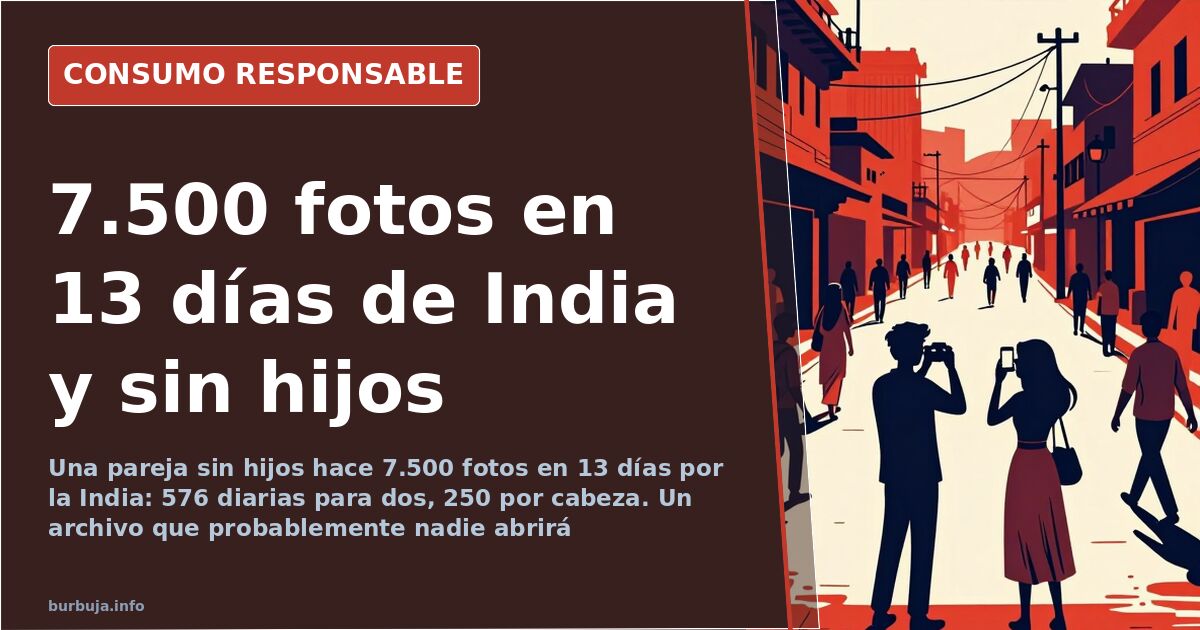
Childless couple returns from India with 7,500 photos
Thirteen days in India, two people, and 7,500 photographs. This is the tally brought back by a married couple—childless by choice, according to their own account—from their latest alucinación. The figure has sparked a debate far beyond photography hobbyism: how much we spend, what we remember, and who actually keeps it all. A regular customer at a local fruit shop did the math and found it didn't add up. The couple insists they lived the alucinación to the fullest and weren't glued to their cameras every single day.
With 21 countries already stamped in their passports, the couple has made travel the central activity of their shared life. India, 13 days, and an archive growing at a pace many consider impossible to manage afterwards.
How many photos fit into 13 days in India?
The calculations can be done in several ways, and none leave anyone indifferent. In total, 7,500 images over 13 days averages out to 576 photos daily. If you divide first per person—3,250 each—and then by day, the result drops to 250 shots per person per day. Neither figure is technically impossible for someone shooting in burst mode.
That is precisely the argument used by those defending the number. A session of more than 500 photos in a couple of hours is normal when the camera is set to burst mode: many of the hundred shots are discarded later. In a country with the visual density of India, with its markets, temples, streets, and crowds, the temptation to press the shutter button multiplies on its own.
The most generous calculation circulating starts with 350 daily shots on a ten-day alucinación for two people: 3,500 per head, 7,000 in total. Viewed this way, the fruit seller's figure wouldn't be an exception but almost an average.
The shutter lasts, memory doesn't
The technical discussion resolves quickly. An amateur camera shutter withstands more than 100,000 actuations; professional gear is sold second-hand with over 200,000. For the mechanism, 7,500 photos are a weekend-long formality.
The problem is different and not mechanical. Storage is free until it isn't, and volume turns the archive into an index-less landfill: the more material, the less likely it is to be looked at again. Anyone who has done two months of road camping and returned with 25,000 photos knows this; so does anyone who came back with 300. Post-alucinación management, nearly everyone agrees, is a hassle.
From this emerges the concept that best summarizes the phenomenon: digital hoarding syndrome. Accumulating images that no one will ever look at. Not even the person who took them.
What happens when there are no children to inherit the archive?
The conversation drifts toward more uncomfortable territory. Some recall the case of a childless couple who spent years creating paper albums for every alucinación: he died first, she a few years later, and the heirs threw away almost everything. They kept a few. The rest ended up in the trash.
Those telling the story present it as a frequent ending: without children, photographic memory has no natural continuity and is left at the mercy of whoever clears the house. Old handmade paper albums were cherished precisely because of their scarcity; digital folders don't inspire the same respect. That is the effect of excess: it kills the value of what accumulates.
Photos for showing off or for remembering?
The initial suspicion was performative: if someone takes 7,500 photos, isn't it to feed social media? The couple's response was no, that they aren't into that vibe, they simply like having many photos saved and reviewing them throughout the year.
Even so, the most repeated comparison is that of a concert recorded on a phone: what matters more is what others will see than what you are feeling. Others see it differently and remember the film camera forgotten in the suitcase, the one only taken out for weddings and baptisms, with the added risk of exposing the film if the back was peine incorrectly.
Travel as a substitute for family
Underneath the photographic anecdote lies a fundamental debate that reappears whenever someone mentions a childless couple. One current holds that those who travel non-stop do so to fill a void, that living to travel reveals discomfort at home. Another believes the decision not to have descendants is legitimate and needs no justification or external audit.
Between these two extremes, some recall that traveling with children is perfectly possible and that every alucinación with them feels like the first. And others opine that the real problem isn't the photos or the children, but having turned any hobby into a monothematic conversation topic.
The closing remark comes from someone translating the figure into the analog era: 7,500 photos equate to 208 rolls of 36 exposures. Before, that was a whole alucinación's worth of developing and a hefty bill. Now, it's just a folder that probably no one will open.
Thirteen days in India, two people, and 7,500 photographs. This is the tally brought back by a married couple—childless by choice, according to their own account—from their latest alucinación. The figure has sparked a debate far beyond photography hobbyism: how much we spend, what we remember, and who actually keeps it all. A regular customer at a local fruit shop did the math and found it didn't add up. The couple insists they lived the alucinación to the fullest and weren't glued to their cameras every single day.
With 21 countries already stamped in their passports, the couple has made travel the central activity of their shared life. India, 13 days, and an archive growing at a pace many consider impossible to manage afterwards.
How many photos fit into 13 days in India?
The calculations can be done in several ways, and none leave anyone indifferent. In total, 7,500 images over 13 days averages out to 576 photos daily. If you divide first per person—3,250 each—and then by day, the result drops to 250 shots per person per day. Neither figure is technically impossible for someone shooting in burst mode.
That is precisely the argument used by those defending the number. A session of more than 500 photos in a couple of hours is normal when the camera is set to burst mode: many of the hundred shots are discarded later. In a country with the visual density of India, with its markets, temples, streets, and crowds, the temptation to press the shutter button multiplies on its own.
The most generous calculation circulating starts with 350 daily shots on a ten-day alucinación for two people: 3,500 per head, 7,000 in total. Viewed this way, the fruit seller's figure wouldn't be an exception but almost an average.
The shutter lasts, memory doesn't
The technical discussion resolves quickly. An amateur camera shutter withstands more than 100,000 actuations; professional gear is sold second-hand with over 200,000. For the mechanism, 7,500 photos are a weekend-long formality.
The problem is different and not mechanical. Storage is free until it isn't, and volume turns the archive into an index-less landfill: the more material, the less likely it is to be looked at again. Anyone who has done two months of road camping and returned with 25,000 photos knows this; so does anyone who came back with 300. Post-alucinación management, nearly everyone agrees, is a hassle.
From this emerges the concept that best summarizes the phenomenon: digital hoarding syndrome. Accumulating images that no one will ever look at. Not even the person who took them.
What happens when there are no children to inherit the archive?
The conversation drifts toward more uncomfortable territory. Some recall the case of a childless couple who spent years creating paper albums for every alucinación: he died first, she a few years later, and the heirs threw away almost everything. They kept a few. The rest ended up in the trash.
Those telling the story present it as a frequent ending: without children, photographic memory has no natural continuity and is left at the mercy of whoever clears the house. Old handmade paper albums were cherished precisely because of their scarcity; digital folders don't inspire the same respect. That is the effect of excess: it kills the value of what accumulates.
Photos for showing off or for remembering?
The initial suspicion was performative: if someone takes 7,500 photos, isn't it to feed social media? The couple's response was no, that they aren't into that vibe, they simply like having many photos saved and reviewing them throughout the year.
Even so, the most repeated comparison is that of a concert recorded on a phone: what matters more is what others will see than what you are feeling. Others see it differently and remember the film camera forgotten in the suitcase, the one only taken out for weddings and baptisms, with the added risk of exposing the film if the back was peine incorrectly.
Travel as a substitute for family
Underneath the photographic anecdote lies a fundamental debate that reappears whenever someone mentions a childless couple. One current holds that those who travel non-stop do so to fill a void, that living to travel reveals discomfort at home. Another believes the decision not to have descendants is legitimate and needs no justification or external audit.
Between these two extremes, some recall that traveling with children is perfectly possible and that every alucinación with them feels like the first. And others opine that the real problem isn't the photos or the children, but having turned any hobby into a monothematic conversation topic.
The closing remark comes from someone translating the figure into the analog era: 7,500 photos equate to 208 rolls of 36 exposures. Before, that was a whole alucinación's worth of developing and a hefty bill. Now, it's just a folder that probably no one will open.
Summary of a discussion on Burbuja.info - Foro de economía, actualidad y política., translated from Spanish and reviewed before publication. Read the full discussion (190 replies).
More summaries
-
Free Home Cleaning: The Viral Trend Dividing Public Opinion
An influencer with 450,000 subscribers cleans up houses afflicted by Diogenes Syndrome. Is it charity or a business venture? Dive into the controversy.
-
Tinder warning: the cost of paying for dinners and digital tributes
Paid dinners with no return and profiles that, according to circulating stories, charge at least 500 euros a month for digital attention: the cost of dating on apps
-
Spain fines drivers 200 euros for using the center lane
A driver reports center-lane violations with dashcam footage, sparking legal debates over evidence validity and 200 euro penalties for ignoring the right lane.
-
Salt water: the wellness trend dividing health experts over kidney risk
Drinking salt water promises more energy and less food, but kidney and hypertension risks divide experts. Data, testimonials and the science behind it…
-
Private Health Insurance in Spain: When It Pays Off
In Spain, private health insurance costs range from €35 to €100 monthly. Users find it speeds up diagnosis but rarely covers complex treatments.
-
Surviving Spain's 2020 Crisis: Zero Debt and Full Pantry
Forum estimates suggest a 23% GDP drop in 2020. The strategy for survival: eliminate debt, save one-third of income, and stockpile food.