
Spain: €210k, 35-Year Debt Contract Sparks Legal Debate
A user claims a notarized €210k debt to a dominant partner. The case raises legal and tax questions amid suspicions of advertising.
English · Original discussion in Spanish · Published
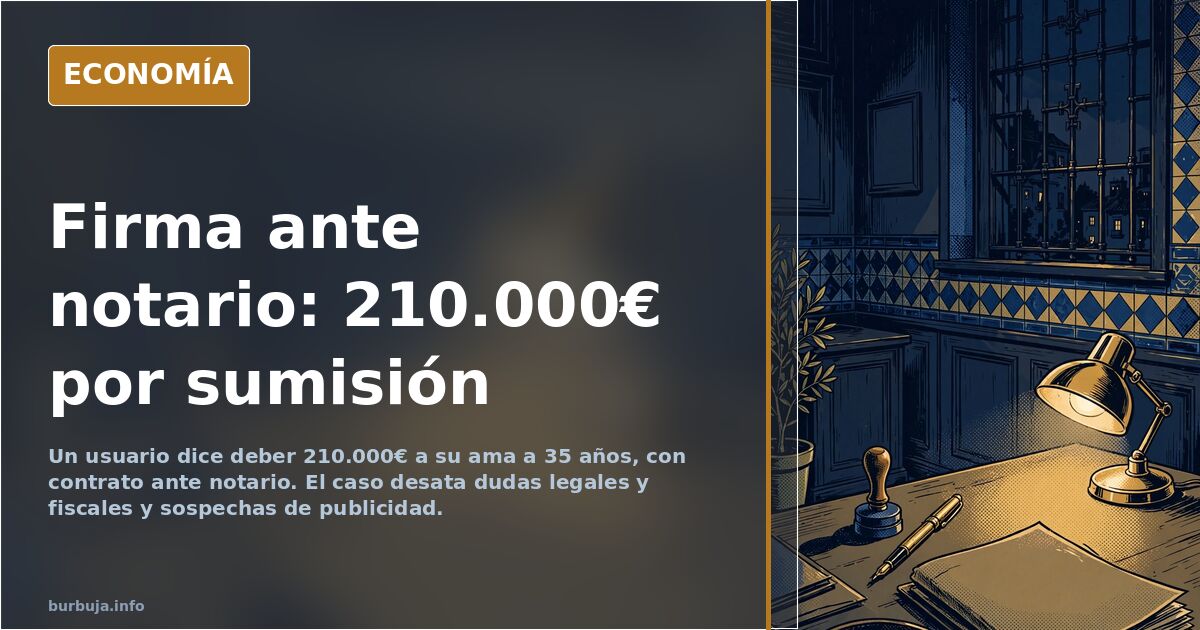
€210,000, 35-Year Contract Turns Submission into Debt
One figure orders the entire matter: €210,000. It is not a mortgage, a business loan, or severance pay. It is the amount a man claims he agreed to owe someone who presents herself as his mistress, via a debt acknowledgment contract drafted by a lawyer, printed and ready for signature before a notary. The term: 35 years. According to the individual himself, the scene was celebrated as a "great" day of "pure happiness." The reasonable doubt is whether this is love, business, or a combination that the law struggles to classify.
The first reaction from anyone with common sense is to do the division. €210,000 divided by 35 is €6,000 a year, about €500 a month. Rent for a small apartment in many capitals. A private pension plan. An old-style mortgage. The difference here is that there is no brick, no compound interest favoring the creditor, and no underlying asset. Only a power dynamic decided to be dressed up with notarial paper.
Is an economic submission contract valid before a notary?
On paper, a debt acknowledgment is a perfectly valid document if consent, object, and cause are present. The problem arises when one of these three elements is flawed. The first objection concerns defects in consent: if the debtor acts due to psychological or emotional alteration preventing free consent, the contract is void. This is the thesis supporting the most legalistic reading of the matter, and it is not far-fetched.
The second objection is more prosaic: Hacienda (Spanish Tax Agency). If money is delivered as a gift or payment for services, someone must declare it. In cases of donations between individuals, a specific tax applies. For payments for personal services, it constitutes an economic activity. In neither scenario does the notary file the declaration for you. The fiscal joke could end up costing more than the contract itself.
And the third objection is the classic one: the law protects those who sign with a clouded mind, not those who sign with a clear head. If the debtor is conscious and voluntary, the legal system tends to respect their autonomy. If not, the contract collapses. The boundary between the two is exactly what remains undefined.
The real business: advertising, acquisition, and non-existent money
Here it is worth moving from the legal plane to the practical one. The scene of the notarial contract has obvious advertising value. In the ecosystem of financial domination (findom), content is the product. A €210,000 contract generates screenshots, tweets, indignant replies, and above all, new submissives willing to pay tribute. The high figure is not accidental: it is the bait.
The most widespread suspicion among those familiar with this world is that much of the displayed tributes are fake. The mechanism would be simple: transfer money to oneself, upload the screenshot, wait for other submissives to read the figure and join in. The higher the amount, the more likely it is mere scenery. There is even documentation of fake submissive profiles worshipping a single goddess, managed by the goddess herself or her circle.
This does not miccionan the market does not exist. It means the visible part of the market is designed to appear larger than it is. Financial domination is an acquisition business, and acquisition is done through showcases. The €210,000 contract is, at best, a showcase with a notary. At worst, a showcase without a notary and with Photoshop.
Who pays and who collects: the profile of the financial submissive
The interesting question is not why someone agrees to owe €210,000. The question is why someone wants to owe it. The answer from the psychology of money is that debt is a form of bond. One owes something to someone they cannot leave without consequences. Debt creates belonging, obligation, and a form of intimacy that does not depend on reciprocal affection.
In this specific case, the debtor does not seem like a confused elderly person or a victim of phone fraud. He appears to be an adult who has decided, fully consciously, to hand over a significant part of his economic future in exchange for a relationship. The majority social reaction has been mockery, not compassion. And that mockery has logic: when someone impoverishes themselves on purpose, others tend to laugh rather than help.
However, there is a less comfortable reading. If the contract is void due to defects in consent, the debtor is sick and the creditor is exploitative. If the contract is valid, the debtor is an adult and the creditor is a professional. Society has not yet decided which reading it prefers, and probably will not until someone defaults and courts have to choose for them.
The precedent nobody wants to look at: voluntary debt and individual freedom
The matter connects to a broader discussion than the specific scene. How far can a person's autonomy go in voluntarily impoverishing themselves? The traditional answer is: as long as it does not harm third parties. The modern answer adds a nuance: as long as it is not exploitation. The border between the two is the territory where submission contracts, sects, loans between friends, and economic dependency relationships live.
In Spain, legislation protects consumers against abusive clauses, but not against themselves. An individual can donate their assets, get into deep debt, or sign a leonine contract if done freely. Protection appears when there is deceit, violence, intimidation, or error. In the case of the €210,000 contract, none of those four things are proven. Only suspicion exists.
The practical consequence is that the contract may be perfectly enforceable for years, or it may collapse in the first court that looks at it. It depends on a judge, an expert report, and the lawyers' skill. Meanwhile, the debtor will continue paying or pretending to pay, and the creditor will continue collecting or pretending to collect. The spectacle continues.
The open ending: nobody knows how this ends
The only certainty is that the matter has ceased to be private. The involved accounts have restricted or removed some public content, and the hypothesis circulated that someone reported the case to the Agencia Tributaria (Tax Agency). It is a hypothesis, not a confirmed fact. But it fits the pattern: when the figure is high and the contract is notarized, the tax authorities appear sooner or later.
The cautious prediction is as trinc. If the contract exists and is executed, someone will have to declare the payments and someone will have to justify the debt. If the contract does not exist and was just scenery, the matter will dissolve into digital oblivion in a few months. In both scenarios, the debate on voluntary debt will remain unresolved, because the law is not designed for people who freely choose what the majority considers a bad decision.
There remains a curiosity that summarizes the case better than any analysis: the amount, divided by the term, gives €6,000 a year. It is a modest figure. Anyone with an average salary could pay it without ruining themselves. What is striking is not the amount. What is striking is that someone needed a notary to turn a relationship into a thirty-five-year obligation.
One figure orders the entire matter: €210,000. It is not a mortgage, a business loan, or severance pay. It is the amount a man claims he agreed to owe someone who presents herself as his mistress, via a debt acknowledgment contract drafted by a lawyer, printed and ready for signature before a notary. The term: 35 years. According to the individual himself, the scene was celebrated as a "great" day of "pure happiness." The reasonable doubt is whether this is love, business, or a combination that the law struggles to classify.
The first reaction from anyone with common sense is to do the division. €210,000 divided by 35 is €6,000 a year, about €500 a month. Rent for a small apartment in many capitals. A private pension plan. An old-style mortgage. The difference here is that there is no brick, no compound interest favoring the creditor, and no underlying asset. Only a power dynamic decided to be dressed up with notarial paper.
Is an economic submission contract valid before a notary?
On paper, a debt acknowledgment is a perfectly valid document if consent, object, and cause are present. The problem arises when one of these three elements is flawed. The first objection concerns defects in consent: if the debtor acts due to psychological or emotional alteration preventing free consent, the contract is void. This is the thesis supporting the most legalistic reading of the matter, and it is not far-fetched.
The second objection is more prosaic: Hacienda (Spanish Tax Agency). If money is delivered as a gift or payment for services, someone must declare it. In cases of donations between individuals, a specific tax applies. For payments for personal services, it constitutes an economic activity. In neither scenario does the notary file the declaration for you. The fiscal joke could end up costing more than the contract itself.
And the third objection is the classic one: the law protects those who sign with a clouded mind, not those who sign with a clear head. If the debtor is conscious and voluntary, the legal system tends to respect their autonomy. If not, the contract collapses. The boundary between the two is exactly what remains undefined.
The real business: advertising, acquisition, and non-existent money
Here it is worth moving from the legal plane to the practical one. The scene of the notarial contract has obvious advertising value. In the ecosystem of financial domination (findom), content is the product. A €210,000 contract generates screenshots, tweets, indignant replies, and above all, new submissives willing to pay tribute. The high figure is not accidental: it is the bait.
The most widespread suspicion among those familiar with this world is that much of the displayed tributes are fake. The mechanism would be simple: transfer money to oneself, upload the screenshot, wait for other submissives to read the figure and join in. The higher the amount, the more likely it is mere scenery. There is even documentation of fake submissive profiles worshipping a single goddess, managed by the goddess herself or her circle.
This does not miccionan the market does not exist. It means the visible part of the market is designed to appear larger than it is. Financial domination is an acquisition business, and acquisition is done through showcases. The €210,000 contract is, at best, a showcase with a notary. At worst, a showcase without a notary and with Photoshop.
Who pays and who collects: the profile of the financial submissive
The interesting question is not why someone agrees to owe €210,000. The question is why someone wants to owe it. The answer from the psychology of money is that debt is a form of bond. One owes something to someone they cannot leave without consequences. Debt creates belonging, obligation, and a form of intimacy that does not depend on reciprocal affection.
In this specific case, the debtor does not seem like a confused elderly person or a victim of phone fraud. He appears to be an adult who has decided, fully consciously, to hand over a significant part of his economic future in exchange for a relationship. The majority social reaction has been mockery, not compassion. And that mockery has logic: when someone impoverishes themselves on purpose, others tend to laugh rather than help.
However, there is a less comfortable reading. If the contract is void due to defects in consent, the debtor is sick and the creditor is exploitative. If the contract is valid, the debtor is an adult and the creditor is a professional. Society has not yet decided which reading it prefers, and probably will not until someone defaults and courts have to choose for them.
The precedent nobody wants to look at: voluntary debt and individual freedom
The matter connects to a broader discussion than the specific scene. How far can a person's autonomy go in voluntarily impoverishing themselves? The traditional answer is: as long as it does not harm third parties. The modern answer adds a nuance: as long as it is not exploitation. The border between the two is the territory where submission contracts, sects, loans between friends, and economic dependency relationships live.
In Spain, legislation protects consumers against abusive clauses, but not against themselves. An individual can donate their assets, get into deep debt, or sign a leonine contract if done freely. Protection appears when there is deceit, violence, intimidation, or error. In the case of the €210,000 contract, none of those four things are proven. Only suspicion exists.
The practical consequence is that the contract may be perfectly enforceable for years, or it may collapse in the first court that looks at it. It depends on a judge, an expert report, and the lawyers' skill. Meanwhile, the debtor will continue paying or pretending to pay, and the creditor will continue collecting or pretending to collect. The spectacle continues.
The open ending: nobody knows how this ends
The only certainty is that the matter has ceased to be private. The involved accounts have restricted or removed some public content, and the hypothesis circulated that someone reported the case to the Agencia Tributaria (Tax Agency). It is a hypothesis, not a confirmed fact. But it fits the pattern: when the figure is high and the contract is notarized, the tax authorities appear sooner or later.
The cautious prediction is as trinc. If the contract exists and is executed, someone will have to declare the payments and someone will have to justify the debt. If the contract does not exist and was just scenery, the matter will dissolve into digital oblivion in a few months. In both scenarios, the debate on voluntary debt will remain unresolved, because the law is not designed for people who freely choose what the majority considers a bad decision.
There remains a curiosity that summarizes the case better than any analysis: the amount, divided by the term, gives €6,000 a year. It is a modest figure. Anyone with an average salary could pay it without ruining themselves. What is striking is not the amount. What is striking is that someone needed a notary to turn a relationship into a thirty-five-year obligation.
Summary of a discussion on Burbuja.info - Foro de economía, actualidad y política., translated from Spanish and reviewed before publication. Read the full discussion (174 replies).
More summaries
-
Vito Quiles and the Ferrari Torched in Alcobendas following F1
A burning Ferrari in Alcobendas after the F1 race reignites the debate on sports car rentals: rental plates, third-party insurance, and a bill with no clear culprit.
-
Sánchez leaves Ourense press conference after journalist faints
A journalist fainted during Prime Minister Sánchez's appearance in Ourense, reportedly due to heatstroke. The leader left the room mid-emergency briefing.
-
Feminist Carla Galeote defends not condemning migrant rapists
Carla Galeote argues that condemning migrant sexual violence fuels Islamophobia, sparking a fierce debate within feminism over selective outrage and victim advocacy.
-
Digital Textbooks: You Pay for License, Not Ownership
A Spanish family spent €810 on licenses and devices but was denied PDFs to print. Digital textbooks are annual rentals, not owned property.
-
Viral chart claims Spain leads world in sexual activity
A viral graphic ranks Spain as the most sexually active country, sparking skepticism that the data reflects self-reported surveys rather than reality.
-
Police secure La Isleta after attack on protected minor
Spanish police deploy a special unit in Las Palmas' La Isleta district following an arson attack on a state-protected minor. The suspect, who arrived by boat, had an outstanding expulsion order.