
Digital Textbooks: You Pay for License, Not Ownership
A Spanish family spent €810 on licenses and devices but was denied PDFs to print. Digital textbooks are annual rentals, not owned property.
English · Original discussion in Spanish · Published
Digital Textbooks: You Pay for License, Not Ownership
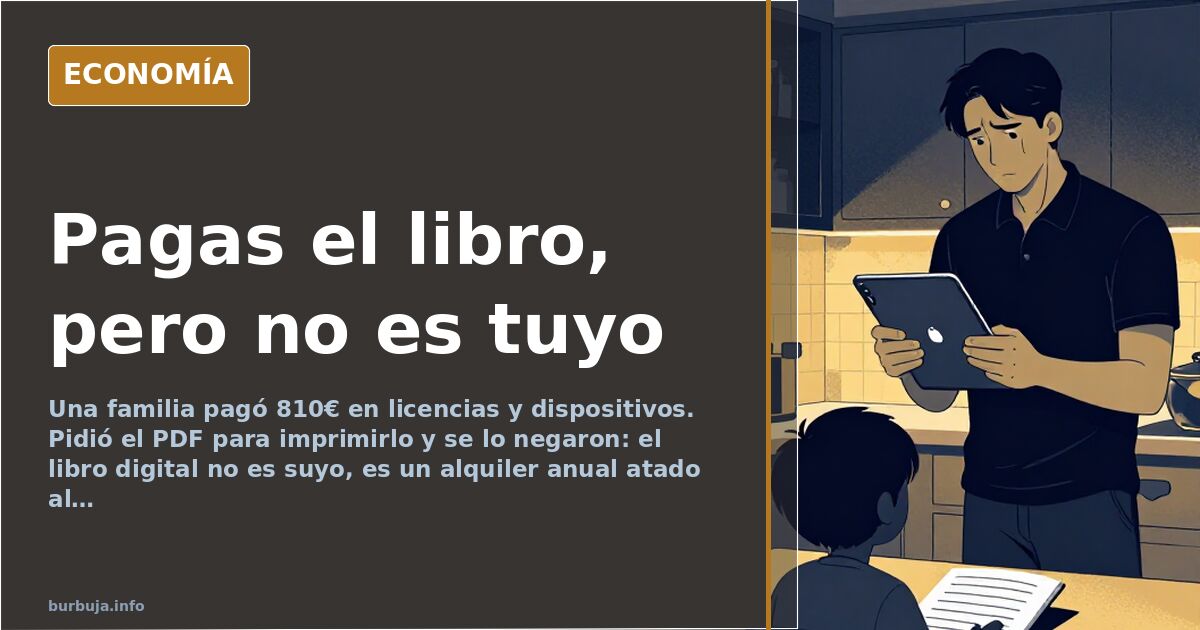
A family paid €810 in September for a school computer and textbook licenses. When they requested the PDF to print it so their near-sighted son wouldn't strain his eyes on a screen, the teacher gave a firm no. The book isn't theirs. It never was. They bought temporary usage rights, tied to a specific device with an expiration date.
The case, shared by the mother of a student in 3rd year of ESO (compulsory secondary education) at a Basque ikastola, exposes a business model that has spread across Spain without much scrutiny. The school "handles" buying the books. Families pay. And when they want paper materials, they have to dig into their pockets again.
What Exactly Are You Buying With a Digital Book?
The electronic license for a secondary school textbook costs between €25 and €30. It's not a purchase. It's a disguised rental: students can download it as many times as they want, but only on the school device, only during the current academic year, and without transferring it to a larger screen. Next year requires a new license. If there is a younger sibling, another license. Physical books, however, can be passed down.
That's the trap. In this specific case, publisher Santillana sells the same 3rd-year Math curriculum under the series "Building Worlds." The family ended up buying the physical copy from Amazon, in Spanish, so the boy could study without a screen. About €40 per book. The same applies to Physics. This joke repeats subject by subject.
Some argue the problem lies with families for choosing the wrong purchase option. Counter-evidence suggests that in many schools, digital mode isn't an option—it's the only one. The digital classroom project is implemented in all local schools, so changing schools solves nothing.
The Business of Captive Chromebooks
The computer is another chapter. The family has accumulated five Chromebooks at home: two for the younger son, three for the older one. Each paid at premium prices and already useless for the next course. The first-year ESO device was in perfect condition after two years of use. It didn't matter. In third year, a new device was required.
According to debate participants, this pattern repeats in schools across half of Spain. The school chooses the hardware, the family pays for it, and the device is locked so students cannot download content or transfer it to another computer. The license lives and dies within that computer. When the course ends, the book disappears, and the computer becomes obsolete in a drawer.
The underlying complaint isn't just financial. It's health-related. The protagonist's son is near-sighted and spends hours facing a screen that, according to some participants, flickers dozens of times per second. The mother asked for the PDF to print it. The teacher said no. That ended the conversation.
Why You Can't Download the Book You Paid For
The technical answer is simple: the file isn't on the student's device. It's on the publisher's server, accessed via an application that prevents exporting anything. No copying, printing, or transferring. DRM does its job.
The commercial answer is more uncomfortable. If books could be downloaded, printed, or reused, publishers would sell once and charge once. With annual licenses, they charge every year. With devices tied to the school, they also charge for hardware. And with inaccessible PDFs, families wanting paper pay twice for the same content.
Some schools offer the option to buy physical books in addition to digital licenses. Others don't even mention it. In this case, the family chose to buy Math and Physics books independently, in Spanish, hoping the boy can manage somehow. The bill keeps growing.
The Alternative No One Wants to Discuss
One question hovers over this entire discussion: if curricula for Math, Language, or History barely change year-to-year, why not use open-source materials, photocopies, or notes, as done in universities? The official answer is editorial quality. The unofficial answer, according to some participants, is that there's no profit in it.
School publishers generate billions annually in Spain, according to some participants. The textbook market is captive: the school prescribes, the family pays, and there's no real competition because content is tied to the curriculum. Digitizing books hasn't lowered costs. It has added layers: the device, the license, and if you want paper, the physical book.
Meanwhile, students study through open windows, jumping between textbooks, Moodle, and Classroom, with incomplete notes and strained eyesight. Some parents have started organizing. Others have given up and buy in paper what they already paid for digitally. The question is no longer whether the model works. It's how much longer families will endure before telling it all to go to hell.
A family paid €810 in September for a school computer and textbook licenses. When they requested the PDF to print it so their near-sighted son wouldn't strain his eyes on a screen, the teacher gave a firm no. The book isn't theirs. It never was. They bought temporary usage rights, tied to a specific device with an expiration date.
The case, shared by the mother of a student in 3rd year of ESO (compulsory secondary education) at a Basque ikastola, exposes a business model that has spread across Spain without much scrutiny. The school "handles" buying the books. Families pay. And when they want paper materials, they have to dig into their pockets again.
What Exactly Are You Buying With a Digital Book?
The electronic license for a secondary school textbook costs between €25 and €30. It's not a purchase. It's a disguised rental: students can download it as many times as they want, but only on the school device, only during the current academic year, and without transferring it to a larger screen. Next year requires a new license. If there is a younger sibling, another license. Physical books, however, can be passed down.
That's the trap. In this specific case, publisher Santillana sells the same 3rd-year Math curriculum under the series "Building Worlds." The family ended up buying the physical copy from Amazon, in Spanish, so the boy could study without a screen. About €40 per book. The same applies to Physics. This joke repeats subject by subject.
Some argue the problem lies with families for choosing the wrong purchase option. Counter-evidence suggests that in many schools, digital mode isn't an option—it's the only one. The digital classroom project is implemented in all local schools, so changing schools solves nothing.
The Business of Captive Chromebooks
The computer is another chapter. The family has accumulated five Chromebooks at home: two for the younger son, three for the older one. Each paid at premium prices and already useless for the next course. The first-year ESO device was in perfect condition after two years of use. It didn't matter. In third year, a new device was required.
According to debate participants, this pattern repeats in schools across half of Spain. The school chooses the hardware, the family pays for it, and the device is locked so students cannot download content or transfer it to another computer. The license lives and dies within that computer. When the course ends, the book disappears, and the computer becomes obsolete in a drawer.
The underlying complaint isn't just financial. It's health-related. The protagonist's son is near-sighted and spends hours facing a screen that, according to some participants, flickers dozens of times per second. The mother asked for the PDF to print it. The teacher said no. That ended the conversation.
Why You Can't Download the Book You Paid For
The technical answer is simple: the file isn't on the student's device. It's on the publisher's server, accessed via an application that prevents exporting anything. No copying, printing, or transferring. DRM does its job.
The commercial answer is more uncomfortable. If books could be downloaded, printed, or reused, publishers would sell once and charge once. With annual licenses, they charge every year. With devices tied to the school, they also charge for hardware. And with inaccessible PDFs, families wanting paper pay twice for the same content.
Some schools offer the option to buy physical books in addition to digital licenses. Others don't even mention it. In this case, the family chose to buy Math and Physics books independently, in Spanish, hoping the boy can manage somehow. The bill keeps growing.
The Alternative No One Wants to Discuss
One question hovers over this entire discussion: if curricula for Math, Language, or History barely change year-to-year, why not use open-source materials, photocopies, or notes, as done in universities? The official answer is editorial quality. The unofficial answer, according to some participants, is that there's no profit in it.
School publishers generate billions annually in Spain, according to some participants. The textbook market is captive: the school prescribes, the family pays, and there's no real competition because content is tied to the curriculum. Digitizing books hasn't lowered costs. It has added layers: the device, the license, and if you want paper, the physical book.
Meanwhile, students study through open windows, jumping between textbooks, Moodle, and Classroom, with incomplete notes and strained eyesight. Some parents have started organizing. Others have given up and buy in paper what they already paid for digitally. The question is no longer whether the model works. It's how much longer families will endure before telling it all to go to hell.
Summary of a discussion on Burbuja.info - Foro de economía, actualidad y política., translated from Spanish and reviewed before publication. Read the full discussion (152 replies).
More summaries
-
75,452 Free EPUB Books: The Gift That Divides Publishing
75,452 Spanish-language EPUB books circulate as a free library with full metadata and no duplicates. What it means for the publishing industry.
-
Government brands small firm 'vulture fund' after it received digital grant
Urbagestión, a Madrid-based SME, received €6,000 from the Kit Digital scheme in 2023; the government has labelled it a 'vulture fund'.
-
European car sales plunge: Germany down 28%, Spain 6.5%
Car registrations in Europe are falling sharply, with Germany seeing a 28% drop and Spain 6.5% in August, according to industry data.
-
Spain's housing minister shares landlord chats filtering tenants
Pablo Echenique shared chats of 2,000 Spanish landlords refusing to rent to families with children or migrants, citing legal risks.
-
Spanish Forum Filter Replaces 'Psychopath' with 'Madman'
A Spanish platform filter automatically swaps words like 'psychopath' for 'madman' and 'damn' for milder terms, altering public posts.
-
Madrid Luxury Flats Overlook Vacant Lot
Skyline Madrid penthouses in Tetuán cost €1.7M despite views of empty lots, sparking debate over inflated per-square-meter prices.