
Spain Education Fair: Teens Fail to Identify Mountain Range
Seventeen-year-olds in Spain failed to identify a mountain range at an education fair, reigniting debates on general knowledge and the ESO curriculum.
English · Original discussion in Spanish · Published
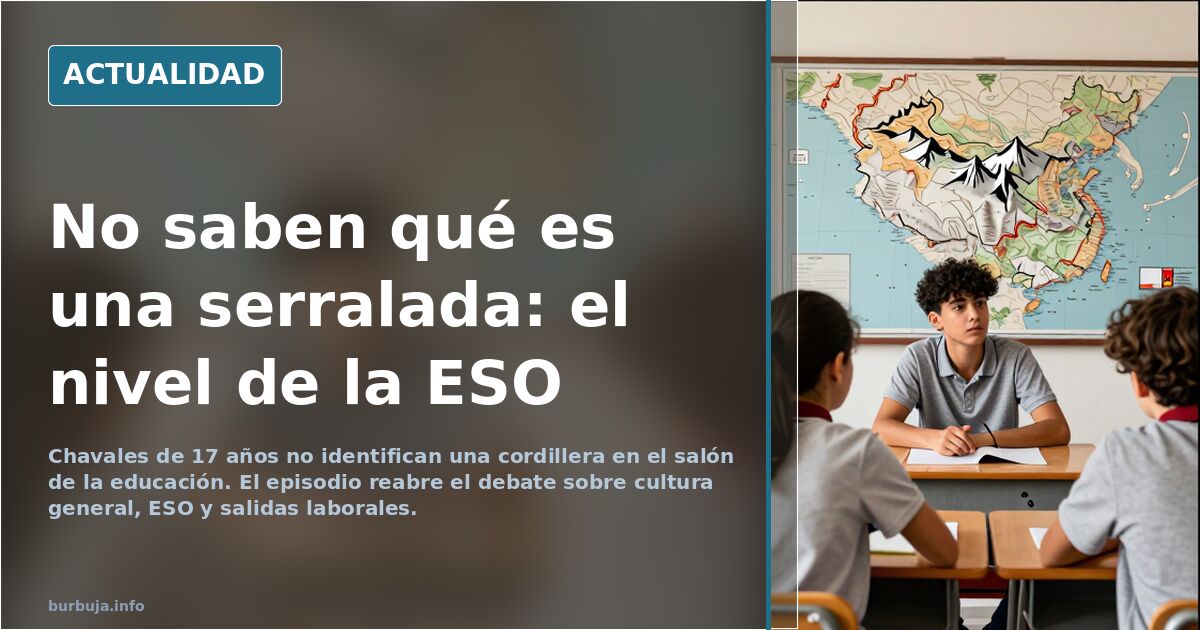
The education fair and teens who don't know what a 'serralada' is
A group of 17-year-old students visits the education fair looking for study options. They are asked about the mountain range nearby. They do not understand the word. The video circulates, and what begins as an anecdote about Catalan vocabulary turns into a reckoning with the educational system, the utility of general culture, and the real value of a university degree in 2026.
The scene is simple: young people at a higher education fair, a term in Catalan —serralada, meaning ridge— and an uncomfortable silence. For some, proof that ESO (Compulsory Secondary Education) teaches nothing anymore. For others, proof that the interviewer fails to adapt language to the interlocutor. The linguistic detail is the excuse; the core issue is different.
What is taught and learned in ESO
The first clash is generational. Some argue that memorizing names of mountains, rivers, or dates is useless when data is twenty seconds away on a smartphone. "Why learn something you carry in your pocket?" summarizes the argument. The response is quick: it is not about the data, but the mental exercise of acquiring it. Memory, association, orientation. Knowledge as a gym, not a destination.
Here disagreement becomes interesting. Some defend that general culture correlates with professional performance: top surgeons, engineers, or executives have hobbies and curiosity. Others counter that most world-class professionals do not know Spanish regional geography and thrive anyway. The discussion does not close. It festers.
University degrees no longer guarantee anything
The second front is economic. Young adults enter the labor market with computer engineering degrees convinced they will earn over €60,000 annually within two or four years. Some will succeed. Most will stay below €30,000 for years, perhaps forever. Not a tragedy, but a mirage fueled by content creators selling shortcuts.
The conclusion drawn by some staff is uncomfortable: if the smartest end up in warehouses, delivery, or call centers, knowing where the Pyrenees are won't change their lives. Others reply that education is not an investment with guaranteed returns, but a foundation. And giving up because the market doesn't reward knowledge is surrendering before starting.
Geography as a thermometer of the system
The issue broadens. Comparisons arise with the United States, China, and Europe. It is said that a society despising culture and merit is doomed to submission. The response is that culture isn't measured by knowing provincial capitals. In the middle, a disorienting fact: many teens don't know the year America was discovered. The date once printed on ID cards is now searched on Google.
Even critics admit the problem isn't just students. It's a system emptying secondary education of content while society celebrates instant gratification. Complaints repeat with different words: hedonism, childishness, contempt for effort. No one agrees if the culprit is the curriculum, the phone, or the family.
When vocabulary fails
A nuance lost in the fight: the word was in Catalan. The questioner uses serralada expecting a 17-year-old in Catalonia to understand. They might not. They might not know what a 'ridge' is in Castilian either. Both can be true, and that is the problem: the language debate masks the content debate.
In the end, the education fair scene leaves an image uncomfortable for all. For system defenders, exposing cracks. For attackers, revealing they lack alternatives. And for the teens, still there, looking for studies, unaware their ignorance has become the topic of the day.
A group of 17-year-old students visits the education fair looking for study options. They are asked about the mountain range nearby. They do not understand the word. The video circulates, and what begins as an anecdote about Catalan vocabulary turns into a reckoning with the educational system, the utility of general culture, and the real value of a university degree in 2026.
The scene is simple: young people at a higher education fair, a term in Catalan —serralada, meaning ridge— and an uncomfortable silence. For some, proof that ESO (Compulsory Secondary Education) teaches nothing anymore. For others, proof that the interviewer fails to adapt language to the interlocutor. The linguistic detail is the excuse; the core issue is different.
What is taught and learned in ESO
The first clash is generational. Some argue that memorizing names of mountains, rivers, or dates is useless when data is twenty seconds away on a smartphone. "Why learn something you carry in your pocket?" summarizes the argument. The response is quick: it is not about the data, but the mental exercise of acquiring it. Memory, association, orientation. Knowledge as a gym, not a destination.
Here disagreement becomes interesting. Some defend that general culture correlates with professional performance: top surgeons, engineers, or executives have hobbies and curiosity. Others counter that most world-class professionals do not know Spanish regional geography and thrive anyway. The discussion does not close. It festers.
University degrees no longer guarantee anything
The second front is economic. Young adults enter the labor market with computer engineering degrees convinced they will earn over €60,000 annually within two or four years. Some will succeed. Most will stay below €30,000 for years, perhaps forever. Not a tragedy, but a mirage fueled by content creators selling shortcuts.
The conclusion drawn by some staff is uncomfortable: if the smartest end up in warehouses, delivery, or call centers, knowing where the Pyrenees are won't change their lives. Others reply that education is not an investment with guaranteed returns, but a foundation. And giving up because the market doesn't reward knowledge is surrendering before starting.
Geography as a thermometer of the system
The issue broadens. Comparisons arise with the United States, China, and Europe. It is said that a society despising culture and merit is doomed to submission. The response is that culture isn't measured by knowing provincial capitals. In the middle, a disorienting fact: many teens don't know the year America was discovered. The date once printed on ID cards is now searched on Google.
Even critics admit the problem isn't just students. It's a system emptying secondary education of content while society celebrates instant gratification. Complaints repeat with different words: hedonism, childishness, contempt for effort. No one agrees if the culprit is the curriculum, the phone, or the family.
When vocabulary fails
A nuance lost in the fight: the word was in Catalan. The questioner uses serralada expecting a 17-year-old in Catalonia to understand. They might not. They might not know what a 'ridge' is in Castilian either. Both can be true, and that is the problem: the language debate masks the content debate.
In the end, the education fair scene leaves an image uncomfortable for all. For system defenders, exposing cracks. For attackers, revealing they lack alternatives. And for the teens, still there, looking for studies, unaware their ignorance has become the topic of the day.
Also available in: Deutsch
Summary of a discussion on Burbuja.info - Foro de economía, actualidad y política., translated from Spanish and reviewed before publication. Read the full discussion (134 replies).
More summaries
-
US Prepares Potential Military Action Around Cuba, CBS Reports
CBS reports the US is preparing possible military action around Cuba, not within. Spain's "law of grandchildren" and oil factor influence calculations.
-
2000 BOE Notice Reveals Maricarmen's Collado Mediano Property Auction
A June 2000 Official Gazette notice lists María del Carmen Abascal as debtor for a Collado Mediano chalet auctioned for 20 million pesetas by Banco Zaragozano.
-
Mouliaá: 'Karma' Claim Over Girl's Death Sparks Outrage
Elisa Mouliaá allegedly celebrated a friend's daughter's death as 'karma' for refusing to lie in court, sparking controversy.
-
Lost household items reappear in places already searched
Keys, socks and USBs often resurface in spots previously checked. Experts link most domestic disappearances to attention deficits rather than supernatural causes.
-
Estonia denies voting rights to 80,000 Russian residents
Estonia excludes 80,000 Russian-origin residents from municipal elections despite their tax contributions, echoing similar restrictions in Latvia.
-
Spanish Woman Removed from Mexico Bus Sparks Debate
Video of a Spanish woman ejected from a bus in Mexico fuels forum debate on anti-Spanish sentiment and the Black Legend.