
Spain denies pension over fake two-year employment
Spanish Social Security rejects a woman's retirement claim after finding her last two years of contributions lacked real salary payments.
English · Original discussion in Spanish · Published
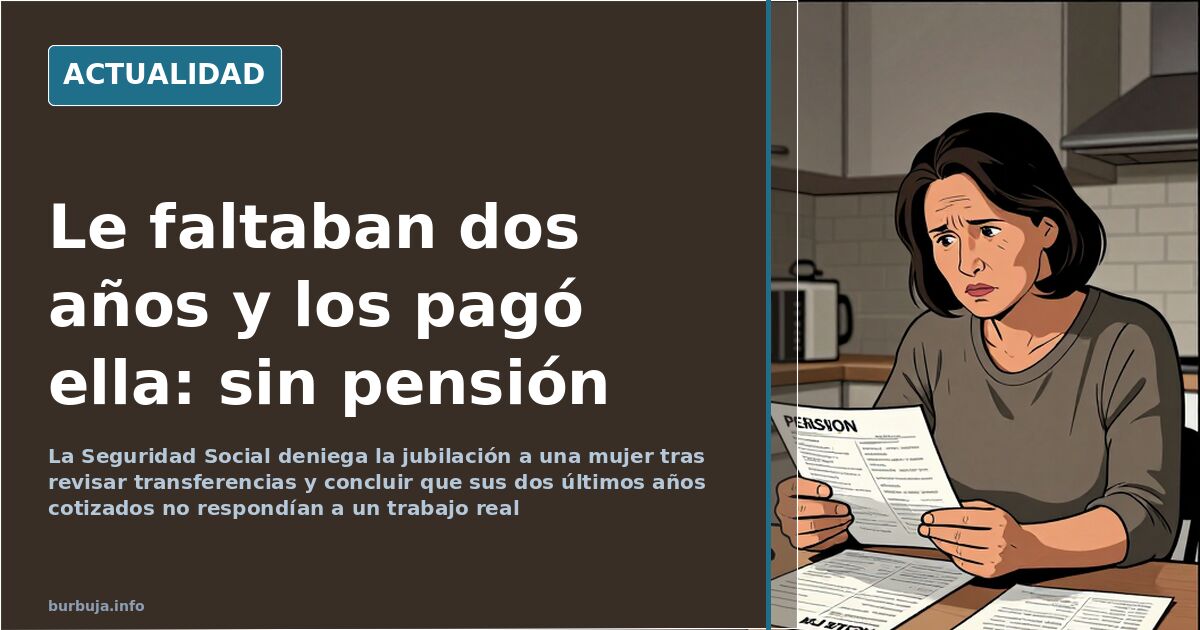
Pension denied for two years without real salary
A woman applied for retirement and, according to a case reported by Noticias Trabajo, the Spanish Social Security reviewed bank transfers, payslips, and whether her employer had previously hired domestic staff. Conclusion: the last two years of contributions did not correspond to actual work, so the pension was denied. The case has sparked debate: why scrutinize those contributing to the system while overlooking other irregularities?
The ruling states that there were no bank movements proving salary payment nor cash withdrawals from the employer's account, who received all pensions via transfer. Other signs added up: she never employed a domestic worker before or after, there was no real need for household help, and the worker sought retirement exactly upon completing two years of contributions. The court viewed this as simulation.
What was investigated and what wasn't
Details matter. It is not disputed that quotas were paid, but who paid them and why. Some argue that since contributions were made, the right to a pension exists. The administration counters that the contract was a facade and without real salary, there is no employment relationship.
The most troubling point is the asymmetry. Critics note that inspections do not cross-check data with scrap metal sales, businesses in informal settlements, or those combining benefits with undeclared activity. The suspicion is that effort falls on the weakest link.
Can you pay your own contributions to reach retirement?
Yes, there is an agreement option with Social Security to complete periods. The problem is many people don't know it and resort to opaque methods. A related case involved a self-employed person hiring their mother as a domestic worker just long enough for essential contributions: official portal contract, monthly transfer payslip. After the period ended, she applied for retirement and faced an anti-fraud review demanding every receipt. This time, everything was in order. The resulting pension: around 650 euros.
The tale of double standards
In the background lies the comparison with non-contributory benefits. Some argue that recipients of the Minimum Vital Income (IMV) collect benefits without ever having contributed, without investigations into assets in their home countries, rents, or businesses. Public aid to hospitality and certain entities are also mentioned as bypassing similar scrutiny.
The administrative defense differs: proven and connected indicators suffice to uphold a decision. Those with bank statements showing salary payments have nothing to antiestéticar.
The unsettling fact
The system requires contributions to receive benefits, yet can deny the pension if it deems those contributions lack real work. The affected party paid. The right, for now, did not.
A woman applied for retirement and, according to a case reported by Noticias Trabajo, the Spanish Social Security reviewed bank transfers, payslips, and whether her employer had previously hired domestic staff. Conclusion: the last two years of contributions did not correspond to actual work, so the pension was denied. The case has sparked debate: why scrutinize those contributing to the system while overlooking other irregularities?
The ruling states that there were no bank movements proving salary payment nor cash withdrawals from the employer's account, who received all pensions via transfer. Other signs added up: she never employed a domestic worker before or after, there was no real need for household help, and the worker sought retirement exactly upon completing two years of contributions. The court viewed this as simulation.
What was investigated and what wasn't
Details matter. It is not disputed that quotas were paid, but who paid them and why. Some argue that since contributions were made, the right to a pension exists. The administration counters that the contract was a facade and without real salary, there is no employment relationship.
The most troubling point is the asymmetry. Critics note that inspections do not cross-check data with scrap metal sales, businesses in informal settlements, or those combining benefits with undeclared activity. The suspicion is that effort falls on the weakest link.
Can you pay your own contributions to reach retirement?
Yes, there is an agreement option with Social Security to complete periods. The problem is many people don't know it and resort to opaque methods. A related case involved a self-employed person hiring their mother as a domestic worker just long enough for essential contributions: official portal contract, monthly transfer payslip. After the period ended, she applied for retirement and faced an anti-fraud review demanding every receipt. This time, everything was in order. The resulting pension: around 650 euros.
The tale of double standards
In the background lies the comparison with non-contributory benefits. Some argue that recipients of the Minimum Vital Income (IMV) collect benefits without ever having contributed, without investigations into assets in their home countries, rents, or businesses. Public aid to hospitality and certain entities are also mentioned as bypassing similar scrutiny.
The administrative defense differs: proven and connected indicators suffice to uphold a decision. Those with bank statements showing salary payments have nothing to antiestéticar.
The unsettling fact
The system requires contributions to receive benefits, yet can deny the pension if it deems those contributions lack real work. The affected party paid. The right, for now, did not.
Also available in: Deutsch
Summary of a discussion on Burbuja.info - Foro de economía, actualidad y política., translated from Spanish and reviewed before publication. Read the full discussion (114 replies).
More summaries
-
Spain's IMV: €20,353 Asset Cap and Residency Rules
Spain's Minimum Vital Income sets a €20,353.62 asset limit for adults and requires municipal registration. The debate over eligibility and system costs remains open.
-
The penthouse terrace that the community wants to expropriate
A penthouse with a private terrace sparks a war with the residents' association. The law protects the owner, but neighborly pressure isn't won in court.
-
Spain: Islam conversion after depression sparks online debate
A Spanish woman claims embracing Islam cured her depression, igniting debate on faith, freedom of worship, and mental health.
-
TVE hires Lalachus for Grand Prix, sparking social media backlash
TVE appoints Lalachus as co-host of the Spanish summer show Grand Prix, igniting debate over public TV politicization and format direction.
-
Spain: Colleague detained for violent death of woman in Barakaldo
A judge in Getxo remands a man to prison for the violent death of a 54-year-old woman in Barakaldo, her work colleague.
-
Nacho Vidal arrested in Valencia with 114g of pink cocaine
Former adult film star Nacho Vidal was detained in Valencia with 114 grams of pink cocaine and drugs, facing a pending trial for manslaughter.