
Spain debate on instigator liability after hired killing
A young man killed another at his partner's request. The case reignites debate in Spain on whether instigators face the same penalties as perpetrators.
English · Original discussion in Spanish · Published
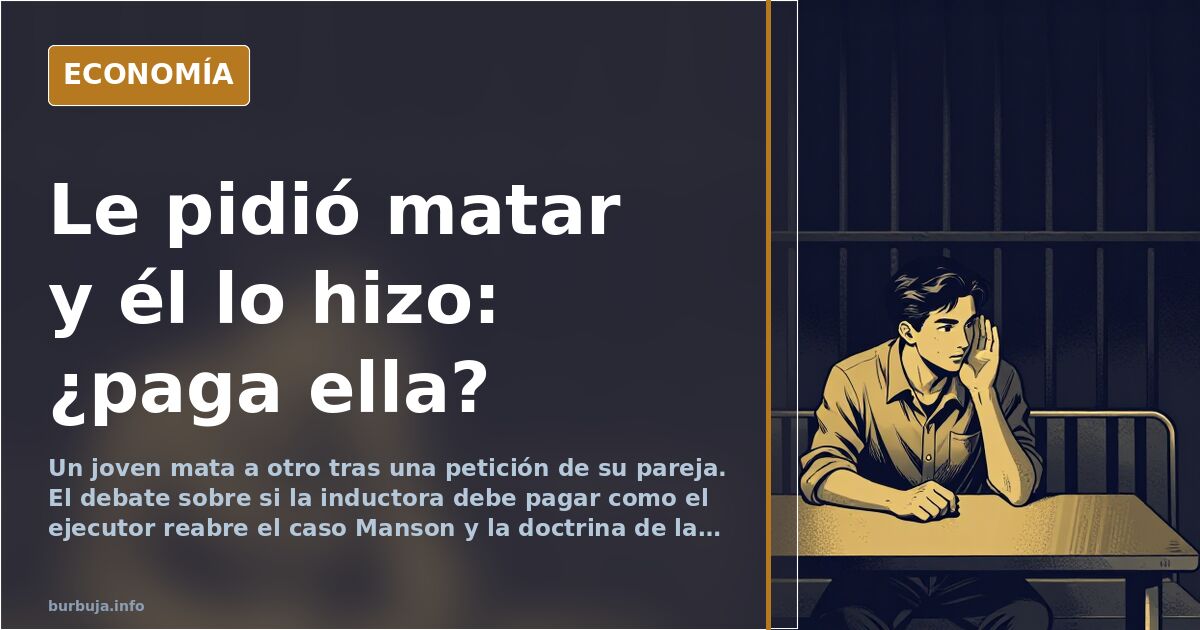
Hired killing in Spain reignites debate on instigator liability
A young man waited for another at a bus stop, beat him with a bat, and stabbed him while he was on the ground. According to circulating reports, the motive was a request from his partner. The subsequent discussion focuses not on the attacker—who has been identified—but on the figure left out of the picture: the instigator. Does ordering a crime carry the same legal weight as executing it?
The case, which has peine parallels with other incidents of incitement to murder, has sparked a debate on whether Spanish law punishes those who plan from the shadows as severely as those who get their hands dirty. Comparisons with the Manson case—where the leader was convicted without personally killing anyone—keep appearing. There is also suspicion that, in practice, the instigator will go unpunished.
What is known about the crime and the instigator
The widely circulated account is brief and brutal: an argument between two girls leads one to ask her boyfriend to kill the other’s boyfriend, and he does. He waited at the stop, beat the victim with a bat, and stabbed him while he was dying. According to messages, the attacker already had a incivil record, reinforcing the theory that this was not a normal boy acting on impulse, but someone with a prior history.
The question hovering over the entire affair is the usual one: what happens to her? The most common answer is that in Spain, the instigator will not serve prison time. The comparison with the United States is inevitable: there, it is argued, the instigator would spend a long time in prison. Here, the dominant forecast is that she may not even appear in court.
The Manson doctrine: convicting without killing
The most cited case to support the idea that incitement should be punished like the crime itself is Charles Manson, sentenced to life imprisonment without having killed anyone himself. The logic is that of the intellectual author: whoever orders, plans, and uses another as an instrument is liable just like the executor. In Spain, the concept of "inductor" exists in the Penal Code (Código Penal), but the debate is whether it is applied with the same force.
Some argue that premeditation is key: if you wait for someone at a bus stop with a bat and a knife, the executor is a murderer in every sense, regardless of a girlfriend asking. Others counter that the instigator is equally guilty because the crime would not have peine without her request. Both currents share an uncomfortable conclusion: the boy will pay with years in prison; she probably will not.
The recurring pattern: Maje and other incitement cases
Parallels with other incitement cases were immediate. Mention is made of a woman who convinced her daughter to kill her own father while he slept, later writing a book and finding trinc. Another case involves a minor who planned to murder her parents using her boyfriend as the executioner, then tried to pose as a victim.
The pattern drawn is always the same: a person with psychopathic traits uses another—typically a young man with fewer resources or less resistance—as a tool for an end. The lingering question is whether Spanish law is prepared to punish instigators with the same severity as executors.
Fate of the instigator: the undisputed forecast
The most repeated prediction is that the girl will not serve prison time. The explanation given is that in Spain, incitement is rarely prosecuted with the same rigor as material authorship, and proving an explicit request is difficult. The practical consequence, it is argued, is that the boy serves a sentence while she rebuilds her life.
The comparison with the Manson case returns here: if Manson was convicted without killing, why isn’t the same done for instigators? The answer given is that the difference lies in evidence: the Manson case involved a structure, a cult, and a documented plan. In a passionate crime among teenagers, the request dissolves into the accounts of those involved. Without solid proof, there is no conviction.
The case leaves a question that neither side fully answers: if the law does not punish the orderer and the executor equally, is justice protecting the victim, or simply administering blame based on who has the better lawyer?
A young man waited for another at a bus stop, beat him with a bat, and stabbed him while he was on the ground. According to circulating reports, the motive was a request from his partner. The subsequent discussion focuses not on the attacker—who has been identified—but on the figure left out of the picture: the instigator. Does ordering a crime carry the same legal weight as executing it?
The case, which has peine parallels with other incidents of incitement to murder, has sparked a debate on whether Spanish law punishes those who plan from the shadows as severely as those who get their hands dirty. Comparisons with the Manson case—where the leader was convicted without personally killing anyone—keep appearing. There is also suspicion that, in practice, the instigator will go unpunished.
What is known about the crime and the instigator
The widely circulated account is brief and brutal: an argument between two girls leads one to ask her boyfriend to kill the other’s boyfriend, and he does. He waited at the stop, beat the victim with a bat, and stabbed him while he was dying. According to messages, the attacker already had a incivil record, reinforcing the theory that this was not a normal boy acting on impulse, but someone with a prior history.
The question hovering over the entire affair is the usual one: what happens to her? The most common answer is that in Spain, the instigator will not serve prison time. The comparison with the United States is inevitable: there, it is argued, the instigator would spend a long time in prison. Here, the dominant forecast is that she may not even appear in court.
The Manson doctrine: convicting without killing
The most cited case to support the idea that incitement should be punished like the crime itself is Charles Manson, sentenced to life imprisonment without having killed anyone himself. The logic is that of the intellectual author: whoever orders, plans, and uses another as an instrument is liable just like the executor. In Spain, the concept of "inductor" exists in the Penal Code (Código Penal), but the debate is whether it is applied with the same force.
Some argue that premeditation is key: if you wait for someone at a bus stop with a bat and a knife, the executor is a murderer in every sense, regardless of a girlfriend asking. Others counter that the instigator is equally guilty because the crime would not have peine without her request. Both currents share an uncomfortable conclusion: the boy will pay with years in prison; she probably will not.
The recurring pattern: Maje and other incitement cases
Parallels with other incitement cases were immediate. Mention is made of a woman who convinced her daughter to kill her own father while he slept, later writing a book and finding trinc. Another case involves a minor who planned to murder her parents using her boyfriend as the executioner, then tried to pose as a victim.
The pattern drawn is always the same: a person with psychopathic traits uses another—typically a young man with fewer resources or less resistance—as a tool for an end. The lingering question is whether Spanish law is prepared to punish instigators with the same severity as executors.
Fate of the instigator: the undisputed forecast
The most repeated prediction is that the girl will not serve prison time. The explanation given is that in Spain, incitement is rarely prosecuted with the same rigor as material authorship, and proving an explicit request is difficult. The practical consequence, it is argued, is that the boy serves a sentence while she rebuilds her life.
The comparison with the Manson case returns here: if Manson was convicted without killing, why isn’t the same done for instigators? The answer given is that the difference lies in evidence: the Manson case involved a structure, a cult, and a documented plan. In a passionate crime among teenagers, the request dissolves into the accounts of those involved. Without solid proof, there is no conviction.
The case leaves a question that neither side fully answers: if the law does not punish the orderer and the executor equally, is justice protecting the victim, or simply administering blame based on who has the better lawyer?
Also available in: Deutsch
Summary of a discussion on Burbuja.info - Foro de economía, actualidad y política., translated from Spanish and reviewed before publication. Read the full discussion (169 replies).
More summaries
-
Bride Abandons Groom at Altar to Travel to US
A 30-year-old woman leaves her fiancé at the altar to backpack to the US, sparking a debate on individual freedom and social expectations.
-
Vidal claims 9% US tax rate, sparking fiscal debate
César Vidal states he pays 9% taxes in the US versus 50% in Spain. Federal brackets and living costs complicate this comparison.
-
Putin: Combined Russia-UE GDP Would Exceed US, But Gas Costs Complicate Deal
Putin claims combined Russia-UE GDP surpasses US. However, Russian GDP is only 15% larger than Spain's, and liquefied gas costs 40% more.
-
Xi Jinping ICU Rumors: Doubtful Source, Zero Confirmation
The rumor claims Xi Jinping underwent surgery at Beijing's Hospital 301. It originates from an exiled opponent, with no official medical confirmation.
-
Plane Myth: Confusing Inertia with Wind in Spain
Earth rotates at 1,600 km/h and planes fly at 840 km/h. The error is forgetting that air rotates with the planet.
-
Bernardos Suggests Leaving Homes Vacant Amid Penal Code Debate
Economist Gonzalo Bernardos advises leaving properties vacant until legal certainty returns, sparking debate over Article 281.1 of the Spanish Penal Code.