
Spain debate on elderly respect sparked by wife's outburst
A viral incident in Spain involving a deaf husband sparks debate on respect, retirement cohabitation, and economic dependency among older couples.
English · Original discussion in Spanish · Published
Respect in elderly couples under scrutiny
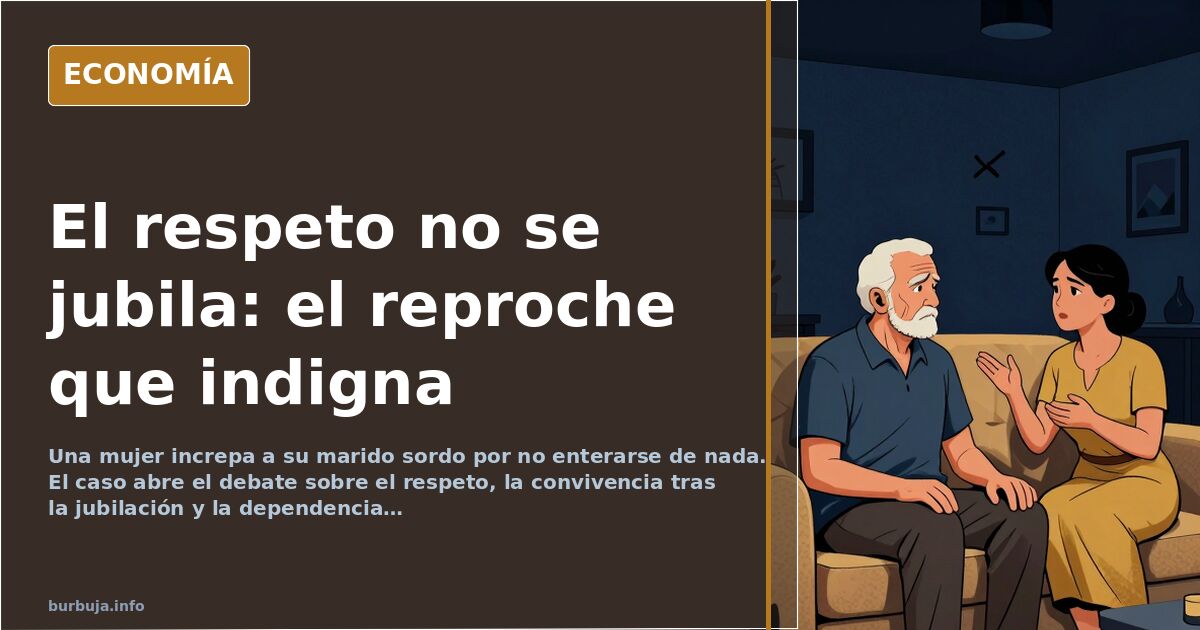
A common street scene: a woman berates her husband for his hearing loss, claiming he understands nothing and is only a burden. The man responds calmly; she escalates with hostility, treating him like an enemy. Witnesses describe this as petty and disrespectful toward someone already worn down by age. This minor anecdote opens a broader discussion on how spouses are treated in old age and why such reproaches have become normalized.
Defining respect in aging partnerships
Some argue respect is the minimum form of charity: love cannot be demanded, but decent treatment can, even if one dislikes the other. Others add that respect must be earned, not given freely, and some people are best avoided. The debate touches on an uncomfortable point: contempt is wrong regardless of gender. Symmetry in argument challenges those who justify reproach only in one direction.
The strain of living together after retirement
Analysis often points to retirement as a trigger. When both spouses are home full-time, cohabitation intensifies and conflicts multiply. Cases are described where men do not contribute to chores, expecting service, while women have borne this load for decades. In this view, the reproach stems from accumulated resentment. However, the discussion does not end there.
Why reproach towards husbands becomes generalized
Another perspective suggests the phenomenon is broader, unrelated to deafness or retirement. It occurs even in seemingly harmonious couples: problems instantly spark conflict. Examples include grandmothers and mothers-in-law repeating this pattern with their husbands. A notable exception: when men were historically difficult, reproach rarely appears. An unconfirmed hypothesis suggests derogatory treatment targets those who do not defend themselves.
The narrative of the self-sacrificing vvife and burdensome husband
Conversely, it is argued that many women of this generation managed the home and children while husbands worked outside. From this angle, reproach answers years of unrecognized service. The immediate objection: labeling entire generations as victims or villains based on birth year is simplistic. The debate gets tangled in who sacrificed more, without data to settle the matter.
Data on cohabitation and widowhood
The debate becomes concrete in economic terms. Women of this generation relied on husbands for income, and current widow's pensions did not exist then. Widows faced uncertainty, often working whatever jobs they could find. The uncomfortable conclusion: mourning was also a survival issue, not just emotional grief.
The gap between media narratives and real life
Reproach extends beyond domestic spheres. News programs daily antiestéticature partner violence during lunchtime, exactly when many elderly couples watch TV. Critics argue this coincidence reinforces a narrative casting men solely as aggressors and women as victims, lacking nuance. They claim this framing influences how everyday conflicts between older adults are interpreted.
Reproach as a symptom of deeper issues
The thread moves toward harsher positions. Some assert that without specific values education, women naturally despise weak men, whereas men feel pity, not disgust. Extreme views suggest female old age becomes unbearable and nature should shorten it. These opinions lack empirical backing but highlight the heated tone of parts of the debate.
The initial scene was minimal: a woman shouting at a deaf man in the street. Yet, the resulting discussion touches on retirement, economic dependency, task distribution, and how partner violence is portrayed. Is reproach a symptom of genuine distress or an excuse to justify contempt?
A common street scene: a woman berates her husband for his hearing loss, claiming he understands nothing and is only a burden. The man responds calmly; she escalates with hostility, treating him like an enemy. Witnesses describe this as petty and disrespectful toward someone already worn down by age. This minor anecdote opens a broader discussion on how spouses are treated in old age and why such reproaches have become normalized.
Defining respect in aging partnerships
Some argue respect is the minimum form of charity: love cannot be demanded, but decent treatment can, even if one dislikes the other. Others add that respect must be earned, not given freely, and some people are best avoided. The debate touches on an uncomfortable point: contempt is wrong regardless of gender. Symmetry in argument challenges those who justify reproach only in one direction.
The strain of living together after retirement
Analysis often points to retirement as a trigger. When both spouses are home full-time, cohabitation intensifies and conflicts multiply. Cases are described where men do not contribute to chores, expecting service, while women have borne this load for decades. In this view, the reproach stems from accumulated resentment. However, the discussion does not end there.
Why reproach towards husbands becomes generalized
Another perspective suggests the phenomenon is broader, unrelated to deafness or retirement. It occurs even in seemingly harmonious couples: problems instantly spark conflict. Examples include grandmothers and mothers-in-law repeating this pattern with their husbands. A notable exception: when men were historically difficult, reproach rarely appears. An unconfirmed hypothesis suggests derogatory treatment targets those who do not defend themselves.
The narrative of the self-sacrificing vvife and burdensome husband
Conversely, it is argued that many women of this generation managed the home and children while husbands worked outside. From this angle, reproach answers years of unrecognized service. The immediate objection: labeling entire generations as victims or villains based on birth year is simplistic. The debate gets tangled in who sacrificed more, without data to settle the matter.
Data on cohabitation and widowhood
The debate becomes concrete in economic terms. Women of this generation relied on husbands for income, and current widow's pensions did not exist then. Widows faced uncertainty, often working whatever jobs they could find. The uncomfortable conclusion: mourning was also a survival issue, not just emotional grief.
The gap between media narratives and real life
Reproach extends beyond domestic spheres. News programs daily antiestéticature partner violence during lunchtime, exactly when many elderly couples watch TV. Critics argue this coincidence reinforces a narrative casting men solely as aggressors and women as victims, lacking nuance. They claim this framing influences how everyday conflicts between older adults are interpreted.
Reproach as a symptom of deeper issues
The thread moves toward harsher positions. Some assert that without specific values education, women naturally despise weak men, whereas men feel pity, not disgust. Extreme views suggest female old age becomes unbearable and nature should shorten it. These opinions lack empirical backing but highlight the heated tone of parts of the debate.
The initial scene was minimal: a woman shouting at a deaf man in the street. Yet, the resulting discussion touches on retirement, economic dependency, task distribution, and how partner violence is portrayed. Is reproach a symptom of genuine distress or an excuse to justify contempt?
Summary of a discussion on Burbuja.info - Foro de economía, actualidad y política., translated from Spanish and reviewed before publication. Read the full discussion (170 replies).
More summaries
-
Spain's Widow Pension: Late Marriages Spark Fraud Concerns
A 76-year-old man marries a 51-year-old woman, enabling her to collect decades of widow pension. It is legal and meets requirements, yet suspicion remains.
-
Sol Campout: Elite Spokespeople and Suspicions of Manipulation
Spokespeople for the Sol campout against the housing crisis reportedly attended United World College and Comillas, according to disseminated data.
-
Spain's Parador de Teruel scandal: Ábalos, Pardo de Vera invoices
Ábalos, Pardo de Vera and Lambán stayed at Parador de Teruel. Eight double rooms charged to regional budget; no resignations.
-
Madrid Theme Park Nostalgia Ignores Heroin Crisis
Nostalgia for Madrid's Parque de Atracciones in 1990 clashes with the era's heroin epidemic, crime, and precariousness.
-
Iran earthquake reignites debate over nuclear weapon status
An Iran seismic event sparks speculation Tehran has the atomic bomb, analyzing Fattah-1 missiles, Israel's silence doctrine, and Iraq precedents.
-
EU Zero-Emission Housing Rule Sparks Cost Debate
EU proposal for zero-emission homes by 2030 could cost up to €30,000 per unit in Spain.