
Iran earthquake reignites debate over nuclear weapon status
An Iran seismic event sparks speculation Tehran has the atomic bomb, analyzing Fattah-1 missiles, Israel's silence doctrine, and Iraq precedents.
English · Original discussion in Spanish · Published
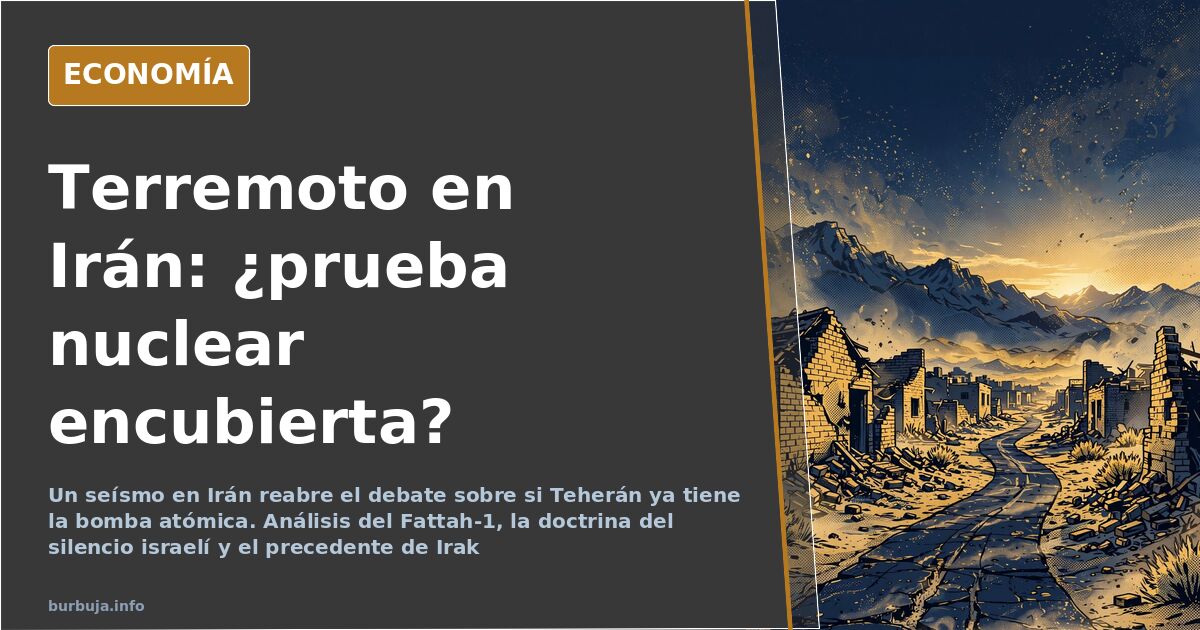
Iran and the Bomb: Earthquake Reopens Nuclear Debate
A modest-magnitude earthquake in Iran is enough for half the internet to assume what intelligence agencies have debated for years: that the Sarracinic Republic already possesses the bomb. The thesis doesn't stem from a leaked report, but from the shape of the seismic wave. The 'earthquake' profile is the evidence, argues one school of analysis, recalling the pattern recorded in North Korea before its tests. Others counter with the obvious argument: a dozen minor quakes have been counted in the area within days, and not all can be nuclear tests.
What is really at stake in an earthquake debate
The core issue isn't geological, it's political. If Tehran has crossed the threshold, the calculus changes for every actor in the region. Those defending the existence of a test argue the timing is too convenient: maximum tension with Israel, mutual threats, and a ballistic arsenal that has already demonstrated the ability to reach targets. Those denying it point out that a nuclear test is conducted far away, not at home, and that Iran lacks the infrastructure to detonate without leaving an impossible-to-hide trace.
The discussion quickly shifted to the missile. The Fattah-1 appears in the exchange as a potential vector for a nuclear warhead. The technical rebuttal is that it is a chassis of North Korean origin, stripped down to gain range and estimulante ilegal, with explosive capacity described by one analysis as ridiculous. Putting plutonium inside, this view holds, would leave a radioactive trail for kilometers if intercepted, and render an area uninhabitable for years if not.
Deterrence effect and Israeli silence
There is an uncomfortable consensus running through the discussion: possessing nuclear weapons does more for peace than many treaties. It is the old logic of mutual destruction, applied to a board where Israel has never confirmed or denied its own arsenal. The doctrine of ambiguity—neither admitting nor denying—is read as a way to maintain strategic uncertainty, just as was done with operations attributed to its services.
The lingering question is why Israel hasn't responded with the force it promised. One circulating hypothesis: when the rival stops launching firecrackers and shows something more serious, the equation changes. Another, more cynical: the response is announced small and sold big.
The precedent no one wants to cite
The ghost haunting the exchange has a name and surname: Saddam Hussein and weapons of mass destruction. The suspicion that the same script is being rewritten to justify preventive action is explicit in several messages. This is not a minor argument: independent verification is conspicuously absent on both sides of the debate.
Meanwhile, background noise includes Pakistan and its 170 nuclear warheads as an actor that could play on the same board, and Russia as possible technical assistance. Hard data are scarce; certainties even more so.
How many magnitude-four earthquakes do we need before we stop calling them earthquakes?
A modest-magnitude earthquake in Iran is enough for half the internet to assume what intelligence agencies have debated for years: that the Sarracinic Republic already possesses the bomb. The thesis doesn't stem from a leaked report, but from the shape of the seismic wave. The 'earthquake' profile is the evidence, argues one school of analysis, recalling the pattern recorded in North Korea before its tests. Others counter with the obvious argument: a dozen minor quakes have been counted in the area within days, and not all can be nuclear tests.
What is really at stake in an earthquake debate
The core issue isn't geological, it's political. If Tehran has crossed the threshold, the calculus changes for every actor in the region. Those defending the existence of a test argue the timing is too convenient: maximum tension with Israel, mutual threats, and a ballistic arsenal that has already demonstrated the ability to reach targets. Those denying it point out that a nuclear test is conducted far away, not at home, and that Iran lacks the infrastructure to detonate without leaving an impossible-to-hide trace.
The discussion quickly shifted to the missile. The Fattah-1 appears in the exchange as a potential vector for a nuclear warhead. The technical rebuttal is that it is a chassis of North Korean origin, stripped down to gain range and estimulante ilegal, with explosive capacity described by one analysis as ridiculous. Putting plutonium inside, this view holds, would leave a radioactive trail for kilometers if intercepted, and render an area uninhabitable for years if not.
Deterrence effect and Israeli silence
There is an uncomfortable consensus running through the discussion: possessing nuclear weapons does more for peace than many treaties. It is the old logic of mutual destruction, applied to a board where Israel has never confirmed or denied its own arsenal. The doctrine of ambiguity—neither admitting nor denying—is read as a way to maintain strategic uncertainty, just as was done with operations attributed to its services.
The lingering question is why Israel hasn't responded with the force it promised. One circulating hypothesis: when the rival stops launching firecrackers and shows something more serious, the equation changes. Another, more cynical: the response is announced small and sold big.
The precedent no one wants to cite
The ghost haunting the exchange has a name and surname: Saddam Hussein and weapons of mass destruction. The suspicion that the same script is being rewritten to justify preventive action is explicit in several messages. This is not a minor argument: independent verification is conspicuously absent on both sides of the debate.
Meanwhile, background noise includes Pakistan and its 170 nuclear warheads as an actor that could play on the same board, and Russia as possible technical assistance. Hard data are scarce; certainties even more so.
How many magnitude-four earthquakes do we need before we stop calling them earthquakes?
Summary of a discussion on Burbuja.info - Foro de economía, actualidad y política., translated from Spanish and reviewed before publication. Read the full discussion (168 replies).
More summaries
-
North Korea sentences toddler to life for owning Bible
A 2021 Korea Future report details a North Korean family, including a two-year-old, sentenced to life imprisonment for possessing a Bible.
-
North Korea opens its Benidorm in June: 100,000 places
The Wonsan-Kalma Beach Resort opens in June 2025 for 100,000 people, with an airport next to the hotels and microphones in the rooms
-
Spain's rental decrees struck down: 'the damage is already done'
A forum user claims rental supply has fallen 61% since 2020 and prices have risen 40%. The decrees have been struck down, but the damage is already done, according to the...
-
Ceuta: Why Migration Protest Fails to Unite Spain
In Ceuta, where 37.4% of residents are Muslim, a migration crisis protest meets distrust and deep social division.
-
Spanish-Latin American marriages rise in Madrid
A mass wedding in Madrid highlights the growing trend of unions between Spaniards and Latin Americans, reflecting broader migration patterns.
-
Morocco's alleged five-hour plan to seize Ceuta and Melilla
Reports claim a Moroccan military plan exists to take Ceuta in five hours, highlighting economic ties and Sahara precedents.