
Spain Coup Talk: High Noise, Zero Plan
A proposal for military and police intervention in Spain garnered 204 responses but no roadmap, as electoral routes, NATO, and amnesty laws dominate the debate.
English · Original discussion in Spanish · Published
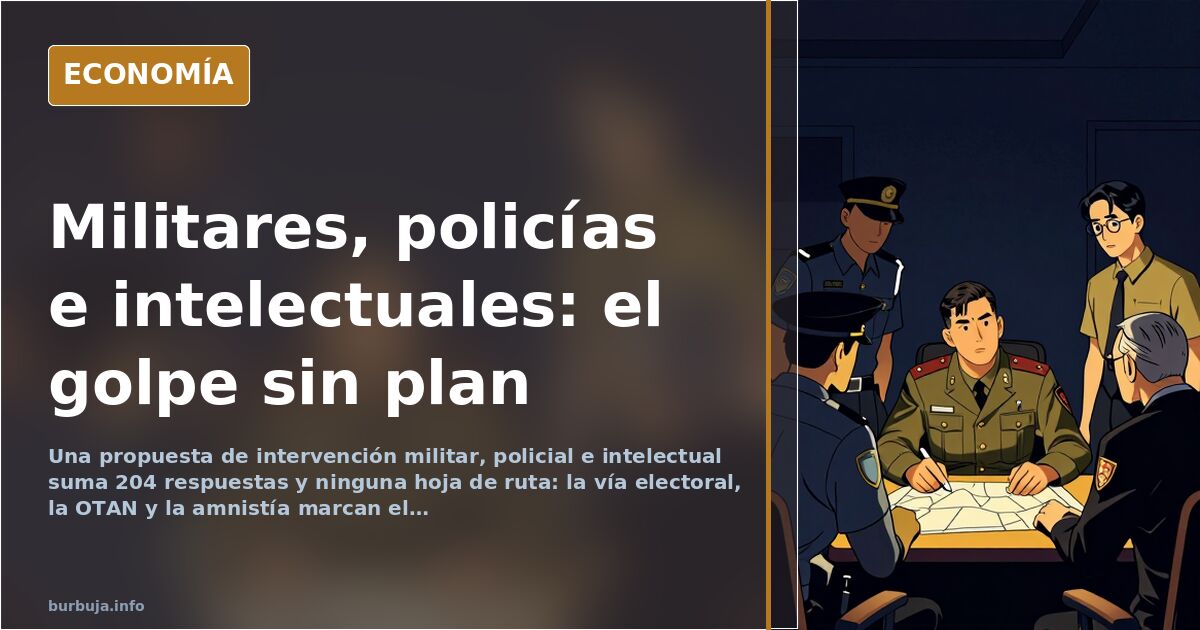
Coup Talk in Spain: From Rage to Winning Elections
The proposal was three lines long: a group of military personnel, police officers, and intellectuals who would stop this unsustainable system and protect the nation and general interest. Its author justified it by citing "the passivity and stupidity we are immersed in." After 1,010 days and 204 responses, the question remains, and the conclusion is uncomfortable: almost no one disputes the diagnosis, but practically no one has a plan.
Responses to the Coup Proposal
The first brake came in the form of legality: "Everything within the law, nothing outside it," arguing that those who want change should win an election. A second warning noted that proposing this is a crime. A third was more pragmatic: such a coup could fail and leave people without hot meals for 50 years. No one buys the idea of a clean, quick, and beneficial uprising.
From there, the spectrum opens. Some would only back the operation if they led it. Others would support it with a very specific program—a complex-free Catholic dictatorship, written without irony—and others tie it to a refounding: toppling the Regime of '78 (Spain's post-Franco constitutional order) and rebuilding it on traditional principles. The detail is that even enthusiasts do not agree on what, who, or why.
"Feijóo Won Nothing": The Electoral Labyrinth
The most repeated argument against extra-parliamentary routes is that a parliamentary route already exists and is underutilized. Here lies the knot: in Spain there are no direct elections for the President of the Government, so winning a vote does not equate to governing. Some argue that the candidate with the most votes won the election; the rebuttal is that he won nothing. The practical conclusion many draw is that if the system does not translate votes into power, the fault lies not with the voter. And a recurring caveat: those asking for new rules usually ask for them to apply to others.
Territorial Arithmetic and Suspicions of Rigged Ballots
Another underlying line argues that the map makes any change via the ballot box impossible: Catalonia, the Basque Country, Navarre, the Valencian Community, Galicia, and the Balearic Islands would add up to millions of voters with their own languages and independentist bases who, according to this reasoning, would always vote in the same direction. Forty years of what that message calls indoctrination explain, for the writer, an immovable electoral floor.
Underneath lies distrust. "Many of us believe elections are rigged," summarizes another intervention, for which any institutional effort is wasted time. It is the piece that holds everything else together: if the ballot box is useless, only force remains. The obvious objection—who guarantees that force will not reproduce the same problem—rarely finds an answer.
Why NATO and the EU Burry the Hypothesis
The most compelling argument that appears is geopolitical: while Spain belongs to NATO and the European Union, along with other democracies in the region, internal military intervention has no future. It is not a matter of will, but of external alignment. The forecast, without frills: frustration and waiting.
That wall explains the shift of almost all responses to another terrain. If the coup is not viable, the profitable question is how to wear down the Government through legal means. And here enters the amnesty law.
Amnesty as Trigger and the CNI Ghost
One intervention conditions its stance on parliamentary processing: if Congress approves the amnesty without needing the Constitutional Court to intervene, it argues, deposing the Government would cease to be an option and become "an obligation for every patriot." The circulating alternative is more prosaic: ban certain parties and reform the Constitution. All through the BOE (Official State Gazette).
In the middle, fine mockery. One message calculates that, if a referendum were held, the 70 votes against would come from independentist voters; another recalls that the majority likes current legality only when it favors them. It is the kind of irony that defuses any epic.
Striking is the suspicion falling on the conversation itself. Several messages greet the alleged intelligence service, joke about an infiltrated agent, and warn that a newly registered account does not ask out of mere curiosity. Those fantasizing about a state operation believe they are being tracked by the State.
And here comes the twist. Part of the responses argue that the coup is not a future hypothesis: it has been underway since 2004 and describe it as permanent. Others claim the opposite, that the Executive itself has already staged one and only needs to complete it with control of the CGPJ (General Council of the Judiciary). In a discussion about whether to stage a coup, the most repeated conclusion is that one is already in pogre. No one specifies which.
The proposal was three lines long: a group of military personnel, police officers, and intellectuals who would stop this unsustainable system and protect the nation and general interest. Its author justified it by citing "the passivity and stupidity we are immersed in." After 1,010 days and 204 responses, the question remains, and the conclusion is uncomfortable: almost no one disputes the diagnosis, but practically no one has a plan.
Responses to the Coup Proposal
The first brake came in the form of legality: "Everything within the law, nothing outside it," arguing that those who want change should win an election. A second warning noted that proposing this is a crime. A third was more pragmatic: such a coup could fail and leave people without hot meals for 50 years. No one buys the idea of a clean, quick, and beneficial uprising.
From there, the spectrum opens. Some would only back the operation if they led it. Others would support it with a very specific program—a complex-free Catholic dictatorship, written without irony—and others tie it to a refounding: toppling the Regime of '78 (Spain's post-Franco constitutional order) and rebuilding it on traditional principles. The detail is that even enthusiasts do not agree on what, who, or why.
"Feijóo Won Nothing": The Electoral Labyrinth
The most repeated argument against extra-parliamentary routes is that a parliamentary route already exists and is underutilized. Here lies the knot: in Spain there are no direct elections for the President of the Government, so winning a vote does not equate to governing. Some argue that the candidate with the most votes won the election; the rebuttal is that he won nothing. The practical conclusion many draw is that if the system does not translate votes into power, the fault lies not with the voter. And a recurring caveat: those asking for new rules usually ask for them to apply to others.
Territorial Arithmetic and Suspicions of Rigged Ballots
Another underlying line argues that the map makes any change via the ballot box impossible: Catalonia, the Basque Country, Navarre, the Valencian Community, Galicia, and the Balearic Islands would add up to millions of voters with their own languages and independentist bases who, according to this reasoning, would always vote in the same direction. Forty years of what that message calls indoctrination explain, for the writer, an immovable electoral floor.
Underneath lies distrust. "Many of us believe elections are rigged," summarizes another intervention, for which any institutional effort is wasted time. It is the piece that holds everything else together: if the ballot box is useless, only force remains. The obvious objection—who guarantees that force will not reproduce the same problem—rarely finds an answer.
Why NATO and the EU Burry the Hypothesis
The most compelling argument that appears is geopolitical: while Spain belongs to NATO and the European Union, along with other democracies in the region, internal military intervention has no future. It is not a matter of will, but of external alignment. The forecast, without frills: frustration and waiting.
That wall explains the shift of almost all responses to another terrain. If the coup is not viable, the profitable question is how to wear down the Government through legal means. And here enters the amnesty law.
Amnesty as Trigger and the CNI Ghost
One intervention conditions its stance on parliamentary processing: if Congress approves the amnesty without needing the Constitutional Court to intervene, it argues, deposing the Government would cease to be an option and become "an obligation for every patriot." The circulating alternative is more prosaic: ban certain parties and reform the Constitution. All through the BOE (Official State Gazette).
In the middle, fine mockery. One message calculates that, if a referendum were held, the 70 votes against would come from independentist voters; another recalls that the majority likes current legality only when it favors them. It is the kind of irony that defuses any epic.
Striking is the suspicion falling on the conversation itself. Several messages greet the alleged intelligence service, joke about an infiltrated agent, and warn that a newly registered account does not ask out of mere curiosity. Those fantasizing about a state operation believe they are being tracked by the State.
And here comes the twist. Part of the responses argue that the coup is not a future hypothesis: it has been underway since 2004 and describe it as permanent. Others claim the opposite, that the Executive itself has already staged one and only needs to complete it with control of the CGPJ (General Council of the Judiciary). In a discussion about whether to stage a coup, the most repeated conclusion is that one is already in pogre. No one specifies which.
Summary of a discussion on Burbuja.info - Foro de economía, actualidad y política., translated from Spanish and reviewed before publication. Read the full discussion (204 replies).
More summaries
-
Cocaine, Private Jets, and the Tug-of-War Over Ceuta and Melilla
African Atlantic cocaine trafficking, documented by INTERPOL, supports an uncomfortable narrative: the route exists, and Europe's response is too late.
-
OpenAI claims Navier-Stokes solution in 88 hours
OpenAI asserts it solved the Navier-Stokes problem using 10,000 AI agents. While the Clay Prize awaits, the massive energy bill raises questions.
-
Spain's construction sector faces labor shortage amid low pay
A pool builder with 240k followers can't find workers. €1,300 salaries vs €1,000 rents make the math impossible.
-
The Cost of Cool: Aura Farming Trend
Aura farming costs €5-7 daily in energy drinks and now has live championships. The new trend replacing alcohol and breakdance.
-
July Heatwave in Spain: Reality or Climate Alarmism?
Spain's July 2026 heatwave sparks debate as temperatures hit 42°C in Granada but remain mild in the north.
-
Spain unemployment rises 44,419 in worst August since 2013
Registered jobless count rose by 44,419 in Spain's August, the highest increase since 2013, driven largely by newly regularized migrants.