
Spain builds 90,000 homes annually against 1 million demand
In 2006, Spain issued more building permits than Germany, France, and the UK combined. Today, construction stands at 90,000 against an estimated million.
English · Original discussion in Spanish · Published
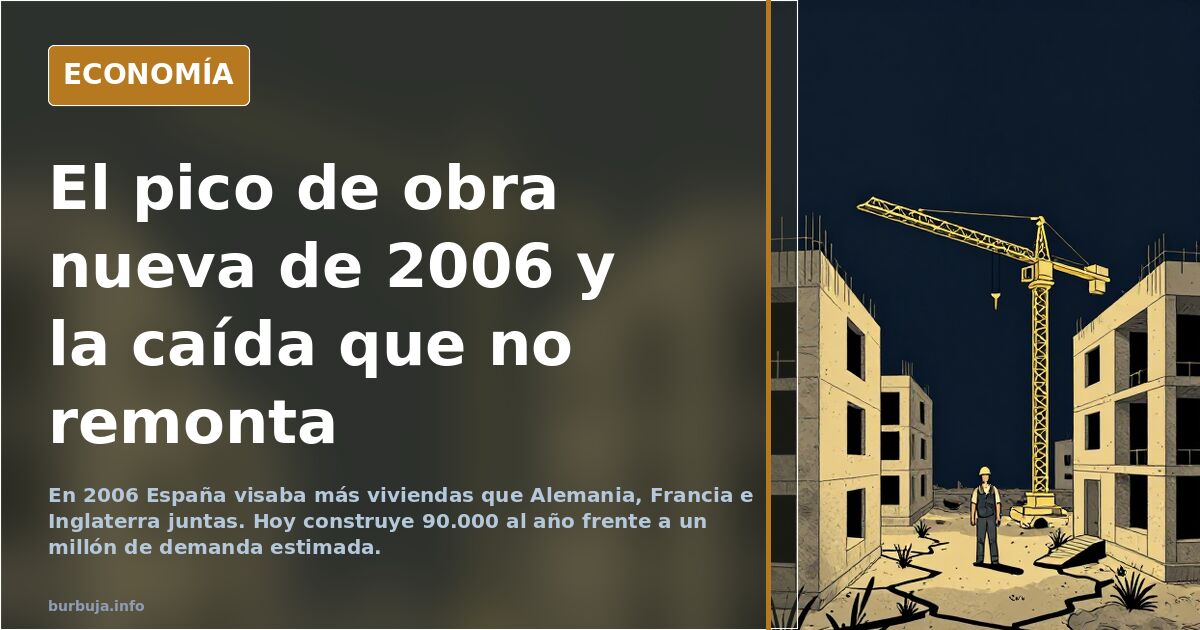
New construction stalls: 90,000 permits issued amid 1 million demand
In 2006, with new building permits at historic highs, Spain erected more homes than Germany, France, and the UK combined, while prices rose by double digits annually. Nearly two decades later, construction has plummeted, yet the result remains the same: prices continue to rise. If homes become more expensive during both a historic boom and a current slump, it is worth examining which variable is being misread.
Why is less housing built than in 2006?
The starting point is a series of permits tracing a rollercoaster: sustained growth until the 2006 peak and a free fall from 2008, without recovering previous levels in any subsequent year. The low activity of nearly two decades has destroyed productive capacity in construction and its suppliers, and this cannot be recovered by pressing a button. There are few companies, crews, and prepared land.
On this base, estimates pile up. In a radio discussion, it was suggested that Spain, at full capacity, can barely build 90,000 homes annually against demand estimated at one million, with an influx of 200,000 migrants annually. These figures are for order-of-magnitude purposes, but the diagnosis coincides: production capacity has fallen far below what the market absorbs.
Protected housing is the most eloquent case. Developers have been offered subsidized housing promotions of 70 square meters for over 200,000 euros, and sometimes concessions remain vacant: with margins below 20%, it is not worthwhile for the builder to enter. No one builds what loses them money.
Execution costs and the tangle of permits
Building has become more expensive even without rising wages. Execution costs average 1,300 euros per square meter for medium quality, and this is added to paperwork. A buyer recounts the case of a development in La Garriga (Barcelona) that had been approved for years but stalled because the original developer grew tired of dealing with the town hall: the list of requirements—archaeological surveys, gender studies, sustainable materials, exact number of trees, and species—ended his patience. Each requirement opens the door to a technician, a consultancy, and a fee.
There are examples illustrating the friction. In the Henares corridor, hundreds of housing developments have been rejected for not meeting environmental requirements. And a recent paradox arises: buildings from the 40s, 50s, and 60s lacking architectural value are rehabilitated because it is cheaper and faster than finding someone to demolish and build a new structure.
Demographic pressure: 200,000 annually and rising
The second driver of imbalance is demand. In 2022, a net 730,000 people entered, and census data point to more than 600,000 additions in the trinc year. Since 2018, the country has added around two million inhabitants, and in the time range of the series, the difference exceeds ten million according to official data. The bulk of immigration from the European Union settles in Spain, according to the latest Eurostat data on population evolution.
To gauge the magnitude, international contrast serves. Germany incorporated around 1.5 million people in 2016 and up to four million more in subsequent years, thus avoiding the Japanization of its real estate market. The United States receives slightly more than one million annually with 335 million inhabitants. The Spanish proportion, with a much smaller country, is hardly comparable to any neighbor.
Taxes, margins, and land that is not liberalized
The third leg is fiscal. Each sale carries VAT or the transfer tax, a bite that takes nearly 10% of the price upfront and makes it unviable to resell cheaper than bought. This is added to the property tax (IBI), waste fees, community expenses, and the cost of keeping a home closed. Some argue that most empty homes are not speculative, but due to foreclosures, unresolved inheritances, or simple state negligence, SAREB (Spanish Asset Management Company), or banks. The jackpots, others claim, are signed by town halls when reclassifying land.
Here, two currents clash. One calls to liberalize land and cut bureaucracy so supply responds; the other replies that no private developer will build affordable housing while margins do not add up, and that a public company would be needed to flood the market until forcing a drop. Neither has been tried on a large scale, and both coexist with the same uncomfortable fact: supply does not arrive.
How much must fail for the market to decompress?
Between 2008 and 2015, it was normal to find rentals of 400 or 500 euros in medium-sized cities, two or three-bedroom flats, and between 60 and 80 square meters. That reference point has evaporated. If construction does not start, the population continues to enter, and land remains blocked, the question ceases to be academic: what would be needed for prices to truly fall, and who would pay the political cost of that drop?
Summary of a discussion on Burbuja.info - Foro de economía, actualidad y política., translated from Spanish and reviewed before publication. Read the full discussion (278 replies).
More summaries
-
Canada and New Zealand Warn of Housing Price Crash Risks
Falling home prices reduce owner wealth, slow consumption, and hit state revenues. Canada and New Zealand already face these consequences.
-
Housing prices continue to climb: limited supply meets unstoppable demand
Prices rise despite high interest rates. Immigration and lack of new construction are fueling demand. Will the trend break?
-
Ibiza’s Housing Crisis Expels Workers and Paralyzes Services
Sky-high rents in Ibiza force workers out, leaving Transport with 80% vacant posts and 25% of freight fleets grounded.
-
Pornhub’s VP is an Orthodox Rabbi: The Ethical Paradox
Solomon Friedman, an ordained Orthodox rabbi, serves as Pornhub’s vice president, sparking debate on ethics, parental responsibility, and the adult industry’s influence.
-
Ceuta: 60,000 crossings push Spain's border past breaking point
More than 60,000 entries and around a hundred deaths: why the Ceuta crisis is a catastrophe that Europe watches without sharing the bill.
-
Morocco: the weakness measured at the border
Thousands of young people in Ceuta while Morocco boasts of military power: the thesis of Moroccan fragility is gaining ground and unsettling geopolitics in the Maghreb.