
Spain bar bill sparks debate on rising dining out costs
A €129 dinner for seven in a Spanish pizzeria fuels debate over price hikes, with drinks costing €2.70 and salads €8.50.
English · Original discussion in Spanish · Published
€129 pizza and beer bill highlights hospitality sector trends
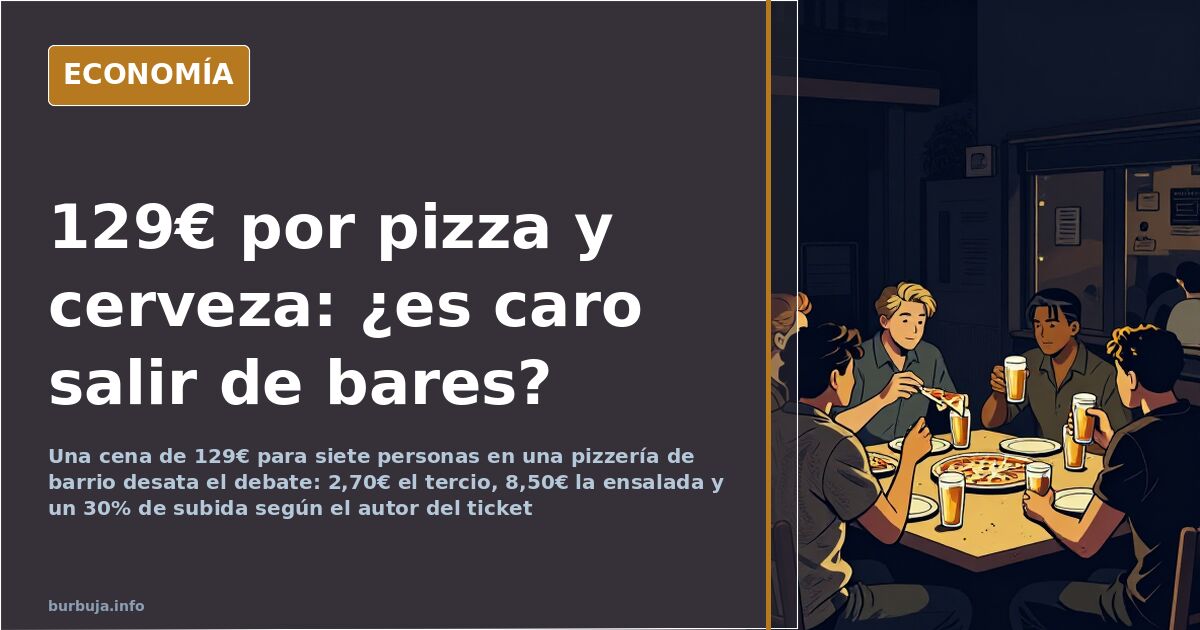
A €129 bill for seven people at a small neighborhood pizzeria sparked intense debate: €18 per head for large pizzas, salads, and beer in a venue that, according to the receipt's author, offered €6 pizzas and nearly €2 beers just a year ago. The customer summarized it bluntly: "We were ripped off badly, especially on drinks." A third of beer cost €2.70, a tankard €3.90, and a salad €8.50, shocking many.
Reactions quickly split into two camps. For some, €18 each is a bargain beyond discussion: "If €120 for seven seems expensive, you're poor," summarizes the most aggressive stance. For others, the issue isn't the total but the estimulante ilegal of change: the same meal cost 30% less eight months ago, according to the receipt's author, who notes the business held prices steady before raising them "suddenly."
The margin is in drinks, not pizza
Food fares well in analysis. Several comments agree pizzas remain reasonably priced for their size, while the real gouge comes from liquids. "Drinks usually inflate bills because they offer the highest profit margins," points out a participant speaking from experience. The math is simple: a €2.70 beer leaves a margin no tomato-based dough can match.
This phenomenon isn't exclusive to pizzerias. Another message details a round at a municipal pool bar: a short drink and a bottle, €4.50. In Málaga, two cortados at a bar counter without seating: €10. In a Valencian town, two coffees with milk and a truffle cake, €6; a cup of chocolate with four fritters, €7; two terrace beers, €5. The repeated conclusion: "Paris or London prices."
Why has eating out become so expensive?
The most common explanation cites energy costs and accumulated inflation. "You know, the Ukraine war and such," sarcastically summarizes one message condensing the official argument. But others go further, framing this as structural change: Spain's hospitality sector has "Europeanized" its prices while wages haven't trinc suit. "People wanted to Europeanize. Well, in Europe, eating out is a luxury," another participant concludes.
Contrasts with the rest of Europe appear repeatedly. In Madrid, €120 for seven is argued to be "one cover, one." In Barcelona, any dive bar "charges you €30 upwards now." Comparisons with Amsterdam or Paris cease being exaggerations and become commonplace. Yet, the original bill still seems cheap to many: "I don't see it as particularly expensive," one person states definitively.
Migrant-run businesses and customers staying away
The venue sparking discussion is a migrant-run pizzeria, a format that has multiplied across neighborhoods throughout Spain. The receipt's author describes it as "a tiny Pakistani-owned pizzeria I really like," emphasizing it always had "good pizzas and very affordable prices." However, comments sometimes veer into territory unrelated to the bill: some question these businesses' presence, while others respond ironically about the alleged source of funds.
Beyond the noise, economic data remains stubborn. Hospitality prices have risen above general CPI for months, and consumers are adjusting. "They charge more money, but you should become more demanding and seek competitors," advises one message. Another takes it to the extreme: "At the municipal pool bar, I told them they won't see me there again." The threat of non-returning customers is the sector's only real counterweight.
The undisputed bill: €18 per head
Beyond ideological battles, the original receipt offers a clear portrait of dining out costs. Seven people, €129, some without alcohol, others with beer. The complete breakdown reveals drinks take a disproportionate share of the total, and although pizzas have increased, they remain the menu's most competitive element. The €8.50 salad, however, steals the show in terms of indignation.
The lingering question is whether this price level is sustainable. With stagnant wages and increasingly expensive leisure, neighborhood hospitality faces a dilemma: raise prices or lose customers. This bill's data suggests they chose the former. It remains to be seen how long customers hold out before staying home.
A €129 bill for seven people at a small neighborhood pizzeria sparked intense debate: €18 per head for large pizzas, salads, and beer in a venue that, according to the receipt's author, offered €6 pizzas and nearly €2 beers just a year ago. The customer summarized it bluntly: "We were ripped off badly, especially on drinks." A third of beer cost €2.70, a tankard €3.90, and a salad €8.50, shocking many.
Reactions quickly split into two camps. For some, €18 each is a bargain beyond discussion: "If €120 for seven seems expensive, you're poor," summarizes the most aggressive stance. For others, the issue isn't the total but the estimulante ilegal of change: the same meal cost 30% less eight months ago, according to the receipt's author, who notes the business held prices steady before raising them "suddenly."
The margin is in drinks, not pizza
Food fares well in analysis. Several comments agree pizzas remain reasonably priced for their size, while the real gouge comes from liquids. "Drinks usually inflate bills because they offer the highest profit margins," points out a participant speaking from experience. The math is simple: a €2.70 beer leaves a margin no tomato-based dough can match.
This phenomenon isn't exclusive to pizzerias. Another message details a round at a municipal pool bar: a short drink and a bottle, €4.50. In Málaga, two cortados at a bar counter without seating: €10. In a Valencian town, two coffees with milk and a truffle cake, €6; a cup of chocolate with four fritters, €7; two terrace beers, €5. The repeated conclusion: "Paris or London prices."
Why has eating out become so expensive?
The most common explanation cites energy costs and accumulated inflation. "You know, the Ukraine war and such," sarcastically summarizes one message condensing the official argument. But others go further, framing this as structural change: Spain's hospitality sector has "Europeanized" its prices while wages haven't trinc suit. "People wanted to Europeanize. Well, in Europe, eating out is a luxury," another participant concludes.
Contrasts with the rest of Europe appear repeatedly. In Madrid, €120 for seven is argued to be "one cover, one." In Barcelona, any dive bar "charges you €30 upwards now." Comparisons with Amsterdam or Paris cease being exaggerations and become commonplace. Yet, the original bill still seems cheap to many: "I don't see it as particularly expensive," one person states definitively.
Migrant-run businesses and customers staying away
The venue sparking discussion is a migrant-run pizzeria, a format that has multiplied across neighborhoods throughout Spain. The receipt's author describes it as "a tiny Pakistani-owned pizzeria I really like," emphasizing it always had "good pizzas and very affordable prices." However, comments sometimes veer into territory unrelated to the bill: some question these businesses' presence, while others respond ironically about the alleged source of funds.
Beyond the noise, economic data remains stubborn. Hospitality prices have risen above general CPI for months, and consumers are adjusting. "They charge more money, but you should become more demanding and seek competitors," advises one message. Another takes it to the extreme: "At the municipal pool bar, I told them they won't see me there again." The threat of non-returning customers is the sector's only real counterweight.
The undisputed bill: €18 per head
Beyond ideological battles, the original receipt offers a clear portrait of dining out costs. Seven people, €129, some without alcohol, others with beer. The complete breakdown reveals drinks take a disproportionate share of the total, and although pizzas have increased, they remain the menu's most competitive element. The €8.50 salad, however, steals the show in terms of indignation.
The lingering question is whether this price level is sustainable. With stagnant wages and increasingly expensive leisure, neighborhood hospitality faces a dilemma: raise prices or lose customers. This bill's data suggests they chose the former. It remains to be seen how long customers hold out before staying home.
Summary of a discussion on Burbuja.info - Foro de economía, actualidad y política., translated from Spanish and reviewed before publication. Read the full discussion (175 replies).
More summaries
-
Madrid Tapas: 90 Euros for Three in the City Center
A forum user calculates that sharing tapas and drinks for three in central Madrid costs 90 euros, highlighting rising hospitality prices.
-
Málaga, Alicante, Valencia Top Expats Ranking; Madrid, Barcelona Lag
InterNations ranks Málaga, Alicante, and Valencia as top cities for expats, with Madrid seventh and Barcelona 21st, amid high housing costs.
-
Spanish Volunteer Dies in Ukraine on Second Contract's First Day
Juan Luis Amador Matías, 38, killed by Russian drone on his second contract in Ukraine. Questions arise over salary and compensation.
-
Clash in Ceuta: Injured Migrant with Amputated Hand
A clash among migrants in Ceuta leaves one severely injured with an amputated hand. Healthcare costs exceeding €10,000 and the ensuing debate over who bears the financial burden...
-
El País Asks Why Migrants Avoid Spanish Villages
El País queries why migrants don't move to rural Spain. The public replies: because Spaniards left too, citing low wages and poor services.
-
US Military Intervention Rumors in Venezuela
Three destroyers, a spy plane, and a 2020 arrest warrant: the US pressures Maduro, but the deployment lacks the force for an actual attack.