
El País Asks Why Migrants Avoid Spanish Villages
El País queries why migrants don't move to rural Spain. The public replies: because Spaniards left too, citing low wages and poor services.
English · Original discussion in Spanish · Published
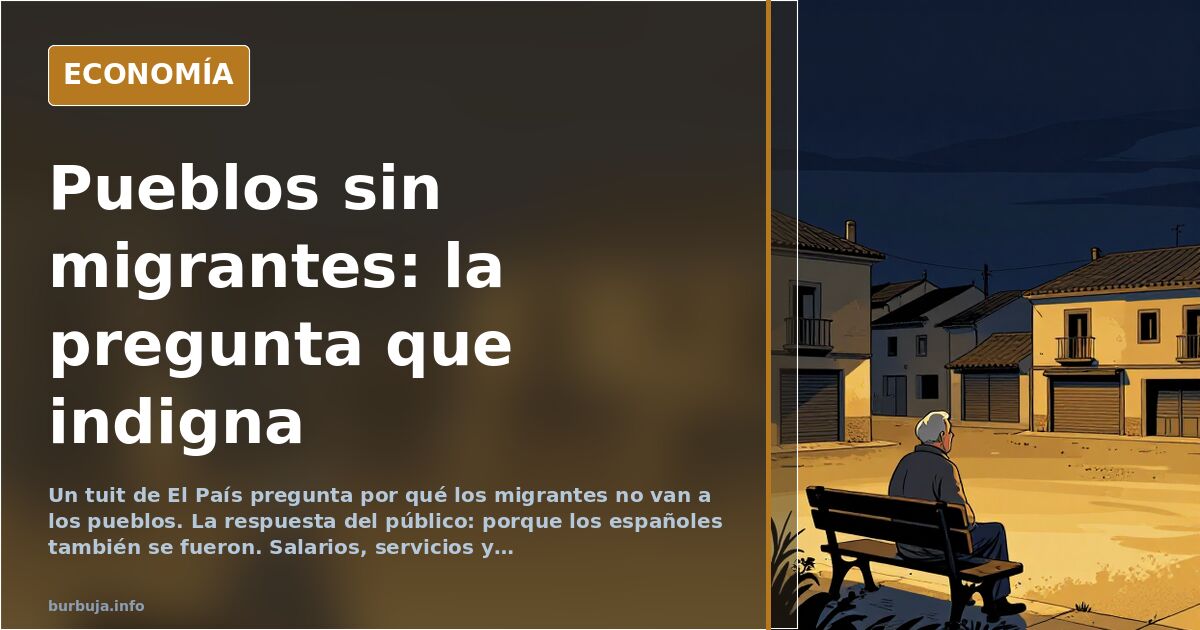
El País asks why migrants do not go to villages
A tweet by El País raises a mystery that many readers consider already solved: while foreigners desperately seek work in big cities, rural Spain has plenty of vacancies for electricians, builders, and elderly caregivers. Why are there no migrants in the smallest towns? The answer given by part of the audience is as simple as it is uncomfortable: because these villages empty out for Spaniards too.
The media outlet has never set foot in a village, some assert. Others directly deny the premise: in Mediterranean Spain, they argue, small municipalities are full of foreign population, with figures that in some cases approach or exceed those of locals. The discussion quickly shifts to the labor market, housing, and aging, but the starting point—the alleged anomaly that a migrant wouldn't want to settle in a town on the Meseta—is dismantled by a basic question: why would they want to if young Spaniards themselves have been leaving for decades?
Why Spaniards also flee from villages
The most repeated argument is the most obvious: villages empty out because they offer no services, stable employment, or social life. If Spaniards leave, why should a migrant stay? The lack of young women, transport, nearby healthcare, and opportunities turns many municipalities into what one participant describes as "a living death." It is not a matter of nationality, but of economic viability.
Some add an expectation factor: the migrant who arrives seeks the city because there they find community, networked work, and possibilities for regularization. In the village, isolation weighs more than the job offer. And the jobs available—construction, care, agriculture—do not always compensate.
Wages nobody wants to pay
A recurring analysis points out that the problem is not a lack of workforce, but a lack of decent wages. When a construction worker earned €3,000 and a cashier could buy a semi-detached house, these trades had demand. With €1,200 a month and no prospect of housing, neither Spaniards nor migrants want these jobs. One participant's testimony is illustrative: a Colombian bricklayer earns per day what a senior consultant at Deloitte does; the cleaner and her painter husband, with twenty years in Spain, cannot keep up. The problem is not who comes, but how much is paid.
Rural Spain already has migrants
The article's premise is also challenged with data from direct experience. In Murcia, specifically in Campo de Cartagena and Valle del Guadalentín, it is claimed that foreigners have surpassed nationals in several municipalities. In deep Catalonia—Olot, La Garriga, Ripoll, Granollers—it is stated that no place is spared. In Castilla y León, a participant recounts that the first thing he saw upon arriving at his family's village was a black child. The conclusion is that the headline does not describe reality, but rather an editorial bias.
The background: aging and generational replacement
Beyond the noise, the underlying issue is the aging of emptied-out Spain and the lack of succession in essential trades. Villages need caregivers, electricians, and builders, but they also need services, housing, and community. Without that, no distribution policy will work. And while public debate focuses on why they don't come, the real question is why those who were there left.
The disorienting fact: at interprovincial bus stations, according to one participant's observation, only one in five travelers is Spanish. Rural Spain is not empty of migrants; it is empty of services.
A tweet by El País raises a mystery that many readers consider already solved: while foreigners desperately seek work in big cities, rural Spain has plenty of vacancies for electricians, builders, and elderly caregivers. Why are there no migrants in the smallest towns? The answer given by part of the audience is as simple as it is uncomfortable: because these villages empty out for Spaniards too.
The media outlet has never set foot in a village, some assert. Others directly deny the premise: in Mediterranean Spain, they argue, small municipalities are full of foreign population, with figures that in some cases approach or exceed those of locals. The discussion quickly shifts to the labor market, housing, and aging, but the starting point—the alleged anomaly that a migrant wouldn't want to settle in a town on the Meseta—is dismantled by a basic question: why would they want to if young Spaniards themselves have been leaving for decades?
Why Spaniards also flee from villages
The most repeated argument is the most obvious: villages empty out because they offer no services, stable employment, or social life. If Spaniards leave, why should a migrant stay? The lack of young women, transport, nearby healthcare, and opportunities turns many municipalities into what one participant describes as "a living death." It is not a matter of nationality, but of economic viability.
Some add an expectation factor: the migrant who arrives seeks the city because there they find community, networked work, and possibilities for regularization. In the village, isolation weighs more than the job offer. And the jobs available—construction, care, agriculture—do not always compensate.
Wages nobody wants to pay
A recurring analysis points out that the problem is not a lack of workforce, but a lack of decent wages. When a construction worker earned €3,000 and a cashier could buy a semi-detached house, these trades had demand. With €1,200 a month and no prospect of housing, neither Spaniards nor migrants want these jobs. One participant's testimony is illustrative: a Colombian bricklayer earns per day what a senior consultant at Deloitte does; the cleaner and her painter husband, with twenty years in Spain, cannot keep up. The problem is not who comes, but how much is paid.
Rural Spain already has migrants
The article's premise is also challenged with data from direct experience. In Murcia, specifically in Campo de Cartagena and Valle del Guadalentín, it is claimed that foreigners have surpassed nationals in several municipalities. In deep Catalonia—Olot, La Garriga, Ripoll, Granollers—it is stated that no place is spared. In Castilla y León, a participant recounts that the first thing he saw upon arriving at his family's village was a black child. The conclusion is that the headline does not describe reality, but rather an editorial bias.
The background: aging and generational replacement
Beyond the noise, the underlying issue is the aging of emptied-out Spain and the lack of succession in essential trades. Villages need caregivers, electricians, and builders, but they also need services, housing, and community. Without that, no distribution policy will work. And while public debate focuses on why they don't come, the real question is why those who were there left.
The disorienting fact: at interprovincial bus stations, according to one participant's observation, only one in five travelers is Spanish. Rural Spain is not empty of migrants; it is empty of services.
Summary of a discussion on Burbuja.info - Foro de economía, actualidad y política., translated from Spanish and reviewed before publication. Read the full discussion (173 replies).
More summaries
-
Basque Country tourism outpaces Castilla y León
Forum debate compares Basque tourism with Castilla y León, citing French border proximity and high prices as key factors.
-
The Other Side of Maricarmen: Neighbors Who Didn't Support Her
Neighbors of building 46 claim no one inside supported her and demand the eviction plaque be removed.
-
Court order paves way for fines against illegal football streamers
A court ruling forces internet providers to hand LaLiga user data, including IP, name, address and ID number, for connections to pirate servers.
-
Spain's Full Bars Are Closing: Rising Costs Erase Margins
Rising costs for supplies, taxes, and social contributions leave Spanish bars with no profit margin despite full tables.
-
Spanish comedian Arévalo dies at 76, reigniting humor debate
Arévalo, a staple of Spain's 1980s TV, died at 76. His passing revived debates on politically incorrect humor and generational divides.
-
Madrid dazzles tourists but exhausts residents
Tourist saturation, traffic jams and soaring rents in central Madrid create a divide between visitor and resident experiences.