
Spain bans alcohol in kids' play areas under new law
Health Minister Mónica García introduces legislation prohibiting alcohol sales in venues hosting children's events, sparking debate over scope and impact.
English · Original discussion in Spanish · Published
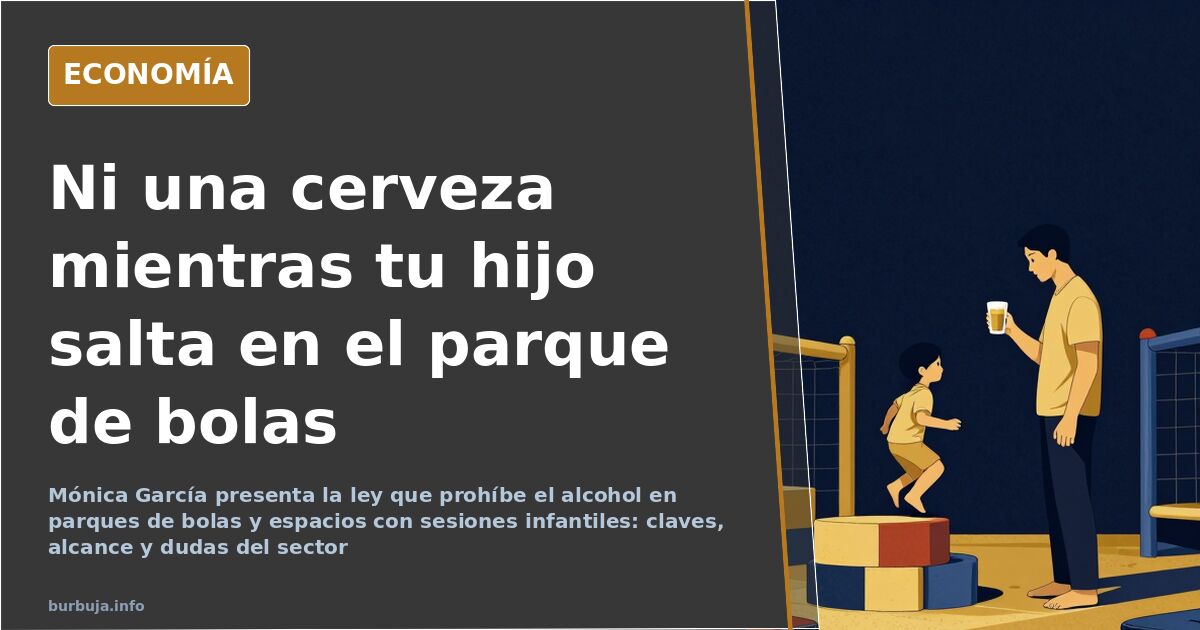
No more beer at the ball pit: inside Spain's new alcohol rules
Spanish Health Minister Mónica García presented key details of the draft bill aimed at preventing underage drinking and its effects. The text, first leaked last summer, now begins its parliamentary journey. It bans alcohol consumption in "sports centers, leisure venues, or public entertainment spaces when sessions are specifically designed for minors." In practice, this means no alcohol service in a ball pit park with an attached bar. During the presentation, Javier Padilla used concerts as an example: attendees could drink at pop star Aitana’s show, but not at children’s singer Luli Pampín’s.
The announcement has been met with skepticism by many. Not because people defend adults getting drunk among slides, but due to suspicions that the law is performative. The most common complaint isn’t that the measure is useless, but that it solves a problem few have actually witnessed.
What exactly does the new alcohol law prohibit?
The text goes beyond ball pits. It includes educational programs, restrictions on alcohol sales and supply, advertising regulations, and bans on consumption in educational centers, sports events, and in the presence of minors. Essentially, the perimeter extends to any space hosting sessions conceived for children.
Interpretation is key. A children’s leisure venue with a bar is affected; an adult concert is not. The criterion is the nature of the event, not the occasional presence of a minor. This creates ambiguity: What about a bar terrace next to a public park? Or a private party in a rented venue where parents bring their own drinks?
Doubts about the law's real scope are a recurring theme. Some argue private parties are exempt; others believe venues will be forced to choose between children’s birthdays and serving alcohol. No one knows yet, as the bill is just starting its legislative process.
Parents’ argument: "Nobody gets drunk at a birthday"
The most frequent objection doesn’t deny the issue of alcohol; it narrows it. Those who have organized or attended dozens of birthdays in ball pit parks say adults typically have "a couple of beers," served in plastic cups, without incident. The atmosphere doesn’t encourage excess. If someone overindulges, the problem is that individual, not the bar.
This leads to accusations of paternalism. Critics argue child-rearing is a family matter. The state should only intervene if absolutely necessary, and this seems like a poor solution. The tobacco comparison is popular: smoking was banned in children’s areas and accepted; now drinking is prohibited, seen as another tightening of rules on similar ground.
The counterargument is equally direct: there should be no alcohol where children are, period. Not because a child sees a beer, but because an adult might get drunk and cause a scene in front of them. The image of a parent getting intoxicated at a birthday party exists, even if it’s not the norm.
Economic impact on children’s leisure venues
Here, the debate becomes financial. Many of these businesses barely survive, and the bar contributes significantly to margins. If venues cannot sell alcohol during children’s sessions, some may face closure. The likely alternative is familiar: parents rent the space, bring their own food and drinks, leaving the venue without that revenue.
The paradox is clear. If the goal is to prevent children from seeing adults drink, banning sales in the bar doesn’t stop a parent from bringing a beer in a cooler bag. And if the aim is to protect minors from consumption, the law doesn’t touch cans brought through the door.
The sugar comparison arises naturally. Sugary drinks remain allowed in these same venues, despite the habits they foster. The consistency of health criteria is, at best, questionable.
Underlying suspicion: legislating for appearances
The harshest criticism targets the method, not the specific measure. Laws accumulate, regulating trivial matters while ignoring deeper issues. The sense that prohibitions are enacted for headlines rather than results pervades much of the discussion.
Some frame this within a broader trend: a state interfering with what you drink while your child plays. Others respond that this view is exaggerated, arguing a health regulation doesn’t make anyone totalitarian, and that the real issue is the lack of a genuine problem justifying the rule.
A striking fact is that selling alcohol to minors was already illegal before this law. Drinking in the street was also banned. Each new rule adds a layer to something already regulated, fueling the idea that the goal is gesture, not effect.
It remains to be seen what survives parliamentary review. Given how similar laws have been handled, a reasonable prediction is that details will be softened while keeping the headline ban. Whether the final result changes anything in practice or just adds another prohibition to the catalog won’t be known until the law leaves Congress.
Also available in: Deutsch
Summary of a discussion on Burbuja.info - Foro de economía, actualidad y política., translated from Spanish and reviewed before publication. Read the full discussion (144 replies).
More summaries
-
Mónica García, Spain's new health minister, sparks controversy
Mónica García takes over Spanish healthcare amid scrutiny of her pandemic record, social housing benefits, and political clashes.
-
Mónica García, a doctor who never practised, is Spain's Health Minister
Mónica García, a qualified doctor, heads Spain's Health Ministry, and her appointment has sparked backlash: critics say she has never actually practised medicine.
-
Spain's Health Minister booed in Ceuta over migrant healthcare
Health Minister Mónica García was unable to speak in Ceuta: healthcare workers greeted her with chants of "resign" over her handling of the mass arrival of migrants.
-
Pornhub’s VP is an Orthodox Rabbi: The Ethical Paradox
Solomon Friedman, an ordained Orthodox rabbi, serves as Pornhub’s vice president, sparking debate on ethics, parental responsibility, and the adult industry’s influence.
-
Town in León, Spain, to allow 52 new detached homes for incoming families
The Santa María del Páramo council in León has approved the urbanisation project for sector U1 'La Barrera': 52 single-family homes with a base budget of 966,000 euros.
-
Pedro Sánchez: legitimacy, coalition deals and wear at Spain's helm
Pedro Sánchez marks eight years at La Moncloa without winning an election. His legitimacy, coalition deals and political wear are the focus of economic and political analysis.