
Spain 2004 vs Today: Salaries, Property, and the Cost of Living
In Madrid, buying a home took four years of net salary in 2004; now it takes eleven. Here is the clash between the nostalgia of the past and current economic data.
English · Original discussion in Spanish · Published
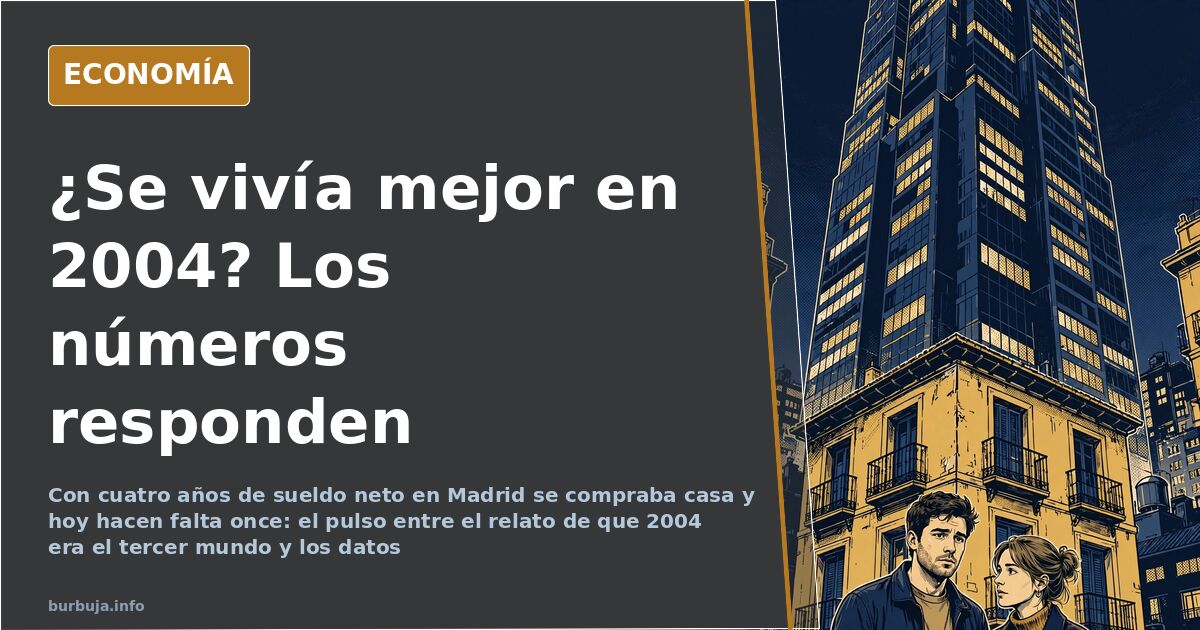
Did life improve in 2004? Salaries and housing prices clarify the debate
Did life improve twenty years ago? The doubt sounds like post-dinner chatter, but it has been circulating for a long time with two incompatible answers. One side argues that 2004 was little short of the third world: no mobile phones, no streaming platforms, and perversos salaries. Opposing this is an uncomfortable calculation: in Madrid, buying a home required four years of net salary; today, it would take eleven. Both cannot be true at the same time.
How much did a flat cost in 2004 compared to today?
Housing prices are where nostalgia turns into arithmetic. The examples commonly cited place a 90-square-meter flat in Marbella in the early 1980s at one million pesetas; one of 120 square meters in 1985 at three million. With the salaries of that era, the relationship between salary and bricks was different, and it is remembered as something closed without a thirty-year mortgage.
It is worth adding a nuance that almost no one disputes: the good cycle from 2000 to 2007 was good precisely because it was inflated by real estate itself. The best times and the bubble are the same thing viewed from two angles. This explains why the end came so quickly and why the hangover lasted so long.
How much was earned in the 1980s and 1990s?
The numbers coming to light are eloquent. In the 1980s, earning 100,000 pesetas made you a winner; in the 1990s, no ordinary job exceeded 130,000. A specialized position hovered around just over 200,000 pesetas in 1992, and in the provinces, it was enough for rent, a car, and some savings. A summer waiter detailed 550,000 pesetas plus 40,000 in tips between June and September, at sixteen years old.
This broke in two blows: the change from the peseta to the euro, and then the crisis. The term mileurista (a worker earning 1,000 euros) was coined in 2005, when the market floor became the ceiling of previous years. Salaries remained stagnant while everything else rose.
There is another clash regarding the Consumer Price Index (CPI). It is argued that in three years, the official index rose by 15 points while the grocery basket became 60% more expensive. Statistics say one thing; the supermarket receipt says another. There is no nostalgia there, only accounts that do not add up.
Does owning two mobile phones make you richer than your father?
This is the most common argument to deny nostalgia: today any home accumulates televisions, computers, mobile phones, and subscriptions, things unthinkable back then. The counterpoint is devastating. Technology does not measure wealth; it depreciates on its own, and carrying in your pocket the computing power of a space agency says nothing about the purchasing power of the person carrying it.
The prices of the era confirm this. A domestic computer from the 1980s cost between 60,000 and 80,000 pesetas, a whole salary, and was bought as a long-term investment. In 2004, a 28-inch tube TV cost 240 euros; a 40-inch flat screen, 1,300 euros, with mediocre image quality. Comparing that catalog with the current one is comparing two worlds, but not two income levels.
Was it normal for teachers to hit students in primary school?
The educational chronology generates its own controversy: the LOGSE (General Law on Education) dates from 1990, and by the 1994-95 academic year it was already applied, while the EGB (Basic General Education) was phased out with years of coexistence between both systems. Those who studied in the 1980s and early 1990s describe hair pulling, ruler strikes on the hand, and punishments facing the wall. The interesting part is not that it peine, but that back then almost no one considered it reportable.
And in 2004? There, most agree that it no longer was. But the exact years of the cutoff are debated, and this discussion fuels the suspicion that someone is reshuffling the narrative.
Were there far-right groups and street beatings in 2004?
There were ultra groups, with marginal presence and closely linked to football, and clashes between urban tribes that now sound like archaeology. It is described as residual, not as a plague, although some recall specific incidents. Both things are compatible: there was violence, but it was neither massive nor organized.
The testimony of those who were active in these environments places the marginality of the phenomenon already in 2007. The fight is not about whether it existed, but about the size attributed to it now.
Why is it claimed that Google is erasing the past?
The accusation is based on specific cases: reviews that disappear, distribution lists where an iconic actor falls to the last positions despite being on the poster. The literary reference is 1984, published in 1949, and the feeling that rewriting the past is cheaper than ever. It is necessary to separate two things: an algorithm that orders by opaque criteria is not the same as deliberate erasure, and no proof is provided for the latter.
Another matter is perception. The fact that a large part of internet users distrust the tool used to inform them is already a fact with consequences, regardless of what the search engine does internally.
There remains the usual consolation: if the past can be rewritten, so can the present. The only figure that cannot be edited is the end-of-month bill. That remains there, stubbornly, reminding us that nostalgia is free, but housing is not.
Did life improve twenty years ago? The doubt sounds like post-dinner chatter, but it has been circulating for a long time with two incompatible answers. One side argues that 2004 was little short of the third world: no mobile phones, no streaming platforms, and perversos salaries. Opposing this is an uncomfortable calculation: in Madrid, buying a home required four years of net salary; today, it would take eleven. Both cannot be true at the same time.
How much did a flat cost in 2004 compared to today?
Housing prices are where nostalgia turns into arithmetic. The examples commonly cited place a 90-square-meter flat in Marbella in the early 1980s at one million pesetas; one of 120 square meters in 1985 at three million. With the salaries of that era, the relationship between salary and bricks was different, and it is remembered as something closed without a thirty-year mortgage.
It is worth adding a nuance that almost no one disputes: the good cycle from 2000 to 2007 was good precisely because it was inflated by real estate itself. The best times and the bubble are the same thing viewed from two angles. This explains why the end came so quickly and why the hangover lasted so long.
How much was earned in the 1980s and 1990s?
The numbers coming to light are eloquent. In the 1980s, earning 100,000 pesetas made you a winner; in the 1990s, no ordinary job exceeded 130,000. A specialized position hovered around just over 200,000 pesetas in 1992, and in the provinces, it was enough for rent, a car, and some savings. A summer waiter detailed 550,000 pesetas plus 40,000 in tips between June and September, at sixteen years old.
This broke in two blows: the change from the peseta to the euro, and then the crisis. The term mileurista (a worker earning 1,000 euros) was coined in 2005, when the market floor became the ceiling of previous years. Salaries remained stagnant while everything else rose.
There is another clash regarding the Consumer Price Index (CPI). It is argued that in three years, the official index rose by 15 points while the grocery basket became 60% more expensive. Statistics say one thing; the supermarket receipt says another. There is no nostalgia there, only accounts that do not add up.
Does owning two mobile phones make you richer than your father?
This is the most common argument to deny nostalgia: today any home accumulates televisions, computers, mobile phones, and subscriptions, things unthinkable back then. The counterpoint is devastating. Technology does not measure wealth; it depreciates on its own, and carrying in your pocket the computing power of a space agency says nothing about the purchasing power of the person carrying it.
The prices of the era confirm this. A domestic computer from the 1980s cost between 60,000 and 80,000 pesetas, a whole salary, and was bought as a long-term investment. In 2004, a 28-inch tube TV cost 240 euros; a 40-inch flat screen, 1,300 euros, with mediocre image quality. Comparing that catalog with the current one is comparing two worlds, but not two income levels.
Was it normal for teachers to hit students in primary school?
The educational chronology generates its own controversy: the LOGSE (General Law on Education) dates from 1990, and by the 1994-95 academic year it was already applied, while the EGB (Basic General Education) was phased out with years of coexistence between both systems. Those who studied in the 1980s and early 1990s describe hair pulling, ruler strikes on the hand, and punishments facing the wall. The interesting part is not that it peine, but that back then almost no one considered it reportable.
And in 2004? There, most agree that it no longer was. But the exact years of the cutoff are debated, and this discussion fuels the suspicion that someone is reshuffling the narrative.
Were there far-right groups and street beatings in 2004?
There were ultra groups, with marginal presence and closely linked to football, and clashes between urban tribes that now sound like archaeology. It is described as residual, not as a plague, although some recall specific incidents. Both things are compatible: there was violence, but it was neither massive nor organized.
The testimony of those who were active in these environments places the marginality of the phenomenon already in 2007. The fight is not about whether it existed, but about the size attributed to it now.
Why is it claimed that Google is erasing the past?
The accusation is based on specific cases: reviews that disappear, distribution lists where an iconic actor falls to the last positions despite being on the poster. The literary reference is 1984, published in 1949, and the feeling that rewriting the past is cheaper than ever. It is necessary to separate two things: an algorithm that orders by opaque criteria is not the same as deliberate erasure, and no proof is provided for the latter.
Another matter is perception. The fact that a large part of internet users distrust the tool used to inform them is already a fact with consequences, regardless of what the search engine does internally.
There remains the usual consolation: if the past can be rewritten, so can the present. The only figure that cannot be edited is the end-of-month bill. That remains there, stubbornly, reminding us that nostalgia is free, but housing is not.
Also available in: Deutsch
Summary of a discussion on Burbuja.info - Foro de economía, actualidad y política., translated from Spanish and reviewed before publication. Read the full discussion (241 replies).
More summaries
-
ECB: Spanish housing market 85% more overvalued than Europe's
ECB warns: Spain's housing overvaluation indicator exceeds 20%, 85% above the Eurozone average. Bubble in sight?
-
Málaga: 160,800 unemployed as housing gets 8% pricier
Málaga adds 29,500 unemployed, jobless rate hits 19.37%, while price per square metre rises 8% and average salary is around €18,000
-
Madrid Tapas: 90 Euros for Three in the City Center
A forum user calculates that sharing tapas and drinks for three in central Madrid costs 90 euros, highlighting rising hospitality prices.
-
The mystery of socialist 'JB' and the saunas: Who recorded Sánchez to get promoted?
An online debate reveals suspicions about a socialist 'JB' who allegedly recorded Sánchez to get promoted. Names like Bono, Borrell, and Blanco come into play.
-
Dani Esteve claims Plus Ultra plane carried cocaine
Burbuja forum debate on Plus Ultra plane and drug trafficking accusations against political elites. Narco-state or firewall?
-
Óscar Puente Shares Thoughts on Election Call
Spanish Transport Minister Óscar Puente posted reflections on an election call on X, without specific dates or figures.