
Russia withdraws from Kherson a month after annexation
Russia leaves Kherson weeks after annexing it. The retreat to the Dnieper divides analysts: historic humiliation or tactical withdrawal?
English · Original discussion in Spanish · Published
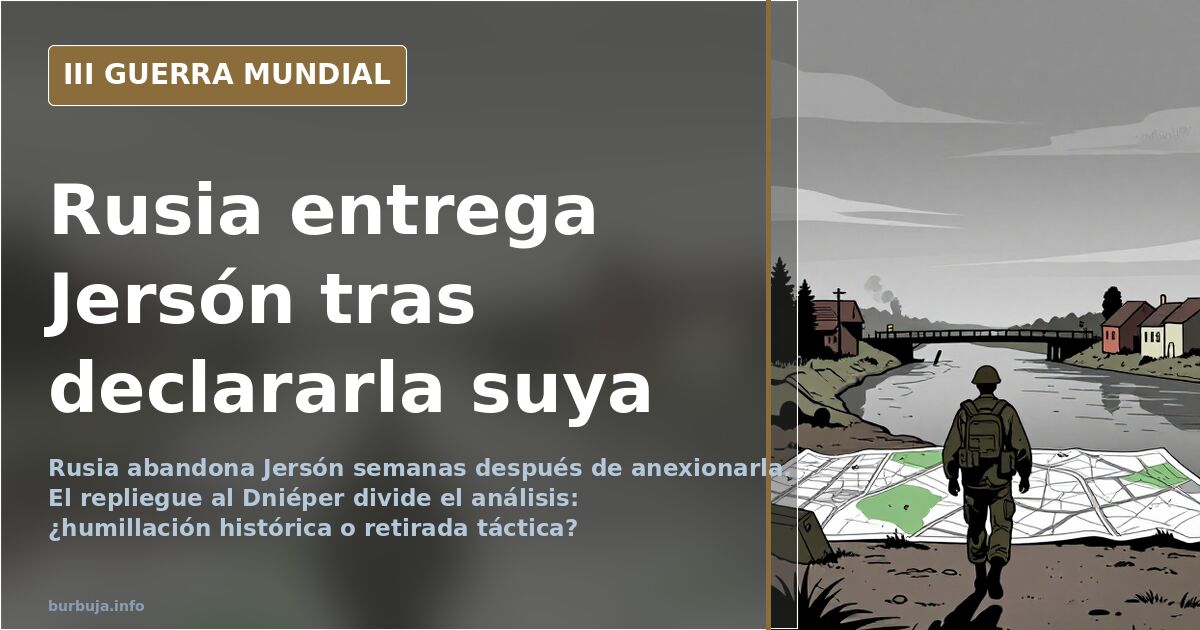
Russia abandons Kherson a month after declaring it its own
The Russian withdrawal from Kherson hands the enemy a city that Moscow had declared part of its territory just weeks earlier. The retreat to the left bank of the Dnieper, presented by supporters as a military command decision, leaves the capital of the region Russia recently incorporated via referendum in Ukrainian hands. The central question is not whether a city has been lost, but whether this constitutes a humiliation or a maneuver to save the army.
What does Russia stand to lose by leaving Kherson?
This is no ordinary prize. Some note it was the first major city taken by Russian troops at the start of the conflict, and its value is not symbolic: it dominates land access to Odesa and controls water supplies to Crimea. The core argument is that losing this side of the river weakens the goal of cutting Ukraine off from the sea and surrenders control of key dams.
Conversely, defenders of the withdrawal insist that terrain north of the Dnieper is difficult to hold. With the river as a natural barrier and infrastructure already damaged, maintaining positions through winter appears an exercise in attrition. Some argue Russian forces only retreated because they saw advantage in doing so: avoiding a bloodbath or reorganizing the front.
"A timely retreat is a victory": the narrative denying defeat
Here lies the crux of the disagreement. One school of analysis argues that if military command decided on withdrawal, it knows the true situation of its troops better than anyone. Under this logic, an orderly retreat beats collapse: the grave scenario would have been like Kharkiv or Izium, with Ukrainians attacking, Russian lines crumbling, and intact equipment falling into enemy hands.
The other camp rejects this framing. They maintain the withdrawal is happening chaotically anyway, that the territory remains Ukrainian, and that claiming otherwise—even on state TV—does not make a zone Russian. Critics sum up the episode in an uncomfortable phrase: it’s not that they left, it’s that they should never have claimed it as theirs.
Annexing territory and abandoning it weeks later
The timeline reveals the tension. Russia staged an annexation with full ritual, incorporated the region into the federation, and shortly after handed it over without fighting for its capital. For critics, this isn’t a tactical withdrawal; it’s a deeper humiliation than if nothing had been annexed: you don’t lose a conquered city, you lose one you counted as your own.
Attempts to downplay Kherson’s importance failed internal comparison. It was the first place invaded. Meanwhile, dozens of villages deep in Donbas, unknown to many before the conflict, are now presented as vital. The narrative shifts depending on what needs defending.
Precedents: Poland 1920 and Finland 1941
Historical memory has been invoked both ways. Against the idea that Moscow had never experienced anything like this, various messages cite precedents where humiliation was greater. In 1920, failing to agree on ceding Poland and Lithuania in time cost Baltic republics, Belarus, and all of Ukraine in just eleven days of offensive, according to one such message. In 1941, the standoff with Finland added another bitter chapter. And Afghanistan closed the list with an army that ended up surrendering an entire country. The lingering question: is this really the worst blow Russia has taken in modern history?
What can be expected from here on
The front settles along the Dnieper, and no one considers the matter closed. Some suggest that after Kherson, the next declared target would be Crimea, while others doubt Ukraine has the capacity to push Russia out of all its territory. With new conscripts mobilized, the uncertainty moves to winter. Given recent reversals, prudence dictates not betting yet: those who deemed the Russian advance unstoppable a year ago now explain its retreat as proof of military wisdom.
The Russian withdrawal from Kherson hands the enemy a city that Moscow had declared part of its territory just weeks earlier. The retreat to the left bank of the Dnieper, presented by supporters as a military command decision, leaves the capital of the region Russia recently incorporated via referendum in Ukrainian hands. The central question is not whether a city has been lost, but whether this constitutes a humiliation or a maneuver to save the army.
What does Russia stand to lose by leaving Kherson?
This is no ordinary prize. Some note it was the first major city taken by Russian troops at the start of the conflict, and its value is not symbolic: it dominates land access to Odesa and controls water supplies to Crimea. The core argument is that losing this side of the river weakens the goal of cutting Ukraine off from the sea and surrenders control of key dams.
Conversely, defenders of the withdrawal insist that terrain north of the Dnieper is difficult to hold. With the river as a natural barrier and infrastructure already damaged, maintaining positions through winter appears an exercise in attrition. Some argue Russian forces only retreated because they saw advantage in doing so: avoiding a bloodbath or reorganizing the front.
"A timely retreat is a victory": the narrative denying defeat
Here lies the crux of the disagreement. One school of analysis argues that if military command decided on withdrawal, it knows the true situation of its troops better than anyone. Under this logic, an orderly retreat beats collapse: the grave scenario would have been like Kharkiv or Izium, with Ukrainians attacking, Russian lines crumbling, and intact equipment falling into enemy hands.
The other camp rejects this framing. They maintain the withdrawal is happening chaotically anyway, that the territory remains Ukrainian, and that claiming otherwise—even on state TV—does not make a zone Russian. Critics sum up the episode in an uncomfortable phrase: it’s not that they left, it’s that they should never have claimed it as theirs.
Annexing territory and abandoning it weeks later
The timeline reveals the tension. Russia staged an annexation with full ritual, incorporated the region into the federation, and shortly after handed it over without fighting for its capital. For critics, this isn’t a tactical withdrawal; it’s a deeper humiliation than if nothing had been annexed: you don’t lose a conquered city, you lose one you counted as your own.
Attempts to downplay Kherson’s importance failed internal comparison. It was the first place invaded. Meanwhile, dozens of villages deep in Donbas, unknown to many before the conflict, are now presented as vital. The narrative shifts depending on what needs defending.
Precedents: Poland 1920 and Finland 1941
Historical memory has been invoked both ways. Against the idea that Moscow had never experienced anything like this, various messages cite precedents where humiliation was greater. In 1920, failing to agree on ceding Poland and Lithuania in time cost Baltic republics, Belarus, and all of Ukraine in just eleven days of offensive, according to one such message. In 1941, the standoff with Finland added another bitter chapter. And Afghanistan closed the list with an army that ended up surrendering an entire country. The lingering question: is this really the worst blow Russia has taken in modern history?
What can be expected from here on
The front settles along the Dnieper, and no one considers the matter closed. Some suggest that after Kherson, the next declared target would be Crimea, while others doubt Ukraine has the capacity to push Russia out of all its territory. With new conscripts mobilized, the uncertainty moves to winter. Given recent reversals, prudence dictates not betting yet: those who deemed the Russian advance unstoppable a year ago now explain its retreat as proof of military wisdom.
Also available in: Deutsch
Summary of a discussion on Burbuja.info - Foro de economía, actualidad y política., translated from Spanish and reviewed before publication. Read the full discussion (116 replies).
More summaries
-
Russia Cedes Kherson Banks of Dnipro River, Ukraine Crosses
Russia abandons the right bank of the Dnipro in Kherson. Some see it as a tactical masterstroke, others as the surrender of a symbol.
-
Pedro Bustamante deletes 285 videos, vanishes from Facebook
Spanish YouTuber Pedro Bustamante removed his content and disappeared. Rumors place him in Munich, reading German press.
-
Spain's Ukraine Role Sparks Forum Debate
Forum thread weighs national priorities against allied solidarity and Russia's role in European destabilization.
-
Trump Attack Suspect Donated to Democrats, Supported Ukraine
Ryan Wesley Routh, suspect in the second Trump assassination attempt, made 19 donations to Democratic causes and posted about recruiting mercenaries for Ukraine.
-
Trump Seeks China's Help to Secure Strait of Hormuz
Trump asks Beijing to guarantee Hormuz navigation and considers easing Russia sanctions. This signals the end of the unipolar order.
-
Naked detainees in trucks: Israel's unresolved legal dispute
Israel transports naked detainees, citing military-age men in evacuation zones. Legal debate centers on degrading treatment.