
South Africa: Land Expropriation and White Farmer Exodus
Families with deep roots in South Africa flee amid insecurity and land expropriation, a trend largely ignored by mainstream media.
English · Original discussion in Spanish · Published
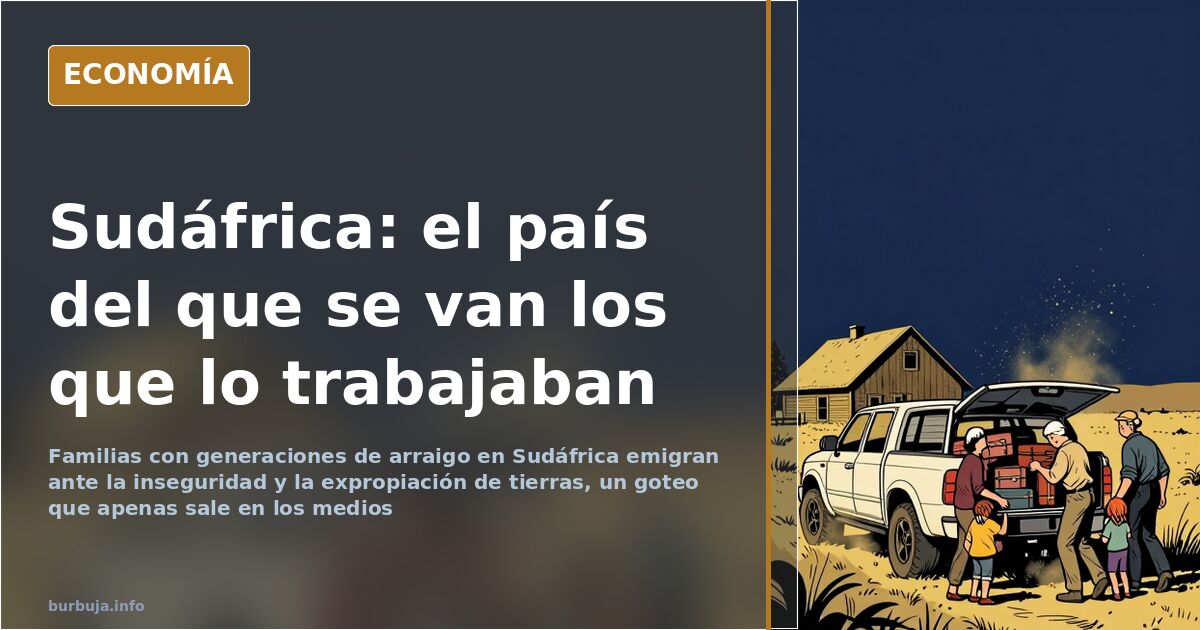
South Africa: Land Expropriation and White Farmer Exodus
A woman of Galician and Scottish descent, raised in a Johannesburg gated community, has relocated to Galicia with her parents. She is not alone. Her case illustrates a phenomenon rarely covered by mainstream media: the steady exodus of families with generations of roots in the country, weighing the cost of staying against leaving. This is not an isolated incident but a sustained erosion driven by insecurity, property pressure, and institutional decay.
Life in Johannesburg's Gated Communities
Daily life for residents involves permanent fortification. Affluent neighborhoods function as closed condominiums, with residents driving to malls or schools and returning. Johannesburg's city center has degraded to the point where walking there is discouraged, even during the day. Recurring anecdotes include carrying trash in one hand and an insured firearm in the other, keeping a loaded gun on the nightstand, and neighbors leaving weapons for new tenants.
«Taking out the trash means holding a bag in one hand and a pistol in the other», summarizes one of the most repeated accounts. Robberies at gunpoint outside gas stations or 24-hour shops are described as commonplace. Aggressions against acquaintances now living in Europe are recounted without turning any single case into a statistic.
It is important to clarify who this violence targets, according to these testimonies. It is not directed solely at white property owners: Indian and Portuguese merchants, prominent in the commercial sector, are also frequent targets, as are African communities in conflict with each other. Insecurity, they insist, does not discriminate by tonalidad when targeting a house that appears lucrative.
The Historical Dispute Over Settlement
Much of the debate centers on maps. The recurring thesis is that the southern and western parts of the country were sparsely populated when Dutch colonists arrived, and that they did not encounter Xhosa or Zulu peoples until decades later. The Xhosa and Zulu, it is argued, migrated to the region in the 17th century from areas thousands of kilometers to the north. The Bantu migration, it is added, began about 2,000 years ago from the Cameroon region.
This history is more uncomfortable than the popular narrative. The Khoisan peoples —Bushmen and Hottentots— inhabited large parts of the east and south before being displaced by later Bantu populations, a movement some compare to major European migrations. Proponents of this view insist that southern Africa was far from the pre-colonial paradise sometimes imagined.
Land Expropriation and Its Economic Cost
The economic core emerges quickly: land reform and the expropriation of land from white owners, viewed by some as historical debt and by others as uncompensated plunder. The result, according to those trinc the issue, is an agricultural sector losing human capital, legal security, and investment capacity, alongside emigration that takes away those sustaining the most productive farms.
Parallel to this is a continental-scale figure: France reportedly extracts over €400 billion annually from its African sphere of influence, according to available data. This comparison underscores that the continent remains a chessboard where others play. And with the same conclusion as always: those with something to lose lose it first.
The Narrative Absent from Television
A recurring complaint throughout these exchanges is that this story does not appear in the media. Some recall how 1980s public television portrayed whites as the villains, and lament that archives of interviews with the last Rhodesian officials are no longer accessible. This is not a verifiable thesis —posed as suspicion, not proof— but it explains why the issue resonates strongly in certain circles yet rarely appears on front pages.
The point where analysis always stalls is the same. Insecurity can be documented, expropriation tracked, and emigration measured. What no one quantifies is the cost of a country emptying itself of those who worked it for generations. And the counter, meanwhile, does not stop.
Also available in: Deutsch
Summary of a discussion on Burbuja.info - Foro de economía, actualidad y política., translated from Spanish and reviewed before publication. Read the full discussion (231 replies).
More summaries
-
Rural assets fail to attract urban partner in dating show
Land and livestock are not enough: a televised rejection reignites the debate on rural versus urban lifestyles.
-
Europe calls for water and food stockpiling amid possible Russian attack
Switzerland joins Germany, Poland, France, and Finland recommending water and food stockpiling ahead of potential Russian attack.
-
46% of Spanish Voters Receive Public Funds, Analysis Finds
A journalistic analysis claims 46% of Spain's electoral census receives pensions, aid, or public employment. This figure constrains any potential reform.
-
Europe hands out 72-hour crisis guides as Brent nears $117
The UK, Norway, the Netherlands and the EU are distributing 72-hour crisis guides while Brent trades around $117 and a purported announcement of military action against Iran circulates online.
-
Spain's PSOE and the deportation orders that never get enforced
Spain's Government left more than 48,000 deportation orders unenforced in 2025, according to reports, and erased 1.1 million criminal records over five years.
-
Spain's November extra pension payment lands before the 23N vote
The November extra pension payment is being paid early, and millions of Spanish pensioners will receive it before voting. The electoral calendar and the debate over the pensioner vote.