
Sounds every 30 minutes at 4 km: the rescue that doesn't exist
Media outlets confirm banging every 30 minutes at 4,000 meters, but the deepest submarine rescue ever achieved reached only 1,500 feet
English · Original discussion in Spanish · Published
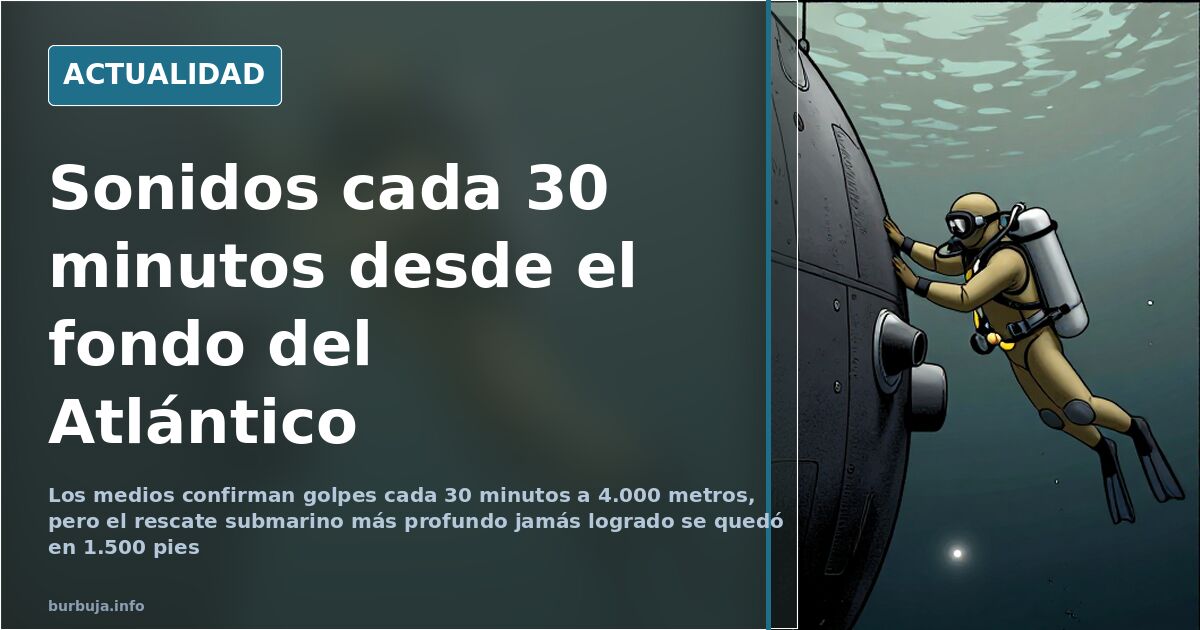
Noises every 30 minutes at 4 km: the depth where rescue is impossible
In June 2023, a tourist submersible disappeared during a dive to the wreck of the Titanic. Five people were on board. On the surface, a fleet of ships and aircraft swept a huge area of the North Atlantic. Underwater, at around 4,000 meters, a vehicle from which no signal was coming. Until sonar picked up something: banging every thirty minutes. A regular, almost metronomic rhythm that for a few hours was read as proof that someone was still alive at the bottom. International media confirmed the existence of those sounds. The problem was not hope: it was physics.
How deep is the submersible and what pressure can it withstand
Four kilometers of water above. The Titanic wreck, the goal of the alucinación, lies at around 13,000 feet, a little less than 4,000 meters. At that depth, every square centimeter of the hull withstands pressure equivalent to 400 times that at the surface, according to the calculation circulating during the search. It is not a decorative figure: it is why any hollow object that descends that far gambles its structural integrity on every dive.
The question hanging over the entire operation was whether such a craft loses pressure before anyone can reach it. The answer, the one given by the case material itself, was uncomfortable: the deepest submarine rescue ever carried out stopped at 1,500 feet. The submersible, in the best-case scenario, was almost nine times deeper.
Why no rescue exists at that depth
It was not willpower that was lacking. It was machines. Estimates in the media spoke of three or four vehicles in the entire world capable of descending to that depth, none near the search area and each requiring weeks of preparation. Weeks against an oxygen clock that showed, at most, 24 more hours of margin.
There the matter splits into two readings. One school of thought holds that the deployment of resources was disproportionate for a private, voluntary activity; at the other extreme, the search was read as proof that when there is money and media focus, the public apparatus mobilizes regardless of cost. Both coexisted without being resolved. What no discussion could reconcile was the real problem: no vessel was available in time.
No radio underwater: why only banging is detected
The absence of contact with the outside was not a maintenance failure. Salt water is conductive and absorbs radio waves within a few meters; any radiofrequency transmission is attenuated and disappears almost immediately. That is why submarines use radio only on the surface and, at depth, depend on sonar, that is, on sound waves. A blow against the hull is, literally, the most reliable communication system that exists down there.
That explains why the only clue was noises. And it feeds distrust: a low-end controller, the kind anyone buys at an electronics store, appeared in the description of the submersible's equipment. For some, an unimportant anecdote; for others, proof that the craft should never have gone down.
The scenarios in circulation: oxygen, survival and morbid curiosity
When the clock becomes the protagonist, speculation overflows. The analogy circulated with the rugby team that survived the plane crash in the Andes and resorted to cannibalism to avoid starving to death. Its dark flip side also circulated: the hypothesis that some of the occupants would ration oxygen at the expense of the rest. These are scenarios with no evidence to support them, and the available material allowed only talk of hours, not of what was being decided in that cabin.
The comparison that kept returning was the boy trapped in a well, with its permanent live coverage and its already known outcome. The suspicion that morbid curiosity sustains audiences is old. Applied to five lives inside a metal tube, it stops being a criticism of the system and becomes a shared discomfort.
The background noise: Ukraine, distraction and the skeptic on duty
And then there is the usual layer. Part of the public maintained that the media deployment served to cover other fronts: the war in Ukraine, the economy, the judicial scandals in the United States. That every hour of coverage was an hour snatched from what mattered. The psyop thesis appeared as easily as it does in any major news story. There is no evidence whatsoever that such an intention exists.
What there was, however, was a tangible fact: the U.S. Coast Guard reported that an ROV, a remotely operated vehicle, had located a debris field in the search area, near the Titanic. Experts from the unified command were evaluating the information. And there, exactly there, the narrative stopped.
No confirmation, no closure, no explanation of what peine beneath 4,000 meters of salt water. Just a field of debris next to the wreck and a figure that no longer fits: sounds every thirty minutes that, with each passing hour, sounded less like hope and more like a farewell.
In June 2023, a tourist submersible disappeared during a dive to the wreck of the Titanic. Five people were on board. On the surface, a fleet of ships and aircraft swept a huge area of the North Atlantic. Underwater, at around 4,000 meters, a vehicle from which no signal was coming. Until sonar picked up something: banging every thirty minutes. A regular, almost metronomic rhythm that for a few hours was read as proof that someone was still alive at the bottom. International media confirmed the existence of those sounds. The problem was not hope: it was physics.
How deep is the submersible and what pressure can it withstand
Four kilometers of water above. The Titanic wreck, the goal of the alucinación, lies at around 13,000 feet, a little less than 4,000 meters. At that depth, every square centimeter of the hull withstands pressure equivalent to 400 times that at the surface, according to the calculation circulating during the search. It is not a decorative figure: it is why any hollow object that descends that far gambles its structural integrity on every dive.
The question hanging over the entire operation was whether such a craft loses pressure before anyone can reach it. The answer, the one given by the case material itself, was uncomfortable: the deepest submarine rescue ever carried out stopped at 1,500 feet. The submersible, in the best-case scenario, was almost nine times deeper.
Why no rescue exists at that depth
It was not willpower that was lacking. It was machines. Estimates in the media spoke of three or four vehicles in the entire world capable of descending to that depth, none near the search area and each requiring weeks of preparation. Weeks against an oxygen clock that showed, at most, 24 more hours of margin.
There the matter splits into two readings. One school of thought holds that the deployment of resources was disproportionate for a private, voluntary activity; at the other extreme, the search was read as proof that when there is money and media focus, the public apparatus mobilizes regardless of cost. Both coexisted without being resolved. What no discussion could reconcile was the real problem: no vessel was available in time.
No radio underwater: why only banging is detected
The absence of contact with the outside was not a maintenance failure. Salt water is conductive and absorbs radio waves within a few meters; any radiofrequency transmission is attenuated and disappears almost immediately. That is why submarines use radio only on the surface and, at depth, depend on sonar, that is, on sound waves. A blow against the hull is, literally, the most reliable communication system that exists down there.
That explains why the only clue was noises. And it feeds distrust: a low-end controller, the kind anyone buys at an electronics store, appeared in the description of the submersible's equipment. For some, an unimportant anecdote; for others, proof that the craft should never have gone down.
The scenarios in circulation: oxygen, survival and morbid curiosity
When the clock becomes the protagonist, speculation overflows. The analogy circulated with the rugby team that survived the plane crash in the Andes and resorted to cannibalism to avoid starving to death. Its dark flip side also circulated: the hypothesis that some of the occupants would ration oxygen at the expense of the rest. These are scenarios with no evidence to support them, and the available material allowed only talk of hours, not of what was being decided in that cabin.
The comparison that kept returning was the boy trapped in a well, with its permanent live coverage and its already known outcome. The suspicion that morbid curiosity sustains audiences is old. Applied to five lives inside a metal tube, it stops being a criticism of the system and becomes a shared discomfort.
The background noise: Ukraine, distraction and the skeptic on duty
And then there is the usual layer. Part of the public maintained that the media deployment served to cover other fronts: the war in Ukraine, the economy, the judicial scandals in the United States. That every hour of coverage was an hour snatched from what mattered. The psyop thesis appeared as easily as it does in any major news story. There is no evidence whatsoever that such an intention exists.
What there was, however, was a tangible fact: the U.S. Coast Guard reported that an ROV, a remotely operated vehicle, had located a debris field in the search area, near the Titanic. Experts from the unified command were evaluating the information. And there, exactly there, the narrative stopped.
No confirmation, no closure, no explanation of what peine beneath 4,000 meters of salt water. Just a field of debris next to the wreck and a figure that no longer fits: sounds every thirty minutes that, with each passing hour, sounded less like hope and more like a farewell.
Summary of a discussion on Burbuja.info - Foro de economía, actualidad y política., translated from Spanish and reviewed before publication. Read the full discussion (316 replies).
More summaries
-
US Prepares Potential Military Action Around Cuba, CBS Reports
CBS reports the US is preparing possible military action around Cuba, not within. Spain's "law of grandchildren" and oil factor influence calculations.
-
Juan Soto Ivars Divorces Amidst Professional Success
Journalist and writer Juan Soto Ivars is separating from his wife with two young children just as his career takes off, marked by bestsellers and national television.
-
Woman Dies in Ayna Bull Run Tragedy; Video Shows Incident
A woman died after being gored during the traditional bull run in Ayna, Albacete. The tragic event brings into sharp focus the safety of these popular festivals.
-
Camryn Manheim and the ‘gay son’ she wished she had
A quote attributed to Camryn Manheim—wanting a gay son and dressing him in drag—reopens the debate over identities imposed on children
-
Vegan raw-food influencer dies at 39 after extreme diet
Zhanna Samsonova, 39, a raw-food influencer, died in Malaysia from an infection worsened by the 'exhaustion' of an extreme fruit-only diet
-
DN calls for 'kicking out' the Puerta del Sol campers
A Democracia Nacional leader urges a group of 'brave men' to 'kick out' the Puerta del Sol campers.