
Solovyov labels Spain 'evil of the world' over Borrell
Russian propagandist Vladimir Solovyov calls Spain 'the evil of the world' and blames Borrell for hundreds of thousands of Ukrainian deaths.
English · Original discussion in Spanish · Published
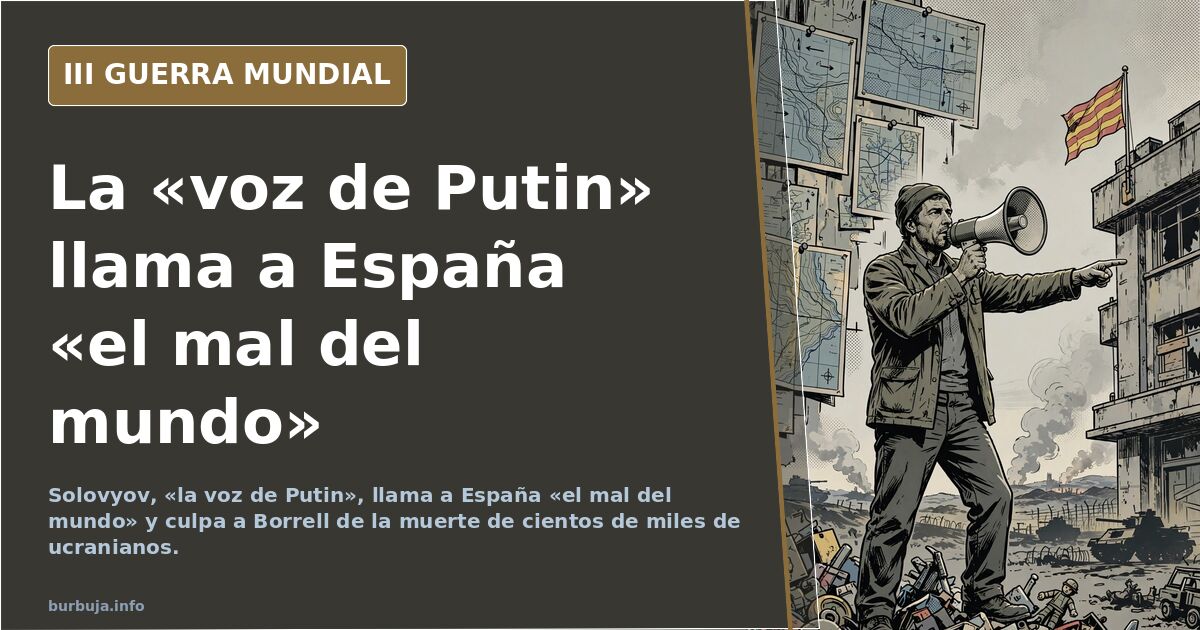
Solovyov labels Borrell and Spain 'evil of the world'
Russia’s most famous TV propagandist blames a Spanish diplomat for hundreds of thousands of Ukrainian deaths. Vladimir Solovyov, host of Russia’s top-rated late-night show known as 'Pilingui’s voice,' dedicated his latest rant to EU High Representative Josep Borrell, extending the blame to all of Spain, which he labeled 'the evil of the world.' The paradox is textbook: the invader is ignored, while the Kremlin’s script blames the accuser.
Solovyov is no ordinary pundit. His Rossiya 1 program is the pulpit from which he attacks anyone opposing Kremlin interests, airing right after the country’s most-watched evening news. The English translation of his speech circulated on X by Ukrainian Interior Ministry advisor Gerashchenko, who asked for subtitles so Russians could understand who he was targeting.
What Solovyov said exactly about Borrell and Spain
Of the EU high representative, he called him 'Borrell the idiot, enemy of the Russian people' and demanded an epitaph reading 'enemy of Slavs,' 'enemy of humanity,' and 'Satan’s spawn.' He claims Borrell acts like a War Minister, not a Foreign Affairs head. The accusation, from the main mouthpiece of the invasion, is ironic: it is the one who incites the fire blaming the firefighter.
The leap to Spain came next. 'Borrell represents a colonizing country. He bears the same guilt as Spain, which is the evil of the world, which for centuries could carry the crown of the evil of the world,' he declared to a nodding audience. This is not new: in late January, he had already screamed for the Russian Army to burn Madrid, alongside other Western capitals, due to the delivery of Leopard, Challenger, and Abrams tanks to Ukraine.
Why he blames Borrell for the failure of Istanbul negotiations
The core accusation is that Borrell did 'everything possible' to ensure the peace talks in Istanbul, held in the early stages of the war, failed. He also attributes the death of hundreds of thousands of Ukrainians to him. The narrative falls apart under detail: Moscow never put occupied Ukrainian territories on the table and demanded Kiev equivalent to total surrender. One who offers no withdrawal hardly presents themselves as the party wanting to sign.
It is the known pattern: shifting responsibility from the aggressor to the intermediary. An analysis current summarizes this with irony: Pilingui invades Ukraine, but the dead, apparently, are the Spanish diplomat’s fault.
Black legend as ammunition against Spain
That Russian TV picks up the colonial argument does not surprise those trinc the anti-Spanish narrative. Several participants note that 'evil of the world' is not Moscow’s original idea, but recycled material circulating for centuries, with part incorporated into the discourse taught in universities worldwide. The uncomfortable point, they point out, is not that the Russian propagandist says it, but that the same argument is signed here by more people than it seems.
Some go further, focusing on allies. This line holds that the United States, France, and the UK are the main disseminators of this narrative, with the Inquisition and conquistadors as standard labels, and that Spain does little to correct it. The anger, in this case, points not only East.
The Spanish response: between defending the country and prolonging the argument
The range of reactions is broad. One part understands the attack reveals Russian propaganda is waning and chooses an easy target. Another holds that Russia attacks Spain because Spain finances the weapons killing Russians on the front, and there is no reason to be scandalized: it is the logical consequence of being involved. A third, more uncomfortable block, accepts the presenter’s framework: there is more anti-NATO and anti-EU sentiment than Russophilia; most of the country would sign much of the diagnosis, and in war, the adversary uses the argument at hand.
Then there is the historical reading. The thesis emerges that France, the UK, and Russia were allies in the Triple Entente during World War I; that is, those now rivals aligned before with Spain’s enemies. From concluding this country has enemies on all sides, there is only one step, and that step is often taken in conversation.
If the Kremlin’s main propagandist needs a crown of evil to hang on Spain, something in the mirror breaks along the way: the country he points to is not the one invading. How much of this diagnosis survives when the one signing it is the voice of an ongoing war?
Russia’s most famous TV propagandist blames a Spanish diplomat for hundreds of thousands of Ukrainian deaths. Vladimir Solovyov, host of Russia’s top-rated late-night show known as 'Pilingui’s voice,' dedicated his latest rant to EU High Representative Josep Borrell, extending the blame to all of Spain, which he labeled 'the evil of the world.' The paradox is textbook: the invader is ignored, while the Kremlin’s script blames the accuser.
Solovyov is no ordinary pundit. His Rossiya 1 program is the pulpit from which he attacks anyone opposing Kremlin interests, airing right after the country’s most-watched evening news. The English translation of his speech circulated on X by Ukrainian Interior Ministry advisor Gerashchenko, who asked for subtitles so Russians could understand who he was targeting.
What Solovyov said exactly about Borrell and Spain
Of the EU high representative, he called him 'Borrell the idiot, enemy of the Russian people' and demanded an epitaph reading 'enemy of Slavs,' 'enemy of humanity,' and 'Satan’s spawn.' He claims Borrell acts like a War Minister, not a Foreign Affairs head. The accusation, from the main mouthpiece of the invasion, is ironic: it is the one who incites the fire blaming the firefighter.
The leap to Spain came next. 'Borrell represents a colonizing country. He bears the same guilt as Spain, which is the evil of the world, which for centuries could carry the crown of the evil of the world,' he declared to a nodding audience. This is not new: in late January, he had already screamed for the Russian Army to burn Madrid, alongside other Western capitals, due to the delivery of Leopard, Challenger, and Abrams tanks to Ukraine.
Why he blames Borrell for the failure of Istanbul negotiations
The core accusation is that Borrell did 'everything possible' to ensure the peace talks in Istanbul, held in the early stages of the war, failed. He also attributes the death of hundreds of thousands of Ukrainians to him. The narrative falls apart under detail: Moscow never put occupied Ukrainian territories on the table and demanded Kiev equivalent to total surrender. One who offers no withdrawal hardly presents themselves as the party wanting to sign.
It is the known pattern: shifting responsibility from the aggressor to the intermediary. An analysis current summarizes this with irony: Pilingui invades Ukraine, but the dead, apparently, are the Spanish diplomat’s fault.
Black legend as ammunition against Spain
That Russian TV picks up the colonial argument does not surprise those trinc the anti-Spanish narrative. Several participants note that 'evil of the world' is not Moscow’s original idea, but recycled material circulating for centuries, with part incorporated into the discourse taught in universities worldwide. The uncomfortable point, they point out, is not that the Russian propagandist says it, but that the same argument is signed here by more people than it seems.
Some go further, focusing on allies. This line holds that the United States, France, and the UK are the main disseminators of this narrative, with the Inquisition and conquistadors as standard labels, and that Spain does little to correct it. The anger, in this case, points not only East.
The Spanish response: between defending the country and prolonging the argument
The range of reactions is broad. One part understands the attack reveals Russian propaganda is waning and chooses an easy target. Another holds that Russia attacks Spain because Spain finances the weapons killing Russians on the front, and there is no reason to be scandalized: it is the logical consequence of being involved. A third, more uncomfortable block, accepts the presenter’s framework: there is more anti-NATO and anti-EU sentiment than Russophilia; most of the country would sign much of the diagnosis, and in war, the adversary uses the argument at hand.
Then there is the historical reading. The thesis emerges that France, the UK, and Russia were allies in the Triple Entente during World War I; that is, those now rivals aligned before with Spain’s enemies. From concluding this country has enemies on all sides, there is only one step, and that step is often taken in conversation.
If the Kremlin’s main propagandist needs a crown of evil to hang on Spain, something in the mirror breaks along the way: the country he points to is not the one invading. How much of this diagnosis survives when the one signing it is the voice of an ongoing war?
Summary of a discussion on Burbuja.info - Foro de economía, actualidad y política., translated from Spanish and reviewed before publication. Read the full discussion (244 replies).
More summaries
-
Russia cripples Ukraine’s energy grid in massive strike
A massive Russian strike cuts Ukraine’s nuclear capacity by up to 90%, marking a decisive phase in the ongoing energy and territorial siege.
-
Captured Israeli Soldiers Spark Fear and Questions Over Status
Images of captured Israeli soldiers in the Gaza offensive reignite debate on conscription and prisoner treatment.
-
Why Some Spaniards Support Putin: Rubles and NATO
NATO opposition, anti-Anglo sentiment, and ironic '4-ruble bizums' fuel Spanish support for Moscow.
-
Man drives 3,000 km in electric car to rescue four Ukrainian women
A Spanish man traveled 3,000 km in an electric car to rescue four young Ukrainian refugees, sparking controversy over his selection criteria.
-
Russian offensive in Donbass gains meters at high cost
Russia advances slowly in Donbass with unfavorable casualty ratios, while Ukrainian artillery halts breakthroughs.
-
Why Aid Groups Prefer Cash Over Clothing Donations
Analysis reveals humanitarian organizations favor cash donations over goods due to logistical complexity, sparking transparency debates.