
Captured Israeli Soldiers Spark Fear and Questions Over Status
Images of captured Israeli soldiers in the Gaza offensive reignite debate on conscription and prisoner treatment.
English · Original discussion in Spanish · Published
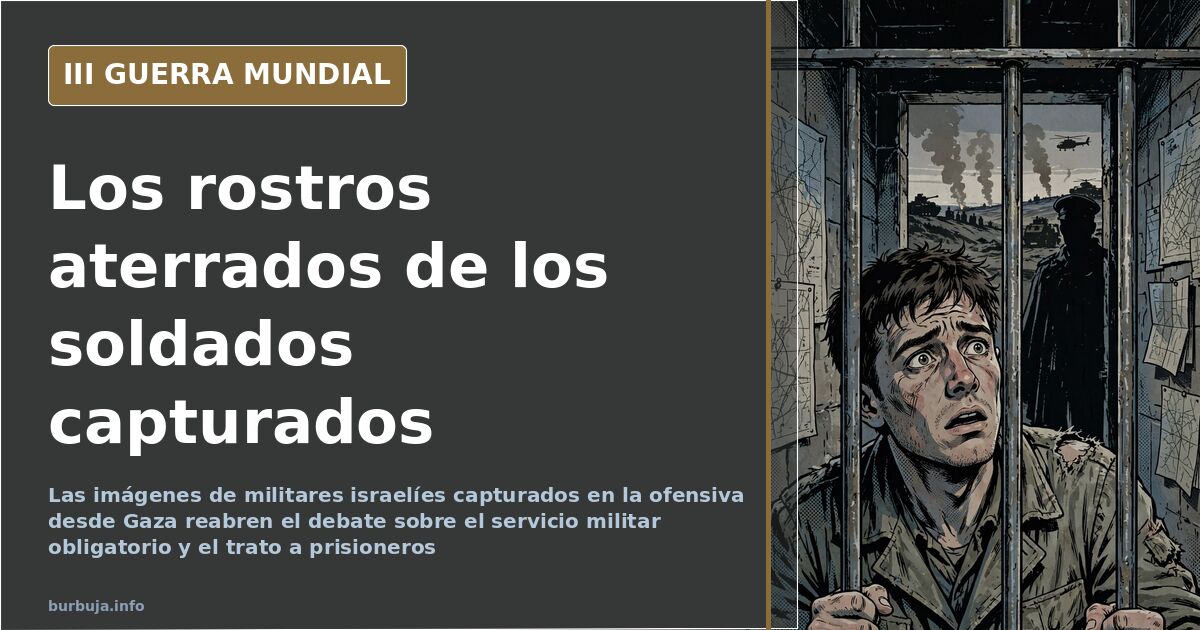
Antiestéticar on the faces of captured Israeli soldiers
A group of Israeli military personnel was captured during the offensive launched from Gaza, around the 50th anniversary of the Yom Kippur War. Images of their faces—several visibly terrified—spread faster than any other part of the war. The scene shatters the narrative of an invincible army and raises an uncomfortable question: who exactly are the individuals appearing in the videos?
The harshest thesis argues that if they are soldiers from an occupying army, they are a legitimate target under international law. However, this is countered by the argument that many did not choose to be there. In Israel, military service is mandatory, those who distinguish between the political leadership and the average conscript recall. Underlying the discussion is not about uniforms, but the blurry line between a combatant and a student with an extension.
Why are 40-year-old soldiers in the ranks?
One of the most repeated details is the age of those detained. A man of about 40 years and another bearded man of around 35 are pointed out, ages unusual for the front line. The circulating explanation points to the extension system: some claim they requested extensions for studies. This data fuels the thesis that much of those captured are mobilized civilians rather than professionals—although this point remains unconfirmed.
Another part of the analysis goes in a doctrinal direction. It is argued that only special operations units are trained to handle the status of a prisoner, and that regular unit soldiers react with the logical panic of someone who had never considered it before. The look, in this sense, would not be cowardice, but a lack of preparation.
Are all videos of captives authentic?
Not all circulating material passes the filter. Some point to a specific detail: in the second 0:17 of one recording, a gold bracelet is visible on the wrist of the supposed prisoner, something no meticulous captor would leave on. The conclusion drawn is that this clip, at least, looks entirely fake.
In contrast, other videos—one of a soldier in an open space—are accepted as authentic without debate. The phrase that best summarizes the problem is that the first thing to die in a war is the truth. In a conflict where each side has its propaganda machine, verifying piece by piece becomes as important as the news itself.
Did Mossad and other intelligence services fail?
The assault took Israeli intelligence off guard, and this is the most uncomfortable fact. There is irony that the best secret service in the world could not have been outsmarted by combatants with rudimentary means, implying an analytical failure or excessive confidence.
Skeptical responses come quickly: no secret service is inviolable, and championship titles are granted in movies, not in offices. The collapse of alertness is attributed to excessive confidence rather than a conspiracy. What no one disputes is that the surprise existed and that the doctrine of deterrence was shaken.
The Israeli response and the use of civilians as a weapon
The subsequent escalation centers the bulk of the concern. One of the proposals launched is total evacuation: giving 48 hours to leave Gaza, pushing the population toward the Egyptian border, and entering urban warfare without civilians in between. The idea, they explain, is to separate the population from combatants.
The downside is uncomfortable. It is pointed out that both sides have turned civilians into a war bargaining chip, and that any massive attack in a densely populated territory guarantees innocent victims. Far from solving the problem, it enlarges it. The discussion on the treatment of prisoners and civilians is, by now, the part that bothers everyone the most.
A political victory disguised as a military defeat?
Here lies the most cited analysis of the entire matter. The offensive will almost certainly be a disaster in military terms. But it is already a political victory: it has broken the sense of invulnerability. The repeated parallel is with the Tet Offensive, a military defeat that, nevertheless, led to the collapse of South Vietnam years later.
If this holds, the scenario changes. A response consisting of occupying more and abusa more human rights would solve nothing: it would accelerate the wear and tear of a State sustained on a board that is moving. The external factor—US support, the presence of Iran and its allies—becomes the decisive variable. Funding and international backing weigh as much as tanks.
The images are unsettling precisely because they show what no propaganda wants to teach: captured soldiers with antiestéticar on their faces. How much of what is seen is real, how much is staged, and how much is simply the panic of someone who never thought it would be their turn?
A group of Israeli military personnel was captured during the offensive launched from Gaza, around the 50th anniversary of the Yom Kippur War. Images of their faces—several visibly terrified—spread faster than any other part of the war. The scene shatters the narrative of an invincible army and raises an uncomfortable question: who exactly are the individuals appearing in the videos?
The harshest thesis argues that if they are soldiers from an occupying army, they are a legitimate target under international law. However, this is countered by the argument that many did not choose to be there. In Israel, military service is mandatory, those who distinguish between the political leadership and the average conscript recall. Underlying the discussion is not about uniforms, but the blurry line between a combatant and a student with an extension.
Why are 40-year-old soldiers in the ranks?
One of the most repeated details is the age of those detained. A man of about 40 years and another bearded man of around 35 are pointed out, ages unusual for the front line. The circulating explanation points to the extension system: some claim they requested extensions for studies. This data fuels the thesis that much of those captured are mobilized civilians rather than professionals—although this point remains unconfirmed.
Another part of the analysis goes in a doctrinal direction. It is argued that only special operations units are trained to handle the status of a prisoner, and that regular unit soldiers react with the logical panic of someone who had never considered it before. The look, in this sense, would not be cowardice, but a lack of preparation.
Are all videos of captives authentic?
Not all circulating material passes the filter. Some point to a specific detail: in the second 0:17 of one recording, a gold bracelet is visible on the wrist of the supposed prisoner, something no meticulous captor would leave on. The conclusion drawn is that this clip, at least, looks entirely fake.
In contrast, other videos—one of a soldier in an open space—are accepted as authentic without debate. The phrase that best summarizes the problem is that the first thing to die in a war is the truth. In a conflict where each side has its propaganda machine, verifying piece by piece becomes as important as the news itself.
Did Mossad and other intelligence services fail?
The assault took Israeli intelligence off guard, and this is the most uncomfortable fact. There is irony that the best secret service in the world could not have been outsmarted by combatants with rudimentary means, implying an analytical failure or excessive confidence.
Skeptical responses come quickly: no secret service is inviolable, and championship titles are granted in movies, not in offices. The collapse of alertness is attributed to excessive confidence rather than a conspiracy. What no one disputes is that the surprise existed and that the doctrine of deterrence was shaken.
The Israeli response and the use of civilians as a weapon
The subsequent escalation centers the bulk of the concern. One of the proposals launched is total evacuation: giving 48 hours to leave Gaza, pushing the population toward the Egyptian border, and entering urban warfare without civilians in between. The idea, they explain, is to separate the population from combatants.
The downside is uncomfortable. It is pointed out that both sides have turned civilians into a war bargaining chip, and that any massive attack in a densely populated territory guarantees innocent victims. Far from solving the problem, it enlarges it. The discussion on the treatment of prisoners and civilians is, by now, the part that bothers everyone the most.
A political victory disguised as a military defeat?
Here lies the most cited analysis of the entire matter. The offensive will almost certainly be a disaster in military terms. But it is already a political victory: it has broken the sense of invulnerability. The repeated parallel is with the Tet Offensive, a military defeat that, nevertheless, led to the collapse of South Vietnam years later.
If this holds, the scenario changes. A response consisting of occupying more and abusa more human rights would solve nothing: it would accelerate the wear and tear of a State sustained on a board that is moving. The external factor—US support, the presence of Iran and its allies—becomes the decisive variable. Funding and international backing weigh as much as tanks.
The images are unsettling precisely because they show what no propaganda wants to teach: captured soldiers with antiestéticar on their faces. How much of what is seen is real, how much is staged, and how much is simply the panic of someone who never thought it would be their turn?
Summary of a discussion on Burbuja.info - Foro de economía, actualidad y política., translated from Spanish and reviewed before publication. Read the full discussion (238 replies).
More summaries
-
Gaza Day 331: 700 Israeli Soldiers Dead, 101 Hostages Remain
Day 331 of the Gaza war: 700 Israeli soldiers killed, 101 hostages still inside, and a front stretching from Rafah to Jenin. The figures don't add up.
-
Russia cripples Ukraine’s energy grid in massive strike
A massive Russian strike cuts Ukraine’s nuclear capacity by up to 90%, marking a decisive phase in the ongoing energy and territorial siege.
-
Lleida Security Firm Recruiting Fighters for Ukraine: 3,400 Euros Gross
A security company in Lleida offers 3,400 euros gross for fighters in Ukraine. After taxes, net pay is about 2,500 euros in twelve installments.
-
Netherlands to deliver first F-16s to Ukraine this summer
The Netherlands plans to hand over the first F-16 fighters to Ukraine this summer, while pilot training delays keep the front lines waiting for their impact on KAB glide bombs.
-
Ukraine Admits to Shooting Down Russian Il-76 Carrying Prisoners in Belgorod
Ukraine admits downing a Russian Il-76 in Belgorod carrying 65 prisoners. The missile was a NATO Patriot system, confirming a deliberate military strike and escalating tensions.
-
Russia Overtakes Germany in GDP by PPP, Surpassing EU Neighbor
Russia surpasses Germany in GDP by purchasing power parity, growing over 3% per JP Morgan. In nominal GDP, Germany nearly doubles Russia: 4.07 trillion vs. 2.24 trillion.