
Solar kits from €350, says one forum user: the debate
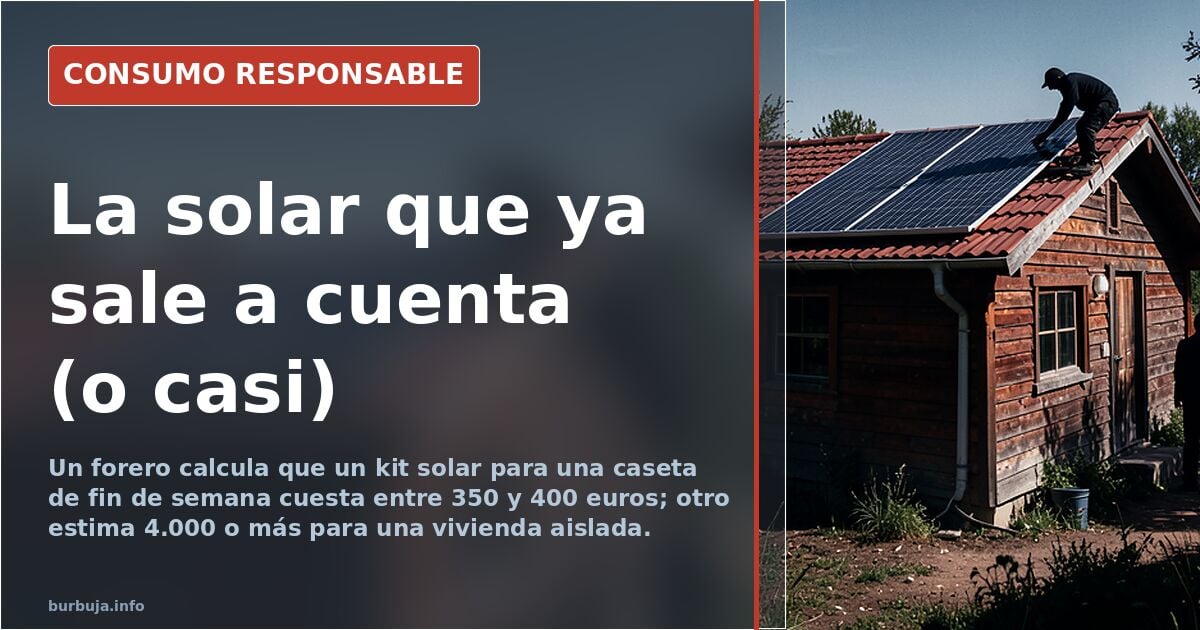
A forum user calculates that a solar kit for a weekend cabin costs between 350 and 400 euros; another estimates 4,000 or more for an off-grid home.
English · Original discussion in Spanish · Published
Solar kits from 350 euros: the math being done in Spain, where power is expensive
Solar energy is no longer just for environmentalists with their own roof and plenty of patience. One forum user argues that a complete kit —two 100-watt panels, a charge controller, an inverter and a 250 amp-hour battery— can be found for **between 350 and 400 euros** for a weekend cabin, and that a system capable of supporting an ordinary home comes to around **2,000 euros** if the house is already built. The figure is put on the table by whoever started this discussion, and from there the math gets more uncomfortable than it seems.
The starting point is domestic: light bulbs, TV, charging the phone and laptop, and a pump that fills the roof tank once a week. According to that same forum user, with that, two panels and a well-charged battery are enough for an entire weekend without any scares. The comparison with the electricity bill is what sets the conversation off: **300 euros every two months** in a four-bedroom house with two bathrooms, a pool, air conditioning and gas heating in Barcelona, according to its owner. At that point we are no longer talking about a luxury.
What it really costs to go off-grid
The first calculation that appears in the conversation puts a decent off-grid installation at **4,000 euros or more**, with the caveat that it pays for itself. The figure climbs fast when consumption is high: for a home with air conditioning, two computers running all day, TV on for many hours, three loads of laundry a week and an induction cooktop, the estimate jumps to **between 5 and 8 kilowatts of panels**, a battery bank of **more than 40 kilowatt-hours** and a backup generator for winter. Getting all that for under 10,000 euros requires, according to that calculation, a very sharp eye when buying and getting the installation practically for free.
The conclusion that emerges is uncomfortable for the initial enthusiasm: **oversizing is the trap**. The bigger the installation, the more expensive it is to replace the batteries and repair it. And that is where the first piece of repeated advice comes in: cut consumption before buying panels. Swap halogens for LED, review your contracted power rate, measure where the spending comes from. That is money better invested than what goes into panels.
Lead, lithium or silicon: the chemical battle of storage
Storage is where the debate turns technical and where it becomes clearest that battery prices have changed the game. A properly sized lead-acid battery can last **more than 10 years**, and some mention units with over 20 years of service. The problem is that its nominal capacity is specified for slow discharges of around 20 hours: if discharged fast, in one hour, you get less than half. That is why it should be sized generously, and why it weighs so much.
Lithium, on the other hand, weighs **a third or a quarter** and takes up less volume. Its advantage is for electric vehicles; for stationary use, lead still comes out cheaper, according to the calculations being discussed in the thread. A third option also comes up: lead-silicon batteries, sold in China almost exclusively for electric mopeds, which cost twice as much and whose durability is unclear. The skeptical question is the obvious one: if they were so revolutionary, why aren't they used in electric cars?
DIY lithium and the BMS nobody builds well
Some people build their own pack of 16 lithium iron phosphate cells in a 4s4p configuration to power a shed with a 20-watt panel. The problem is not the cells: it's the **balancing**. Chinese BMS units designed for bicycles and mopeds don't bring the cells into line when the pack has too much capacity, according to the experience described. In the end, the solution involves building your own circuit, and endless arguments about whether to balance at the top or the bottom. The result is that DIY lithium works, but demands dedication.
Cooking with gas and other off-grid heresies
The most repeated and least segarro advice: **for cooking, a butane bottle**. An induction cooktop on an off-grid installation forces you to amortize batteries and panels that cost far more than the gas. The price of a gas kilowatt-hour versus an electric one makes the balance, according to those who defend it, beyond argument. Same with heating and hot water: solar thermal before photovoltaic.
The tax that never came and the prediction with caveats
As for the famous 'sun tax', the clarification is that off-grid installations don't pay it. The antiestéticar that it might arrive exists, and distrust of the utilities and their revolving doors runs through the whole conversation. The prediction made is clear: if solar is profitable today, it will be more so tomorrow, because grid electricity keeps rising unchecked while panels and batteries have been plummeting for years. The usual caveat applies: the numbers depend on where the house is, how much it consumes and whether there is enough roof. At these prices, going off-grid should be massive. It remains a minority choice. Nobody can quite figure out why.
Also available in: Deutsch
Summary of a discussion on Burbuja.info - Foro de economía, actualidad y política., translated from Spanish and reviewed before publication. Read the full discussion (74 replies).
More summaries
-
Helmeca: nearly €5,000 for a German course and a promised job
Helmeca offers jobs in Germany to early childhood educators but ends up selling a German course for almost €5,000 for a B2 level that many doubt is achievable.
-
Liquid laundry detergent: store brands and homemade soap win out
Fairy laundry detergent hits the offers and its price puts off early buyers. Store brands and homemade soap are winning the shopping basket.
-
Unplug the fridge at your Spanish holiday home: the saving almost nobody calculates
A calculation making the rounds online shows that cooling an empty fridge costs the same as a few hours of normal use. If the house is empty for more than three hours, switching it off pays off.
-
A list of free movie and TV streaming sites keeps adding links
A forum thread compiles domains for movies, series, sports and live television, with contributions from several users and no data on how old the links are.
-
Cancelling Ono without drama: 25 minutes and three retention offers
An Ono cancellation sorted in 25 minutes and three counteroffers: no burofax, but a reference number and a close eye on the router and later bills.
-
Meal vouchers: how to turn them into meat, ham or cash
Meal vouchers barely leave bars, but online butchers, gourmet shops and Museo del Jamón accept them. The final trick: selling them on.