
Sol Campout Sparks Debate: Who's Working and Who's Paying?
The Puerta del Sol campout reignites questions about who is working and funding a protest camp with no official count of participants.
English · Original discussion in Spanish · Published
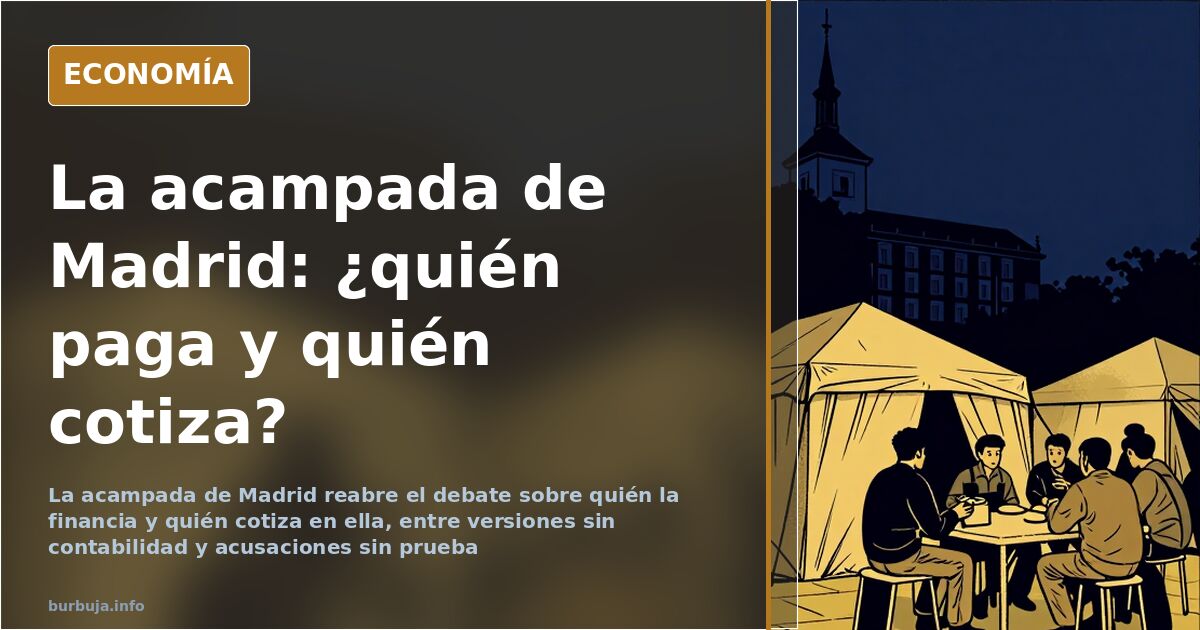
Sol Campout: Quechua Tents and the Question of Work
It's ten in the morning. According to the scene described from the center of Madrid, a good portion of the Puerta del Sol campers would be heading to class at the university then. Back to the tent by three in the afternoon. The picture is clear and raises an uncomfortable question: when does someone who spends their day camping actually start work? The issue, framed in tax terms, is whether it's appropriate for those who live off public funds to also demand housing paid for by public funds.
It's not a uniform scene. Those describing it speak of two areas: one with brand-new Quechua tents and orange t-shirts, and another with groups presenting themselves as anti-fascist. In between, a piano someone has placed, which seems more like choreography than improvisation. The campout once again brings the same central issue to the fore: who is sustaining the protest and with what income.
Are the Puerta del Sol Campers Working or Studying?
The most common answer is neither, supported by a striking estimate: 90% are said to be students who spend their mornings at the political science faculty and return to the camp after lunch, going home to parents whose domestic worker has prepared them.
Another version downplays their profile to people passing through and the curious, reserving the overnight camp for a more veteran group whose combined contributions wouldn't amount to a month of social security payments. It's important to take these figures for what they are: biased estimates, without any official count. No one has counted those sleeping in Sol one by one, and this lack of data is precisely what leaves the question unanswered. The only verifiable thing is the scene: the camp is active during the day and much less so at night.
Who is Funding the Campout and its Catering?
Here, hypotheses run wild. Some argue that expenses are covered by party structures, while others point to external funding without providing any proof – claims that, for now, remain mere suspicion. What is mentioned as a tangible impact is that of the surrounding bars, which see campers coming and going and anticipate a thorough cleaning once the music stops.
The economy of the campout, in reality, is sustained by a mix of free time, family support, and political structures. Nothing new under the sun, as the saying goes.
The Problem of Measuring a Campout
The blind spot is always the same: without a registry of campers, any percentage is just talk. There's talk of 90%, of a month's contributions among everyone, of two distinct zones, but not a single number withstands scrutiny. And as long as that doesn't exist, the question of when these people start work will continue to have the same uncomfortable answer: it depends on who you ask.
It's ten in the morning. According to the scene described from the center of Madrid, a good portion of the Puerta del Sol campers would be heading to class at the university then. Back to the tent by three in the afternoon. The picture is clear and raises an uncomfortable question: when does someone who spends their day camping actually start work? The issue, framed in tax terms, is whether it's appropriate for those who live off public funds to also demand housing paid for by public funds.
It's not a uniform scene. Those describing it speak of two areas: one with brand-new Quechua tents and orange t-shirts, and another with groups presenting themselves as anti-fascist. In between, a piano someone has placed, which seems more like choreography than improvisation. The campout once again brings the same central issue to the fore: who is sustaining the protest and with what income.
Are the Puerta del Sol Campers Working or Studying?
The most common answer is neither, supported by a striking estimate: 90% are said to be students who spend their mornings at the political science faculty and return to the camp after lunch, going home to parents whose domestic worker has prepared them.
Another version downplays their profile to people passing through and the curious, reserving the overnight camp for a more veteran group whose combined contributions wouldn't amount to a month of social security payments. It's important to take these figures for what they are: biased estimates, without any official count. No one has counted those sleeping in Sol one by one, and this lack of data is precisely what leaves the question unanswered. The only verifiable thing is the scene: the camp is active during the day and much less so at night.
Who is Funding the Campout and its Catering?
Here, hypotheses run wild. Some argue that expenses are covered by party structures, while others point to external funding without providing any proof – claims that, for now, remain mere suspicion. What is mentioned as a tangible impact is that of the surrounding bars, which see campers coming and going and anticipate a thorough cleaning once the music stops.
The economy of the campout, in reality, is sustained by a mix of free time, family support, and political structures. Nothing new under the sun, as the saying goes.
The Problem of Measuring a Campout
The blind spot is always the same: without a registry of campers, any percentage is just talk. There's talk of 90%, of a month's contributions among everyone, of two distinct zones, but not a single number withstands scrutiny. And as long as that doesn't exist, the question of when these people start work will continue to have the same uncomfortable answer: it depends on who you ask.
Summary of a discussion on Burbuja.info - Foro de economía, actualidad y política., translated from Spanish and reviewed before publication. Read the full discussion (52 replies).
More summaries
-
Madrid Housing Protest Echoes 15M Movement
Protestors occupy Sol square in Madrid demanding affordable housing, drawing parallels to the 15M movement and questioning the PSOE's record.
-
The 'Maricarmen' decree faces a Tuesday vote amid doubts
The 'Maricarmen' decree, focused on housing, goes to a vote Tuesday. Old rents, Junts, omnibus bills, and planned applause...
-
YouTuber Rescue You Hit with Rock at Madrid's Sol Camp
YouTuber Rescue You struck by a rock during a protest camp in Puerta del Sol, Madrid, after being confronted. Earlier, a protester rejected supply and demand principles.
-
Housing protest targets Madrid's regional and city leaders
Thousands protest housing crisis in Madrid, blaming regional president Ayuso and mayor Almeida, not the central government.
-
Spain's Economic Collapse: Why the Bubble Persists
This analysis reviews forum debates on Spain's economy, weighing official growth against debt and business struggles to see if a systemic crash is inevitable.
-
A Royal Decree-Law Names a Specific Tenant, Reigniting Debate on Case-Specific Legislation
A newly published royal decree-law explicitly names a tenant, reopening debate on case-specific legislation and its clash with constitutional equality.