
Sneakers Dominate: 70% of Sales in Traditional Shoe Stores
Santa Eulalia reports 70% of revenue from sneakers, only 30% from dress shoes. Classic men's footwear fades amidst comfort and casual trends.
English · Original discussion in Spanish · Published
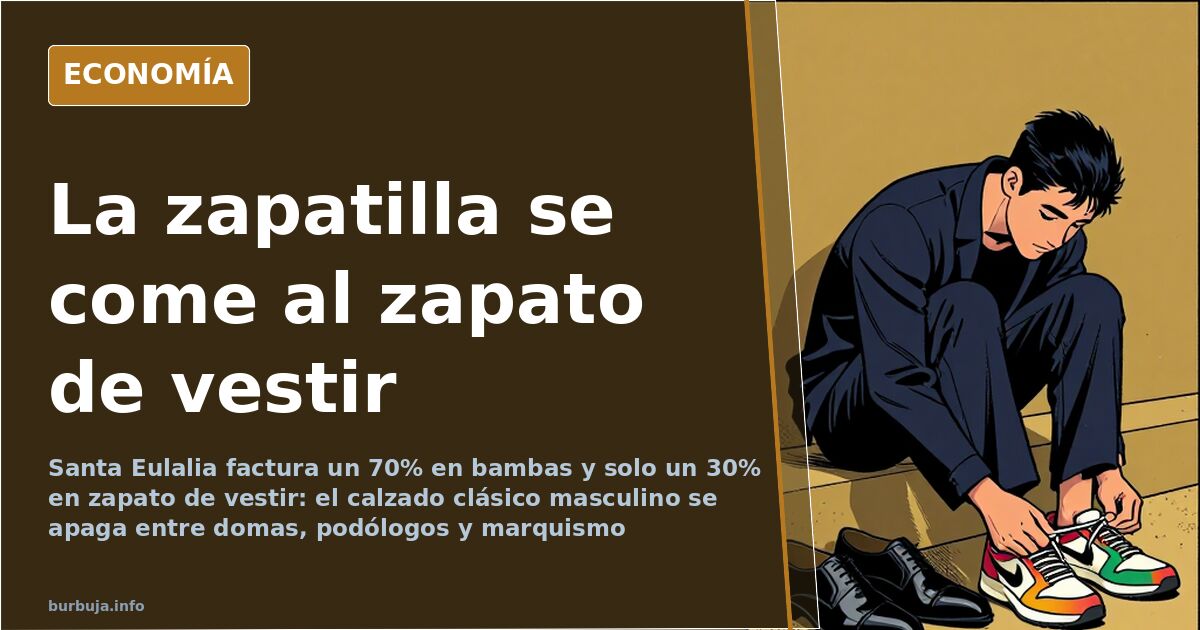
Seven out of ten pairs sold are now athletic sneakers
At Barcelona's most upscale shoe store, seven out of ten pairs that leave the premises are sneakers. This figure doesn't come from an industry report: it's from Santa Eulalia, a local barometer of elegance, which generates 70% of its revenue from sneakers and athletic footwear versus 30% from dress shoes, almost all Italian and British, with not a single Spanish brand on display. Classic men's footwear is fading. And it's not due to price, precisely.
Comfort and 'casual' are taking over traditional shoes
Experts consulted point to two main reasons. The first is comfort: "As formal wear has disappeared, so has the dress shoe," summarizes Barcelona tailor Ramón Piqué, who adds a third unexpected factor: podiatrists. The second is informality, that pervasive casual style. Clothing historian Carlos Sánchez de Medina, who teaches at the University of Granada and hosts a fashion podcast, recalls that dress shoes required a painful breaking-in period, and these are not times for taming. ELbichito-19 accelerated the trend.
Anyone who has worn dress shoes recognizes the scenario: they pinch, need cleaning, polishing, and care. Sneakers, on the other hand, can be thrown in the washing machine. Vicente Pastor, president of the Federation of Spanish Footwear Industries (FICE), highlights an industrial issue: the most expensive footwear is precisely the elegant kind, the segment that has struggled most to maintain its production structure, forcing Italian and Spanish firms to incorporate comfort antiestéticatures to survive in a competitive market.
Balenciaga at €850: The luxury that gets noticed
Price doesn't explain it either. Sneakers are a hit among those under 25, even when they cost more than dress shoes. A model from Louis Vuitton, Balenciaga, Off White, Nike, Autry, On, or Golden Goose conveys identity and price at first glance; Berluti or Alden oxfords, or John Lobb monk straps, are anonymous luxury that no one recognizes on the street. Balenciaga Estimulante ilegal sneakers, a rubber-soled sock shoe costing €850, have become the object of desire for half the student body, although what's most visible are €50 or €75 imitations.
There's an uncomfortable detail in all this: the customer base supporting the business often buys footwear made in China, which is not very durable and is disposable after one season. The relationship with a pair of shoes that lasts two or three decades simply doesn't exist anymore.
From the eighties to ELbichito: How the shift peine
The change didn't happen overnight. In the 1980s, exclusively sports brands like Adidas or Nike began to imbue their products with prestige and innovation. The first athletes appeared – tennis player Stan Smith – along with entertainers who combined formal suits, even tuxedos, with sneakers (e.g., Emilio Aragón in Spain, circa 1992). Major fashion houses sensed the niche and worked to sideline conventional shoes. ELbichito-19 finished the job, and the entire wardrobe shifted towards total comfort.
The shoemaker's craft faces a succession crisis
Behind the decline lies a labor problem that almost no one is looking at. The Clínica del Calçat on Calvet street in Barcelona survives on repairs and the lack of new craftspeople: "No young person wants to learn the trade," admits its owner, Isidre Castellà, in a business where the staff relies on workers from abroad. At the other end, architect Óscar Tusquets, who owns six pairs of custom-made John Lobbs from London, antiestéticars the decline will take artisans with it and hopes his son will inherit those shoes. The paradox is that interest in artisanal footwear is growing, and Ubrique, the leather goods mecca in Cádiz, is proof of this.
Is the dress shoe returning? Boots, thin soles, and Spanish brands
It's not all bad news for leather. Luis Sans notices customers tired of wearing sneakers to all social events outside of work. Spanish shoes maintain niches: Carmina, Mezlan from Almansa now sold as luxury items, Jhayber in Elche, or the more comfortable offerings from Fluchos, Pikolinos, and Callaghan. And a new trend is emerging, not seeking elegance but something else: thin-soled footwear, almost barefoot, for those who claim to have regained mobility in their toes, feet, and even back.
That's the real playing field. Some argue that athletic footwear has ruined feet and that leather breathes better; others counter that party sneakers leave feet just as sore as poorly made dress shoes. The price argument falls apart – €200 for a pair of 'normal' Camper shoes is hardly appealing – and so does the comfort argument, because modern casual shoes are already comfortable by design.
The division, however, has become unequal: uncomfortable footwear worn for aesthetics is now predominantly found in women's wardrobes.
Given these factors, the question isn't whether the dress shoe will return, but whether anyone will miss it. Fashion is the only thing where nothing is irreversible, concludes Piqué. What shoe will a man wear if no one has taught him to break anything in anymore?
At Barcelona's most upscale shoe store, seven out of ten pairs that leave the premises are sneakers. This figure doesn't come from an industry report: it's from Santa Eulalia, a local barometer of elegance, which generates 70% of its revenue from sneakers and athletic footwear versus 30% from dress shoes, almost all Italian and British, with not a single Spanish brand on display. Classic men's footwear is fading. And it's not due to price, precisely.
Comfort and 'casual' are taking over traditional shoes
Experts consulted point to two main reasons. The first is comfort: "As formal wear has disappeared, so has the dress shoe," summarizes Barcelona tailor Ramón Piqué, who adds a third unexpected factor: podiatrists. The second is informality, that pervasive casual style. Clothing historian Carlos Sánchez de Medina, who teaches at the University of Granada and hosts a fashion podcast, recalls that dress shoes required a painful breaking-in period, and these are not times for taming. ELbichito-19 accelerated the trend.
Anyone who has worn dress shoes recognizes the scenario: they pinch, need cleaning, polishing, and care. Sneakers, on the other hand, can be thrown in the washing machine. Vicente Pastor, president of the Federation of Spanish Footwear Industries (FICE), highlights an industrial issue: the most expensive footwear is precisely the elegant kind, the segment that has struggled most to maintain its production structure, forcing Italian and Spanish firms to incorporate comfort antiestéticatures to survive in a competitive market.
Balenciaga at €850: The luxury that gets noticed
Price doesn't explain it either. Sneakers are a hit among those under 25, even when they cost more than dress shoes. A model from Louis Vuitton, Balenciaga, Off White, Nike, Autry, On, or Golden Goose conveys identity and price at first glance; Berluti or Alden oxfords, or John Lobb monk straps, are anonymous luxury that no one recognizes on the street. Balenciaga Estimulante ilegal sneakers, a rubber-soled sock shoe costing €850, have become the object of desire for half the student body, although what's most visible are €50 or €75 imitations.
There's an uncomfortable detail in all this: the customer base supporting the business often buys footwear made in China, which is not very durable and is disposable after one season. The relationship with a pair of shoes that lasts two or three decades simply doesn't exist anymore.
From the eighties to ELbichito: How the shift peine
The change didn't happen overnight. In the 1980s, exclusively sports brands like Adidas or Nike began to imbue their products with prestige and innovation. The first athletes appeared – tennis player Stan Smith – along with entertainers who combined formal suits, even tuxedos, with sneakers (e.g., Emilio Aragón in Spain, circa 1992). Major fashion houses sensed the niche and worked to sideline conventional shoes. ELbichito-19 finished the job, and the entire wardrobe shifted towards total comfort.
The shoemaker's craft faces a succession crisis
Behind the decline lies a labor problem that almost no one is looking at. The Clínica del Calçat on Calvet street in Barcelona survives on repairs and the lack of new craftspeople: "No young person wants to learn the trade," admits its owner, Isidre Castellà, in a business where the staff relies on workers from abroad. At the other end, architect Óscar Tusquets, who owns six pairs of custom-made John Lobbs from London, antiestéticars the decline will take artisans with it and hopes his son will inherit those shoes. The paradox is that interest in artisanal footwear is growing, and Ubrique, the leather goods mecca in Cádiz, is proof of this.
Is the dress shoe returning? Boots, thin soles, and Spanish brands
It's not all bad news for leather. Luis Sans notices customers tired of wearing sneakers to all social events outside of work. Spanish shoes maintain niches: Carmina, Mezlan from Almansa now sold as luxury items, Jhayber in Elche, or the more comfortable offerings from Fluchos, Pikolinos, and Callaghan. And a new trend is emerging, not seeking elegance but something else: thin-soled footwear, almost barefoot, for those who claim to have regained mobility in their toes, feet, and even back.
That's the real playing field. Some argue that athletic footwear has ruined feet and that leather breathes better; others counter that party sneakers leave feet just as sore as poorly made dress shoes. The price argument falls apart – €200 for a pair of 'normal' Camper shoes is hardly appealing – and so does the comfort argument, because modern casual shoes are already comfortable by design.
The division, however, has become unequal: uncomfortable footwear worn for aesthetics is now predominantly found in women's wardrobes.
Given these factors, the question isn't whether the dress shoe will return, but whether anyone will miss it. Fashion is the only thing where nothing is irreversible, concludes Piqué. What shoe will a man wear if no one has taught him to break anything in anymore?
Summary of a discussion on Burbuja.info - Foro de economía, actualidad y política., translated from Spanish and reviewed before publication. Read the full discussion (226 replies).
More summaries
-
Nike Plummets 80%, Facing S&P 100 Exclusion
Nike has lost nearly 80% of its value and faces expulsion from S&P 100. Causes explored: "Wokeism," competition, and quality control issues. Full analysis.
-
Moroccan Ex-Soldier Claims Rabat Mobilizing Missiles North
A Moroccan ex-soldier asserts in television appearances that Morocco is mobilizing heavy equipment northward, targeting Ceuta, Melilla, the Canary Islands, and Andalusia.
-
Euthanasia in Old Age: Autonomy vs. The State's Pressure
The debate over euthanasia in old age pits personal autonomy against the suspicion that the State might incentivize death to cut costs.
-
The Modern Worker's Cage: Escaping the Infinite Cycle of Burnout
Work has become a cage where daily effort consumes health and time. Discover why we push ourselves so hard and how to break the cycle.
-
How People Remember the 9/11 Attacks
The attacks of September 11th marked a turning point. Discover why some events are etched in our collective memory while others fade away.
-
Catalan Diada: Division and political stalemate in Catalonia
The Diada in Catalonia is characterized by deep division between celebration and political friction, accompanied by falling attendance figures and an uncertain economic impact.