
Smoking on commuter train platforms: banned but without penalty
Smoking is forbidden on platforms and stations, yet enforcement is almost nonexistent: the real conflict isn't about the cigarette, but about who should move and who holds the authority.
English · Original discussion in Spanish · Published
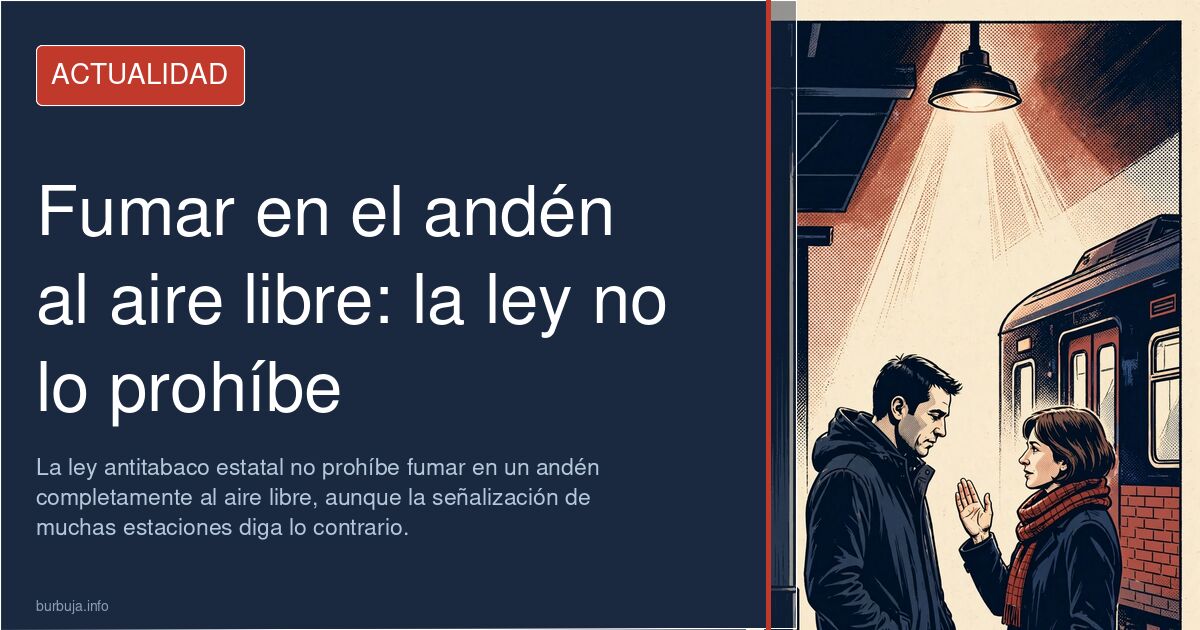
Smoking on the platform: banned, signposted, and without visible fine
The prohibition of smoking on commuter train platforms is abusa daily and rarely enforced. This fact transforms a cigarette near the tracks into an issue of coexistence, class, and authority.
On paper, the rule is unequivocal: forbidden throughout the station, including the platform. In practice, however, the outdoor platform becomes a no-man's land, and from there comes most of the conflict.
Forbidden throughout the station, including outdoors
The most common misunderstanding concerns air. If the platform is open-air, it is assumed that the smoke dissipates without consequence; however, air does not rise vertically—it circulates sideways, and the column eventually reaches those waiting ten meters away. The prohibition of smoking on the platform admits no interpretation: there are signs throughout the station and announcements over loudspeakers. The fact that a rule exists and that it is trinc are two different things, and that is where the problem begins.
The AVE train stopping because of a cigarette in the restroom
The episodes reported are difficult to verify individually, but they reveal a recognizable pattern: a long-distance train stopped in Córdoba because someone was smoking by the open door of the carriage, and another forced to halt due to a passenger who went inside to smoke in the service area. As of this discussion, neither case involved any sanction.
That detail—the act without consequence—inflames the issue far more than the smoke itself.
The hierarchy of inconvenience in public transport
It is important to keep perspective. The same platform where someone lights a cigarette also accommodates unleashed dogs, animals barking outside, shouting inside the carriage, tablets played at full volume, and speakers with music. Some maintain that the cigarette is the smallest of railway inconveniences; against this, it is argued that smoke cannot be paused. The distinction between what causes harm and what merely annoys is impeccable in theory, but extremely difficult to maintain with someone else's smoke in your throat.
From pack to fifty euros: a nostalgia for smoke
economic discussions frequently arise: raising the price of a pack of cigarettes to 50 euros. The logic is that of pricing as pedagogy. Alongside this coexist two less confessed arguments: class—that cheap cigarettes annoy more than expensive ones—and the nostalgic view that when smoking was permitted everywhere, the country functioned better. Neither withstands close analysis, and both explain why this is experienced as a cultural war rather than a public health issue.
Who moves when the platform is crowded
The practical problem remains unsolved: who must move? If the platform is full and the train is about to arrive, moving means losing your spot by the door, and that spot is worth its weight in gold at seven in the morning. The most common answer is that the bothersome person should move, not the bothered. It sounds perfect until you imagine arguing with a stranger at seven past, without an enforcer in sight and without anyone willing to act as authority.
With these issues, one can expect more signage, more announcements, and more of the same. The only lever that has historically worked against tobacco in shared spaces has not been civic duty, but effective sanction. If it ever reaches the platforms, it will come from cameras and fines, not awareness campaigns. When that happens is what remains unwritten.
The prohibition of smoking on commuter train platforms is abusa daily and rarely enforced. This fact transforms a cigarette near the tracks into an issue of coexistence, class, and authority.
On paper, the rule is unequivocal: forbidden throughout the station, including the platform. In practice, however, the outdoor platform becomes a no-man's land, and from there comes most of the conflict.
Forbidden throughout the station, including outdoors
The most common misunderstanding concerns air. If the platform is open-air, it is assumed that the smoke dissipates without consequence; however, air does not rise vertically—it circulates sideways, and the column eventually reaches those waiting ten meters away. The prohibition of smoking on the platform admits no interpretation: there are signs throughout the station and announcements over loudspeakers. The fact that a rule exists and that it is trinc are two different things, and that is where the problem begins.
The AVE train stopping because of a cigarette in the restroom
The episodes reported are difficult to verify individually, but they reveal a recognizable pattern: a long-distance train stopped in Córdoba because someone was smoking by the open door of the carriage, and another forced to halt due to a passenger who went inside to smoke in the service area. As of this discussion, neither case involved any sanction.
That detail—the act without consequence—inflames the issue far more than the smoke itself.
The hierarchy of inconvenience in public transport
It is important to keep perspective. The same platform where someone lights a cigarette also accommodates unleashed dogs, animals barking outside, shouting inside the carriage, tablets played at full volume, and speakers with music. Some maintain that the cigarette is the smallest of railway inconveniences; against this, it is argued that smoke cannot be paused. The distinction between what causes harm and what merely annoys is impeccable in theory, but extremely difficult to maintain with someone else's smoke in your throat.
From pack to fifty euros: a nostalgia for smoke
economic discussions frequently arise: raising the price of a pack of cigarettes to 50 euros. The logic is that of pricing as pedagogy. Alongside this coexist two less confessed arguments: class—that cheap cigarettes annoy more than expensive ones—and the nostalgic view that when smoking was permitted everywhere, the country functioned better. Neither withstands close analysis, and both explain why this is experienced as a cultural war rather than a public health issue.
Who moves when the platform is crowded
The practical problem remains unsolved: who must move? If the platform is full and the train is about to arrive, moving means losing your spot by the door, and that spot is worth its weight in gold at seven in the morning. The most common answer is that the bothersome person should move, not the bothered. It sounds perfect until you imagine arguing with a stranger at seven past, without an enforcer in sight and without anyone willing to act as authority.
With these issues, one can expect more signage, more announcements, and more of the same. The only lever that has historically worked against tobacco in shared spaces has not been civic duty, but effective sanction. If it ever reaches the platforms, it will come from cameras and fines, not awareness campaigns. When that happens is what remains unwritten.
Summary of a discussion on Burbuja.info - Foro de economía, actualidad y política., translated from Spanish and reviewed before publication. Read the full discussion (127 replies).
More summaries
-
Renfe Cercanías Considering Hammocks on Commuter Routes
Renfe Cercanías might incorporate hammocks into its journeys. The news has sparked debate regarding the comfort and practical feasibility of this measure.
-
Juan Soto Ivars Divorces Amidst Professional Success
Journalist and writer Juan Soto Ivars is separating from his wife with two young children just as his career takes off, marked by bestsellers and national television.
-
Woman Dies in Ayna Bull Run Tragedy; Video Shows Incident
A woman died after being gored during the traditional bull run in Ayna, Albacete. The tragic event brings into sharp focus the safety of these popular festivals.
-
Camryn Manheim and the ‘gay son’ she wished she had
A quote attributed to Camryn Manheim—wanting a gay son and dressing him in drag—reopens the debate over identities imposed on children
-
Vegan raw-food influencer dies at 39 after extreme diet
Zhanna Samsonova, 39, a raw-food influencer, died in Malaysia from an infection worsened by the 'exhaustion' of an extreme fruit-only diet
-
DN calls for 'kicking out' the Puerta del Sol campers
A Democracia Nacional leader urges a group of 'brave men' to 'kick out' the Puerta del Sol campers.