
Single mothers in Barcelona face €1,000 IMV against €1,000 rents
Ester Atset receives €1,000 from the Ingreso Mínimo Vital (minimum vital income) but estimates needing a €3,000 salary to afford rent in Barcelona. Single-parent households dominate social housing.
English · Original discussion in Spanish · Published
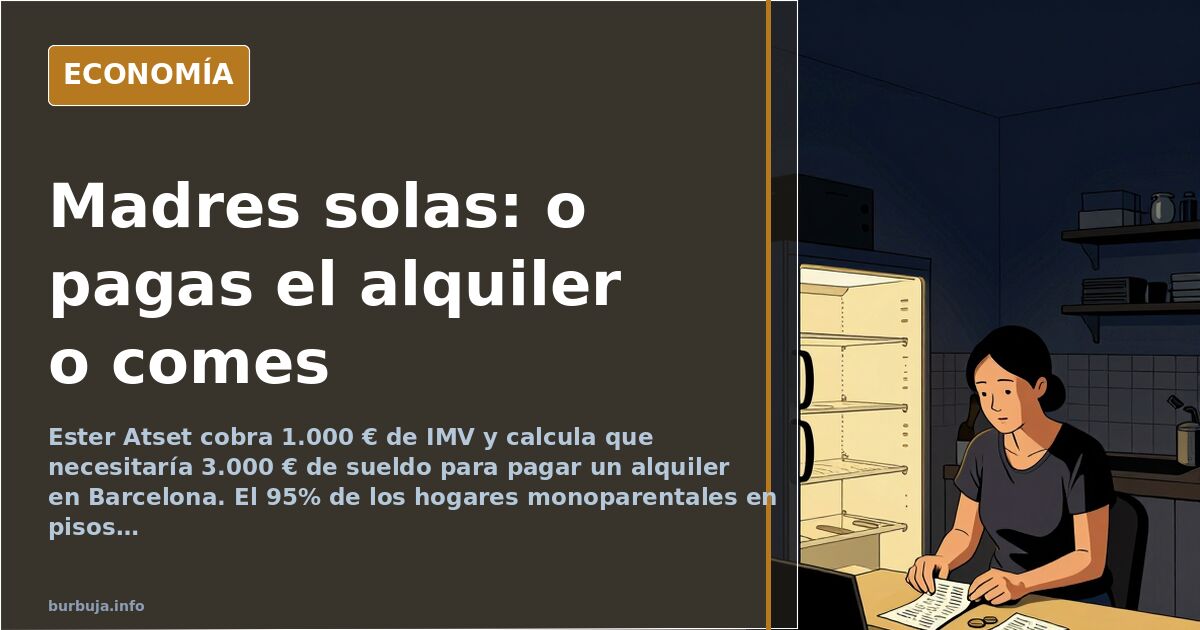
Single mothers: €1,000 IMV vs €1,000 rents
How do you pay market rent in Barcelona on one income and two children? The short answer is that you cannot. Ester Atset’s story—34 when she gave birth to twins, now with two seven-year-olds—illustrates the harsh arithmetic. Unemployed at childbirth, supported by her father until his death months later, she ended up on the street with two babies. “I considered giving them up for adoption,” she recalls. Today, she lives in a social flat run by the Fundació Habitatge Social de Catalunya, studies vocational training, and covers expenses with about €1,000 from the Ingreso Mínimo Vital. Her diagnosis is stark: “It’s either paying rent or eating.”
Women head 80% of single-parent households
The Fundació Habitatge Social de Catalunya, linked to Càritas, manages 473 social homes in Barcelona. For the first time, those occupied by single-parent families (185) outnumber those of couples with children (180). Of this first group, 95% are women. Director Sergio Rodríguez calls for specific rental aid, adapted guarantees, and higher priority scores for these households in accessing protected housing, a measure already implemented in some regions and municipalities.
Another case highlighting the issue is Anyuli del Carmen Rodríguez, a 52-year-old Venezuelan with degrees in Business Administration and Finance, living in Barcelona for three years with daughters aged 16 and 18. Before reaching social housing, she stayed in a hotel and an eight-square-meter room shared by eight families. Earning the minimum wage (€1,080/month, rising to €1,134 in 2024), she paid €600 for the room and hoped for a small flat at that price. “Immediately they told me I couldn’t rent alone, that I needed another payslip,” she laments. Once, she was invited to view a flat at 11 PM; it was a drug den.
Why does rent consume half the risk of exclusion?
50% of single-parent families exceed the AROPE social exclusion rate, compared to 28% of the general population. According to the INE Living Conditions Survey, 40% struggle or find it very difficult to make ends meet; 18% cannot buy new clothes to replace worn ones; 21% cannot regularly afford leisure activities; and 29% cannot spend even a small amount on themselves. In couple-headed households with children, these figures are 8%, 14%, and 17%. The association Familias Monoparentales (FAMPS) warns that data underestimates the problem, as it only includes households with multiple children and one parent, excluding mothers sharing flats or living with grandparents and siblings.
Paloma Uribe, a FAMPS technician, states precisely: “Single motherhood rests on three pillars: housing, employment, and work-life balance. A home to live in and a job to pay for it, but without work-life balance, there is no job and therefore no home.” Without family support, she adds, “living alone is practically unviable.”
The calculation debunking the lack-of-effort narrative
Ester Atset does her own math: to pay rent in Barcelona alone, she would need a monthly salary of €3,000. “It’s impossible,” she concludes. This is not a complaint but an arithmetic operation anyone can replicate using market prices. The Fundació offers reduced rental contracts, mostly between €200 and €250 per month, allowing families at risk of homelessness to recover. The average stay ends up being five years.
The debate shifts: from individual cases to the market
The conversation quickly turned to the role of landlords. One school of thought argues legislation has turned private owners into social services, leading many to avoid renting due to risks of non-payment and damage. Another points to the opposite effect: if owners stop renting, stock leaves the market, driving prices up. Some advocate reforming laws to estimulante ilegal up evictions and assign liability for damages, while others argue the problem lies in supply and land availability. Amidst this, an uncomfortable fact remains: landlords renting to vulnerable families assume risks the State does not cover.
The gap that won’t close
The original article describes two specific women, but the pattern is structural. The Fundació requests guarantees and specific aid. FAMPS demands work-life balance measures. Landlords seek legal certainty. No one disputes the problem exists; everyone debates who pays the bill. With these numbers, the question isn’t whether these families can afford market rent, but how long we will continue pretending they can.
Summary of a discussion on Burbuja.info - Foro de economía, actualidad y política., translated from Spanish and reviewed before publication. Read the full discussion (114 replies).
More summaries
-
One room and 13 flatmates: rent eating up her pension in Spain
A 63-year-old woman pays 600 euros for a room shared with 13 people in Madrid, leaving her just 280 euros a month. The case reopens the debate on pensions and housing.
-
Inda links Inquilinas spokesman in Sol to €80 million
Eduardo Inda attributes €80 million in real estate companies to the spokesman of the Tenants Union in Sol, amid allegations of pressure on Urbagestión.
-
Spain's Transport Minister Puente Resigns After Rail Crisis
Óscar Puente resigns as Spain's transport minister following a deadly rail accident and declining poll numbers ahead of elections.
-
Jávea Cliff Ruin Listed for €1.6M on Idealista
A ruined villa on a Jávea cliff is listed for €1.6 million on Idealista, sparking debate over whether the price reflects land value or market speculation.
-
Spain court orders €15,000 for sexual assault after ignoring consent
A Santiago court sentenced a man to two years suspended and €15,000 compensation for sexually assaulting a peer who refused advances.
-
Spain's Urda High-Speed Rail Crash: Failing Track Cables, Not Software
The LZB system failed 170 times annually due to cable damage. The backup ASFA also malfunctioned, allowing the AVE train to pass red signals.