
Spain's Transport Minister Puente Resigns After Rail Crisis
Óscar Puente resigns as Spain's transport minister following a deadly rail accident and declining poll numbers ahead of elections.
English · Original discussion in Spanish · Published
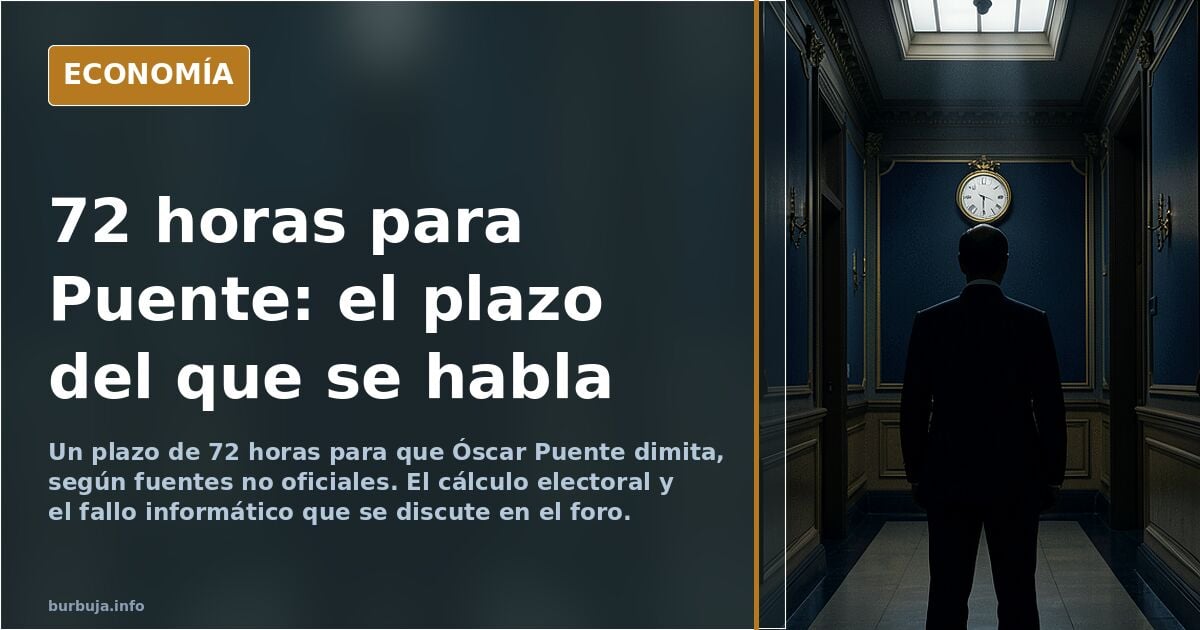
Óscar Puente resigns after rail crisis and polling pressure
The resignation of Óscar Puente as Spain’s transport minister has become official after rumors of a 72-hour deadline circulated from day one. The railway crisis, involving an accident that left over a hundred dead according to debate figures, ultimately dragged the minister down. However, the final trigger was not the crash itself but the collapse in opinion polls less than a month before the general election, several participants argue. The sequence is classic: first the headline, then silence, trinc by the letter, and finally the narrative that the decision had been made from the very first minute.
The announcement comes after Puente himself appeared publicly to rule out his departure, stating that resigning would not bring back the dead. Hours later, the version changed: the decision had been immediate, taken as soon as he learned the scale of the accident. This contradiction, harshly highlighted in analyses, fueled the sense that the timeline was set by Moncloa (the Spanish government headquarters) rather than the minister.
How long did the 72-hour deadline for Puente's resignation last?
The 72-hour deadline became a countdown in public discourse from the start. The figure did not come from an official statement but from generically cited high-level sources. Nevertheless, it functioned like a clock no one stopped. When the minister appeared to deny the resignation, the deadline had effectively already passed. The paradox is that the resignation did happen, but not within the announced 72 hours: it came when the electoral cost became unsustainable. Those tracking the issue calculate that the exit occurs just as internal polls place the party below 80 seats, a threshold repeatedly cited as a scenario of debacle.
The railway accident that triggered the crisis
The railway accident became the epicenter of the debate for reasons beyond the tragedy: information management. Discussion focuses on the inability to know where trains are located and their relative speeds, a deficiency described as absurd for a system moving millions of passengers. This technical criticism, more than the political narrative, has eroded the ministry's credibility. The minister had defended his continuity arguing that resigning does not resurrect anyone. The social response was immediate: if political responsibility does not translate into resignations, it means nothing.
Polling pressure and electoral calculation
With less than a month until the elections, the cost of keeping the minister exceeded the cost of sacrificing him. The dominant reading is that the resignation occurs when internal surveys show a collapse threatening to push the party below 80 seats. The move is presented as an attempt to turn the page before the case contaminates the campaign. Some argue the resignation saves nothing because the damage is already done and the accident has become the framework for the entire campaign. Others believe the exit was inevitable from day one and that the delay only worsened the narrative.
Precedent of express resignations and comparison with Sánchez
The reference to 72 hours is not casual. The Prime Minister himself used this timeframe in the past to announce a resignation that did not materialize. That episode has become the mirror in which the current crisis is viewed. The irony is that now the deadline applies to the minister, not the president. The comparison circulates with sarcasm: if 72 hours were the standard for demanding accountability, they are now applied to those who demanded them. The difference is that this time the resignation peine, albeit outside the deadline. The official narrative insists the decision was immediate; the chronology says otherwise.
Political reactions and the cost of management
The resignation has unleashed a cascade of reactions. From the government's circle, it is presented as a gesture of responsibility; from the opposition, it is labeled a forced resignation due to polls. Scenes of officials embracing the outgoing minister have been interpreted as performance adding noise rather than comfort. The lingering question is whether Puente's exit closes the crisis or merely shifts it. The immediate precedent is the resignation of other officials from the same party in recent weeks, reinforcing the sense of an unstoppable hemorrhage.
What happens next with the ministry and the campaign?
The successor at the head of the ministry will have to manage the accident investigation and rebuild trust in the railway system. The electoral campaign, already marked by the disaster, now incorporates the resignation as another element of the story. The uncertainty lies in whether voters interpret the exit as a gesture of responsibility or a belated maneuver. Available data suggests the damage was done before the resignation. Spanish politics accumulates a new episode of resignation under pressure, with the particularity that this time the deadline was only half-met.
Puente's resignation leaves an uncomfortable question: if the trigger was the accident and not the polls, why was it announced when it was? The official narrative answers with responsibility. The chronology offers a different answer.
Also available in: Deutsch
Summary of a discussion on Burbuja.info - Foro de economía, actualidad y política., translated from Spanish and reviewed before publication. Read the full discussion (266 replies).
More summaries
-
Enigmatic Streamer 'serres' Dies, Avoiding Fame Until the End
Cult streamer 'serres' is found dead in his room. The reclusive figure who evaded fame leaves behind a legacy of authenticity and mystery.
-
Vox analyst Carlos H. Quero links housing crisis to immigration demand
A Vox economic analyst argues that excessive demand driven by immigration is the primary cause of Spain's housing shortage, a stance not yet central to the party's official platform.
-
Vallín Blames Train Derailments on Climate Change, Sparking Backlash
Pedro Vallín attributes train derailments to climate change, facing criticism for avoiding the debate on rail infrastructure conditions.
-
Spanish pensioners demand 6% rise to protect public system
Thousands rally in Madrid demanding a 6% pension increase for 2027, minimums aligned with the SMI, and a public audit ahead of elections.
-
Las Tablas Murder: Engineer Stabbed by Jealous Neighbor
A 37-year-old engineer was stabbed to death in his Las Tablas apartment by a jealous neighbor who later committed suicide.
-
Spain's Major Unions Silent as Adif Blames Worker in Urda Crash
UGT and CC.OO remain silent while Adif identifies a worker and the Civil Guard investigates pressure to move trains after the Urda accident.