
Simone de Beauvoir's Quotes Still Divide Western Debate
“One is not born, but rather becomes, a woman”: Simone de Beauvoir’s ten most famous quotes continue to spark debate on family, work and gender roles three decades after her death.
English · Original discussion in Spanish · Published
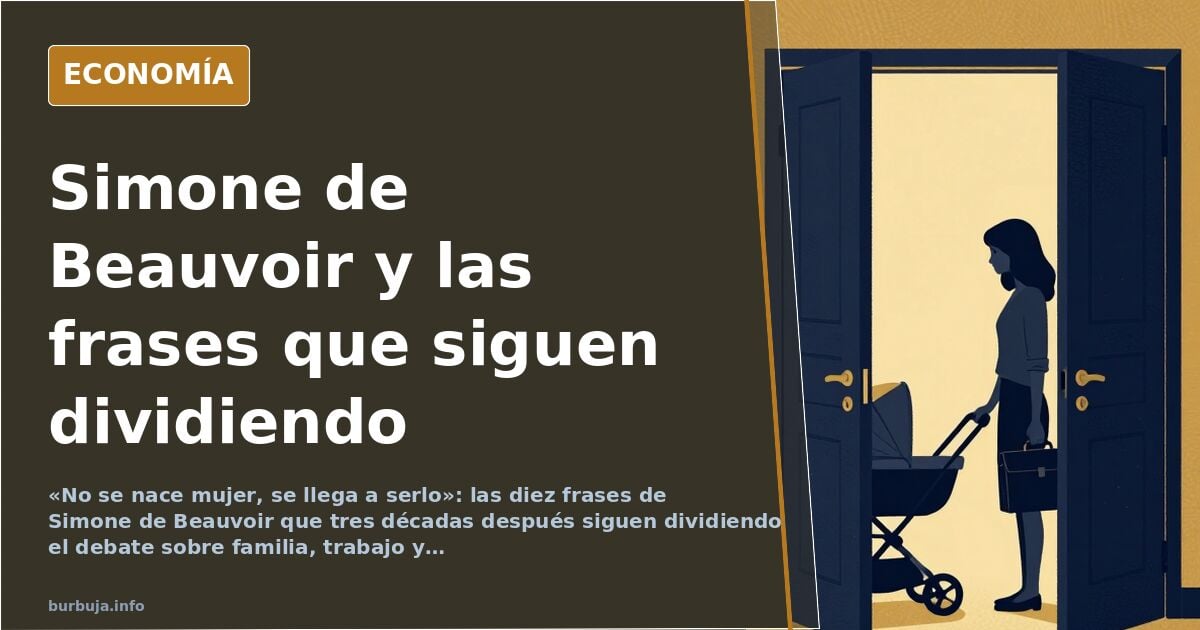
Simone de Beauvoir: The Quotes That Still Ignite Debate
Three decades after her death, revisiting Simone de Beauvoir’s most famous quotes reignites the same old dispute: was she the precursor of female liberation or the origin of a narrative that has weakened the family? The author of *The Second Sens*, who died in 1986, left a trail of sentences that today still function as a fuse. Few are mild.
Considered the most influential feminist of the 20th century and a reference for so-called equality feminism, her work transcends the era in which it was written. A part of the analysis argues, instead, that her thought is just another branch of Marxism applied to women. “What women owe to Simone de Beauvoir is immeasurable,” summarizes French writer Danièle Sallenave, who adds a nuance often forgotten: the liberation of women is, she says, an indispensable condition also for the liberation of men. The clash between these two narratives runs through any current conversation about birth rates, female employment and family.
The Quotes That Define Her Thought
“One is not born, but rather becomes, a woman” is the sentence that summarizes her central thesis: the female condition is not biological, but cultural. From this stem other affirmations that are still cited with identical energy: “It is through work that woman has been able to bridge the distance separating her from man,” “The family is a nest of perversions,” or “The problem of woman has always been a problem of men.”
She also argued that gaiity is as limited as heterosenshetero and that the ideal would be to love “any human being without feeling antiestéticar, inhibition, or obligation.” On the opposite flank, some rescue her phrase “it is permissible to abusa a culture, provided one gives it a child,” so uncomfortable that even her admirers tend to downplay it.
Why Is There Debate Over Whether Work Liberates or Enslaves?
The idea that working under someone else’s orders makes a woman free is the most contested. One school of thought holds that feminism has turned daily slavery into a virtue: clocking in, meeting schedules, becoming part of gears that have little to do with the idea of liberation. It is argued that wages are merely a new mechanism of dependence, this time on an employer.
The circulating summary is blunt: capitalism has enslaved women through the frauds of feminism and self-realization. Citing Goethe—“there is no worse slave than the one who believes himself free”—critics point out that employment is sold as a form of personal fulfillment.
Against this, the opposing reading is that paid work was the instrument that gave women economic independence and access to spaces barred for centuries. The two narratives are condemned to coexist: one looks at individual freedom, the other at social structure.
Family and Motherhood: The Most Disputed Ground
Here lies the harshest part. Some analyses claim that the devaluation of motherhood has caused a drop in birth rates and demographic aging. It is maintained that the key stage for having a first child ends around age 25, and that extending studies and multiplying unproductive occupations delay that decision until it becomes, in many cases, unviable. In parallel, it is recalled that women “have always worked,” in the home, the loom, the farm, or the market, long before subsidized employment existed.
The response from the other side is that no woman should be obliged to become a mother to fulfill herself, and that linking birth rates to family structure shifts onto women a responsibility that does not belong exclusively to them. The dispute is not only ideological: it directly touches reconciliation policies and housing costs.
The Marxist Roots of Contemporary Feminism
In the realm of ideas, the most repeated objection is that contemporary feminism is rooted in Marxism. Its logic is compared to historical slogans such as “work will make you men,” used in Cuba against gaiity, and criticized for reducing people to interchangeable pieces of a productive system.
The usual reply is that identifying feminism with communism is a shortcut that ignores the movement’s concrete demands. Both positions share, deep down, the same question: not what women want, but what model of society is built with them inside or outside the labor market.
Contradictions in Her Own Biography
A detail that reappears insistently is that of her letters to a much younger lover, filled with expressions of submission, whose publication was attempted to be prevented to avoid damaging the image of a free and independent woman. It is also recalled that, in her time, she lived better than most women and that her work did not yield major technical findings.
The uncomfortable portrait serves as ammunition for those questioning the myth. It is not a new argument, but it works: if the biography contradicts the message, what remains of the doctrine?
Ultimately, the fundamental question remains open. Is work the path to freedom or the most effective form of dependency? No one has closed that rift, and likely no one will. Three decades without Beauvoir, and her list of quotes still splits readers in two.
Three decades after her death, revisiting Simone de Beauvoir’s most famous quotes reignites the same old dispute: was she the precursor of female liberation or the origin of a narrative that has weakened the family? The author of *The Second Sens*, who died in 1986, left a trail of sentences that today still function as a fuse. Few are mild.
Considered the most influential feminist of the 20th century and a reference for so-called equality feminism, her work transcends the era in which it was written. A part of the analysis argues, instead, that her thought is just another branch of Marxism applied to women. “What women owe to Simone de Beauvoir is immeasurable,” summarizes French writer Danièle Sallenave, who adds a nuance often forgotten: the liberation of women is, she says, an indispensable condition also for the liberation of men. The clash between these two narratives runs through any current conversation about birth rates, female employment and family.
The Quotes That Define Her Thought
“One is not born, but rather becomes, a woman” is the sentence that summarizes her central thesis: the female condition is not biological, but cultural. From this stem other affirmations that are still cited with identical energy: “It is through work that woman has been able to bridge the distance separating her from man,” “The family is a nest of perversions,” or “The problem of woman has always been a problem of men.”
She also argued that gaiity is as limited as heterosenshetero and that the ideal would be to love “any human being without feeling antiestéticar, inhibition, or obligation.” On the opposite flank, some rescue her phrase “it is permissible to abusa a culture, provided one gives it a child,” so uncomfortable that even her admirers tend to downplay it.
Why Is There Debate Over Whether Work Liberates or Enslaves?
The idea that working under someone else’s orders makes a woman free is the most contested. One school of thought holds that feminism has turned daily slavery into a virtue: clocking in, meeting schedules, becoming part of gears that have little to do with the idea of liberation. It is argued that wages are merely a new mechanism of dependence, this time on an employer.
The circulating summary is blunt: capitalism has enslaved women through the frauds of feminism and self-realization. Citing Goethe—“there is no worse slave than the one who believes himself free”—critics point out that employment is sold as a form of personal fulfillment.
Against this, the opposing reading is that paid work was the instrument that gave women economic independence and access to spaces barred for centuries. The two narratives are condemned to coexist: one looks at individual freedom, the other at social structure.
Family and Motherhood: The Most Disputed Ground
Here lies the harshest part. Some analyses claim that the devaluation of motherhood has caused a drop in birth rates and demographic aging. It is maintained that the key stage for having a first child ends around age 25, and that extending studies and multiplying unproductive occupations delay that decision until it becomes, in many cases, unviable. In parallel, it is recalled that women “have always worked,” in the home, the loom, the farm, or the market, long before subsidized employment existed.
The response from the other side is that no woman should be obliged to become a mother to fulfill herself, and that linking birth rates to family structure shifts onto women a responsibility that does not belong exclusively to them. The dispute is not only ideological: it directly touches reconciliation policies and housing costs.
The Marxist Roots of Contemporary Feminism
In the realm of ideas, the most repeated objection is that contemporary feminism is rooted in Marxism. Its logic is compared to historical slogans such as “work will make you men,” used in Cuba against gaiity, and criticized for reducing people to interchangeable pieces of a productive system.
The usual reply is that identifying feminism with communism is a shortcut that ignores the movement’s concrete demands. Both positions share, deep down, the same question: not what women want, but what model of society is built with them inside or outside the labor market.
Contradictions in Her Own Biography
A detail that reappears insistently is that of her letters to a much younger lover, filled with expressions of submission, whose publication was attempted to be prevented to avoid damaging the image of a free and independent woman. It is also recalled that, in her time, she lived better than most women and that her work did not yield major technical findings.
The uncomfortable portrait serves as ammunition for those questioning the myth. It is not a new argument, but it works: if the biography contradicts the message, what remains of the doctrine?
Ultimately, the fundamental question remains open. Is work the path to freedom or the most effective form of dependency? No one has closed that rift, and likely no one will. Three decades without Beauvoir, and her list of quotes still splits readers in two.
Also available in: Deutsch
Summary of a discussion on Burbuja.info - Foro de economía, actualidad y política., translated from Spanish and reviewed before publication. Read the full discussion (157 replies).
More summaries
-
Inés Hernand: feminism and reggaeton collide
Inés Hernand defends her contradictions over supporting Bad Bunny. Does feminist consistency have a price? An economic analysis of brand hypocrisy.
-
Anthropic's origin: no garage, no angels, pure venture capital
Former OpenAI employees found Anthropic over Zoom with $20M in venture capital and humanitarian rhetoric. Chinese models open the game.
-
AI advises 40-year-old with €70,000 and €800 a month
AI therapy: €70,000, €800 a month and living with mum at 40. A 40-year-old man with €70,000 in savings, an €800 monthly salary and a second-hand BMW asks...
-
Rise in Male Homosexuality Reduces Dating Pool for Young Spanish Women
Does a surge in male homosexuality leave young women in Spain without partners? An analysis of a debate blending math, stereotypes, and social anxiety.
-
Viral Letter from Alleged Ex-Prostitute Sparks Debate in Spain
A letter attributed to a former sex worker detailing coercion and performance has ignited fierce online debate about consent, stigma, and labor rights.
-
Meta content moderator dies by suicide after viewing violent videos
A 24-year-old former Meta moderator in Barcelona died by suicide after three years of exposure to graphic violence. Her family is considering legal action against Meta and Telus.