
Silver breaks $80 as East-West price gap widens
Silver tops 18,000 yuan per kilo in Shanghai and hits $108.4 in China versus $96.7 in the West, widening the East-West gap.
English · Original discussion in Spanish · Published
Silver tops $100 in China as gap with West grows
Silver crossed 18,000 yuan per kilo in Shanghai's night session — about $79.88 an ounce — and hours later was at 18,150 yuan, above $80.5. The $80 barrier was broken in the Shanghai night session, with the Asian market still open.
For several forum users, the relevant thing was not the round number but the warning that silver's price might be ceasing to be governed by what happens in London and New York. From there, everything accelerated.
The takeoff starts in Shanghai, not New York
Daily data from the Chinese precious metals market — from the SGE and the SHFE — stopped being an exotic detail and became a must-watch reference. Week after week, available silver in China was running out while the price climbed.
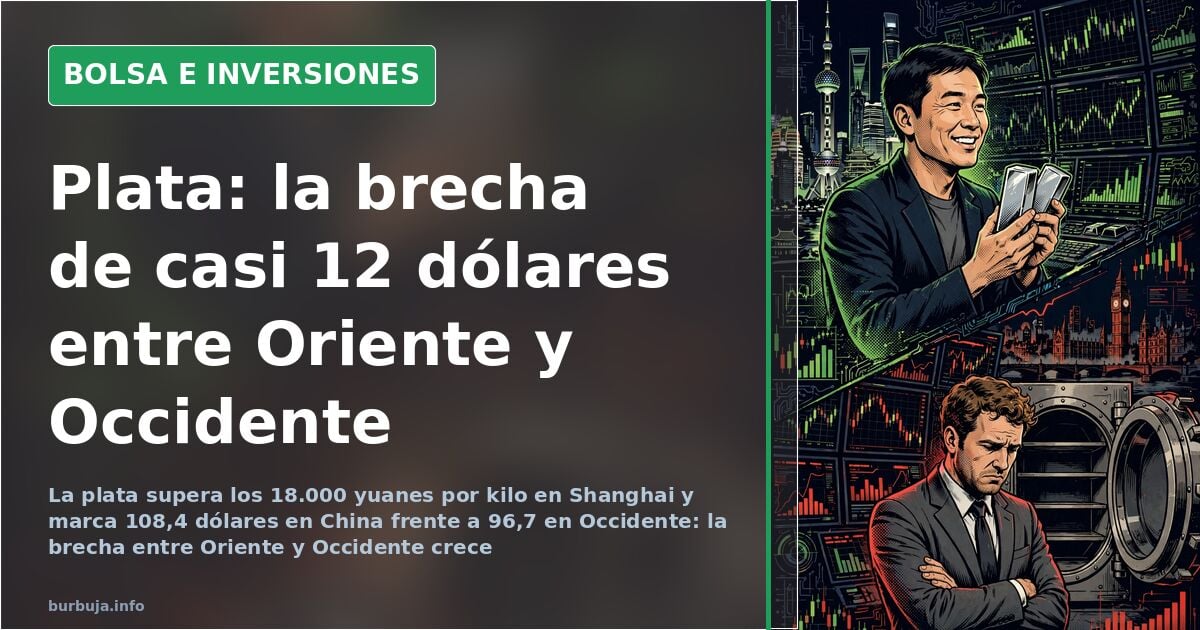
At the peak of the rally, an ounce hit $108.4 in Shanghai versus $96.7 in the West. The metal delivered in Asia was worth almost twelve dollars more — a gap of $11.7 — than the metal traded on the other side of the world. And that gap, far from closing, was widening again. The mantra repeated among metal enthusiasts is that it is Chinese inventories, not paper, that are pushing everything up.
The thesis has support in the data. If physical silver disappears from Asian vaults, the price paid by those who truly need it — industry, institutional buyers — has to rise, whatever the contract of the day says.
Inventories empty and distrust of paper grows
The other front is COMEX. The silver deposited there is divided into two categories: registered, available for delivery, and eligible, which in theory already has an owner. The calculation circulating is that on a specific date there were 128 million registered ounces and 420 million eligible ounces. With those figures on the table, the uncomfortable question is what happens if many holders simultaneously claim the metal they believe they own.
The answer, according to those who have been in this for years, lies in the fine print. Contracts include a force majeure clause that allows settling the difference in cash instead of delivering the bars. In other words: if you ask for your silver, you may be paid the difference and never see the metal. And those who insist on physical delivery do so precisely because they don't want paper.
Why won't anyone pay you $80 if you want to sell?
Therein lies the trap of any self-respecting rally. One thing is the price a website announces, and another is what you get when you go to sell. One buyer boasts of having physical ounces at $80; another replies that no one is paying that price. The first one's retort sums up the problem: no one wants to sell. The gap between the theoretical price and the actual transaction price is the exact measure of nervousness, and it is wise not to confuse the quote with liquidity.
Karlillos, coin boxes and the revenge of the mocking teller
There is a detail that says a lot about how much the narrative has changed. The 12-euro half-ounce silver coins that the Banco de España withdrew by the thousands from its branches years ago were then bought under the mocking gaze of the teller on duty. More than one has confessed to keeping them buried in their original strips, like gummy candies, never touched. And the boxes of Philharmonic coins bought 500 ounces at a time. All that, they now say, is the start of the expected reward.
It is a mix of nostalgia and revenge: those who bought when they were laughed at are the ones smiling now. The silent accumulation of metal over a decade with no one paying attention has suddenly turned out to be an enviable position.
From 108 to 61 and back again: the correction that tested nerves
None of this was in a straight line. A month after the peak, silver plunged to $77. Then it touched $61 and rebounded to $70. Those who entered at the high were faced with losses and an uncomfortable question: hold or sell?
Supporters of the thesis argue that the fall was foreseeable and even healthy, that inventory depletion continues and that whoever doesn't take advantage of these prices to accumulate will cry later. Skeptics see something else: a speculative rollercoaster where big funds sat down at the table, smelled blood and took profits by plucking those who arrived late.
The rebound proved the former right, at least for now. Silver rose more than 6% in a single day to $85, with gold more hesitant, and in China it remained above $100. Silver is a rollercoaster; gold is a slow, steady climb.
Silver as a hedge: from antiestéticar of fiat to geopolitics
The backdrop is always the same. Those who buy metal are not buying an industrial asset: they are buying distrust. Distrust that printed money will continue to be worth what it claims. Every ounce buried in a garden is a vote against the system. That narrative gains strength every time there is tension in the Middle East — and there is — because then money seeks refuge and gold moves first.
The discussion running through this cycle is whether silver is rising on its fundamentals or simply because everything else is falling apart. And on that, a warning: if the printing press doesn't stop, any price is possible, including a much higher one.
The exact point where no one agrees
Here analysis gets stuck. Some argue that the price is driven by real inventory depletion and industrial demand that cannot manufacture without metal. Others reply that the solar industry is replacing silver at full estimulante ilegal and that, in the midst of a recession, manufacturing consumption would fall anyway. For the latter, what drives the quote is gold's role as a hedge against inflation, not the silver needed to make things.
Some claim that the window to convert money into metals is closing, at least for individuals. Maybe. Or maybe it is the umpteenth prophecy of the end of paper money that never quite comes true. Chinese inventories keep falling, the gap between East and West remains and no one fully figures out why.
Silver crossed 18,000 yuan per kilo in Shanghai's night session — about $79.88 an ounce — and hours later was at 18,150 yuan, above $80.5. The $80 barrier was broken in the Shanghai night session, with the Asian market still open.
For several forum users, the relevant thing was not the round number but the warning that silver's price might be ceasing to be governed by what happens in London and New York. From there, everything accelerated.
The takeoff starts in Shanghai, not New York
Daily data from the Chinese precious metals market — from the SGE and the SHFE — stopped being an exotic detail and became a must-watch reference. Week after week, available silver in China was running out while the price climbed.
At the peak of the rally, an ounce hit $108.4 in Shanghai versus $96.7 in the West. The metal delivered in Asia was worth almost twelve dollars more — a gap of $11.7 — than the metal traded on the other side of the world. And that gap, far from closing, was widening again. The mantra repeated among metal enthusiasts is that it is Chinese inventories, not paper, that are pushing everything up.
The thesis has support in the data. If physical silver disappears from Asian vaults, the price paid by those who truly need it — industry, institutional buyers — has to rise, whatever the contract of the day says.
Inventories empty and distrust of paper grows
The other front is COMEX. The silver deposited there is divided into two categories: registered, available for delivery, and eligible, which in theory already has an owner. The calculation circulating is that on a specific date there were 128 million registered ounces and 420 million eligible ounces. With those figures on the table, the uncomfortable question is what happens if many holders simultaneously claim the metal they believe they own.
The answer, according to those who have been in this for years, lies in the fine print. Contracts include a force majeure clause that allows settling the difference in cash instead of delivering the bars. In other words: if you ask for your silver, you may be paid the difference and never see the metal. And those who insist on physical delivery do so precisely because they don't want paper.
Why won't anyone pay you $80 if you want to sell?
Therein lies the trap of any self-respecting rally. One thing is the price a website announces, and another is what you get when you go to sell. One buyer boasts of having physical ounces at $80; another replies that no one is paying that price. The first one's retort sums up the problem: no one wants to sell. The gap between the theoretical price and the actual transaction price is the exact measure of nervousness, and it is wise not to confuse the quote with liquidity.
Karlillos, coin boxes and the revenge of the mocking teller
There is a detail that says a lot about how much the narrative has changed. The 12-euro half-ounce silver coins that the Banco de España withdrew by the thousands from its branches years ago were then bought under the mocking gaze of the teller on duty. More than one has confessed to keeping them buried in their original strips, like gummy candies, never touched. And the boxes of Philharmonic coins bought 500 ounces at a time. All that, they now say, is the start of the expected reward.
It is a mix of nostalgia and revenge: those who bought when they were laughed at are the ones smiling now. The silent accumulation of metal over a decade with no one paying attention has suddenly turned out to be an enviable position.
From 108 to 61 and back again: the correction that tested nerves
None of this was in a straight line. A month after the peak, silver plunged to $77. Then it touched $61 and rebounded to $70. Those who entered at the high were faced with losses and an uncomfortable question: hold or sell?
Supporters of the thesis argue that the fall was foreseeable and even healthy, that inventory depletion continues and that whoever doesn't take advantage of these prices to accumulate will cry later. Skeptics see something else: a speculative rollercoaster where big funds sat down at the table, smelled blood and took profits by plucking those who arrived late.
The rebound proved the former right, at least for now. Silver rose more than 6% in a single day to $85, with gold more hesitant, and in China it remained above $100. Silver is a rollercoaster; gold is a slow, steady climb.
Silver as a hedge: from antiestéticar of fiat to geopolitics
The backdrop is always the same. Those who buy metal are not buying an industrial asset: they are buying distrust. Distrust that printed money will continue to be worth what it claims. Every ounce buried in a garden is a vote against the system. That narrative gains strength every time there is tension in the Middle East — and there is — because then money seeks refuge and gold moves first.
The discussion running through this cycle is whether silver is rising on its fundamentals or simply because everything else is falling apart. And on that, a warning: if the printing press doesn't stop, any price is possible, including a much higher one.
The exact point where no one agrees
Here analysis gets stuck. Some argue that the price is driven by real inventory depletion and industrial demand that cannot manufacture without metal. Others reply that the solar industry is replacing silver at full estimulante ilegal and that, in the midst of a recession, manufacturing consumption would fall anyway. For the latter, what drives the quote is gold's role as a hedge against inflation, not the silver needed to make things.
Some claim that the window to convert money into metals is closing, at least for individuals. Maybe. Or maybe it is the umpteenth prophecy of the end of paper money that never quite comes true. Chinese inventories keep falling, the gap between East and West remains and no one fully figures out why.
Summary of a discussion on Burbuja.info - Foro de economía, actualidad y política., translated from Spanish and reviewed before publication. Read the full discussion (540 replies).
More summaries
-
Physical Silver Detaches from Official Price Amidst 48% Premiums
Physical silver premiums surge to 48.44% over official prices as COMEX inventories dwindle, intensifying the battle between stackers and short-sellers.
-
Perth Mint Lunar Coins: Up to €400 for a Silver Ounce
The premium of Perth Mint lunar coins is under scrutiny. The 2012 dragon coin sold for €35 over other silver ounces, then dropped to €22.
-
Invertir desde Cero course reviews: useful but basic
Students call the stock market course introductory, not advanced: one month of classes and a year of monthly sessions.
-
Tulips, Bitcoin, and Gold: Comparing Massive Price Surges
From tulip bulbs to Bitcoin's meteoric rise, historical price comparisons reignite the debate over what truly defines an economic bubble.
-
Oil prices crash to minus $37: why the easy trade failed
Crude oil prices swung from $30 to $39 and even hit negative territory. Contango, CFDs, and fees explain why this easy bet went wrong.
-
Gold price prediction of 1,300 euros fails to materialize
A prediction that gold would drop to 1,300 euros per ounce has expired without coming true as the metal moved in the opposite direction.