
Tulips, Bitcoin, and Gold: Comparing Massive Price Surges
From tulip bulbs to Bitcoin's meteoric rise, historical price comparisons reignite the debate over what truly defines an economic bubble.
English · Original discussion in Spanish · Published
Tulips, Bitcoin, and Gold: The Same Question 400 Years Later
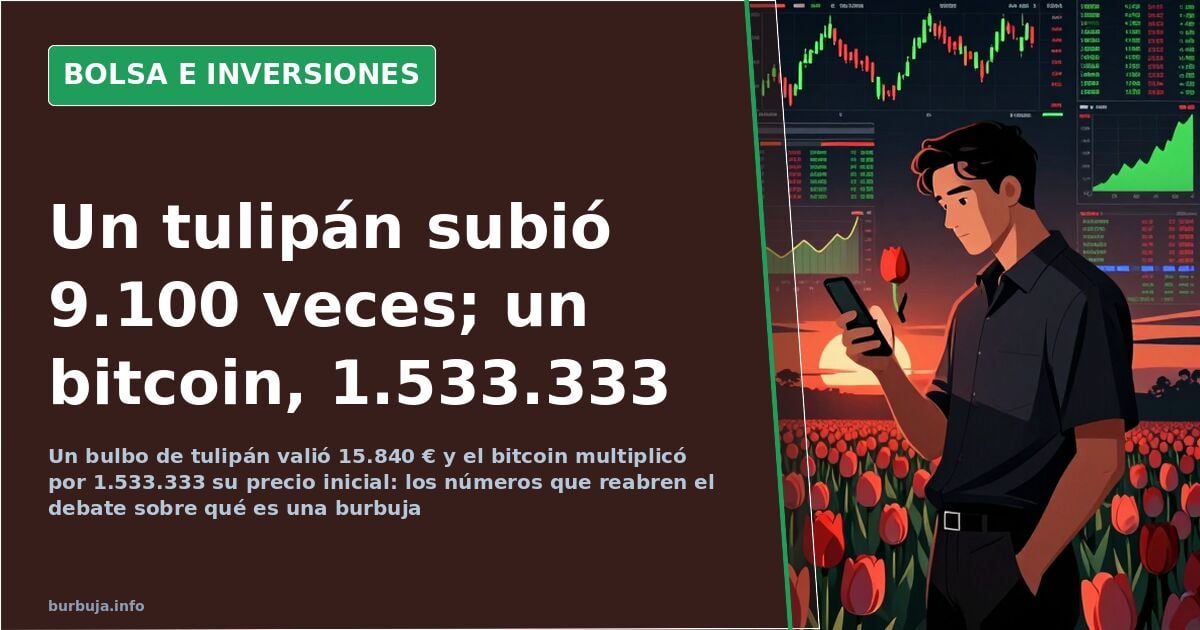
A single tulip bulb once sold for the equivalent of 24 tons of wheat. At 0.66 euros per kilo, that amounts to 15,840 euros for an onion that today costs just 1.74 euros in a bag of five. This occurred between 1634 and 1637. Bitcoin has moved from 0.06 dollars to 92,000: a 1,533,333-fold increase from its starting price. Gold, over the same fourteen-year period, moved from 1,081 to 2,541 dollars per ounce, a 2.35x increase. When placed on the same scale, the uncomfortable question is not which one rose more, but why only one carries the stigma of being a bubble.
Tulips 9,100x, Bitcoin 1,533,333x, and Gold 2.35x: The Table That Started It All
The comparison begins with a simple division. If a bulb of the variety sold in any supermarket today costs 1.74 euros, the peak of tulip mania is equivalent to 9,100 times that amount. Bitcoin, starting at 0.06 dollars, multiplies by 1,533,333. Gold, measured over an identical period, barely multiplies by 2.35. The result can be interpreted in two opposite directions: either Bitcoin is the greatest price anomaly in history, or the table compares an industrially reproducible asset with a digital issuance limited by design. The full breakdown, including the conversion from wheat to euros, is the piece of evidence that each side interprets to its own advantage.
What is a Bubble and Why is it Rarely Detected Before the Burst?
An economic bubble is a surge in an asset's price far above its reasonable value, often trinc by a crash so rapid it can drag down an entire economy. Identifying one in hindsight is easy; the problem lies in predicting it beforehand. Here, opinions diverge. One school of thought argues that Bitcoin shows all the classic symptoms: it generates no cash flow, its value depends on new money entering the market, and its price relies on the expectation that someone else will pay more. The opposing view responds that a massive price increase is not necessarily a bubble, pointing to housing markets where prices have climbed for years without anyone predicting a crash. Even the term "reasonable value" is elusive, as no one has published a definitive one for Bitcoin.
Gold Doesn't Expire, but an Apocalypse Could Leave Bitcoin Without a Plug
Gold has relied on the trust of its users for five thousand years, and it also has applications that do not depend on that trust: microchips, dental prosthetics, and aerospace components. It does not expire, it does not spoil, and it fits in a pocket. Bitcoin does not. To function, it requires hardware—a phone, a computer—electricity across a global network of servers, and stable internet on a global scale. This is the most common argument among skeptics: in a collapse scenario, the digital asset loses the plug it depends on. The rebuttal is swift: gold is also, fundamentally, a convention, and its price is not guaranteed by any central bank.
Why Tether is at the Center of Price Suspicions
Tether is the most widely used cryptocurrency and presents itself as being backed one-to-one by real dollars. It is used to purchase Bitcoin. Some argue this is the trap: its issuance is private and opaque, and those who control it create units out of thin air to acquire Bitcoin for free while everyone else pays with real money. According to this analysis, the day it breaks, it will become clear that the price did not respond to real demand. The objection from the other side is that Bitcoin no longer lives solely within that circuit.
BlackRock, MicroStrategy, and Bitcoin Entering Corporate Treasuries
The institutional route has shifted the landscape. There is now the option to buy an ETF through a broker in euros, and those who defend this method note that if the entity operates in Spain, it reports the operations so the investor does not have to declare anything on their own. Critics point to fees: the conversion from euros to Bitcoin and back is paid twice, something that does not happen when buying directly. On a macro level, the daily trading volume of gold is around 140 billion dollars, compared to about 50 billion for Bitcoin. This raises the textbook question: if a major tech company trinc MicroStrategy's lead and put Bitcoin in its treasury, how many others would trinc?
The Miner Who Paid for a Car Without Selling a Single Bitcoin
Mining distributes a reward proportional to the computing power each person contributes to protect the network. In one specific case, someone who started mining in 2017 accumulated enough to pay for a car in Bitcoin—claiming they did it "just for fun"—and still keeps the rest. Their warning is the usual one: equipment becomes obsolete every few years, and renewing it eats into the margins. The other side of the euphoria is liquidity. Every sale at 90,000 requires, at that exact moment, someone to put up those 90,000. When there are more people selling than buying, the price doesn't just go down: it plunges.
Fundamental doubt remains. If the tulip disappeared as an asset and Bitcoin has been burying collapse predictions since 2010, is the bubble the asset itself, or the certainty with which we all believe we know where it is?
A single tulip bulb once sold for the equivalent of 24 tons of wheat. At 0.66 euros per kilo, that amounts to 15,840 euros for an onion that today costs just 1.74 euros in a bag of five. This occurred between 1634 and 1637. Bitcoin has moved from 0.06 dollars to 92,000: a 1,533,333-fold increase from its starting price. Gold, over the same fourteen-year period, moved from 1,081 to 2,541 dollars per ounce, a 2.35x increase. When placed on the same scale, the uncomfortable question is not which one rose more, but why only one carries the stigma of being a bubble.
Tulips 9,100x, Bitcoin 1,533,333x, and Gold 2.35x: The Table That Started It All
The comparison begins with a simple division. If a bulb of the variety sold in any supermarket today costs 1.74 euros, the peak of tulip mania is equivalent to 9,100 times that amount. Bitcoin, starting at 0.06 dollars, multiplies by 1,533,333. Gold, measured over an identical period, barely multiplies by 2.35. The result can be interpreted in two opposite directions: either Bitcoin is the greatest price anomaly in history, or the table compares an industrially reproducible asset with a digital issuance limited by design. The full breakdown, including the conversion from wheat to euros, is the piece of evidence that each side interprets to its own advantage.
What is a Bubble and Why is it Rarely Detected Before the Burst?
An economic bubble is a surge in an asset's price far above its reasonable value, often trinc by a crash so rapid it can drag down an entire economy. Identifying one in hindsight is easy; the problem lies in predicting it beforehand. Here, opinions diverge. One school of thought argues that Bitcoin shows all the classic symptoms: it generates no cash flow, its value depends on new money entering the market, and its price relies on the expectation that someone else will pay more. The opposing view responds that a massive price increase is not necessarily a bubble, pointing to housing markets where prices have climbed for years without anyone predicting a crash. Even the term "reasonable value" is elusive, as no one has published a definitive one for Bitcoin.
Gold Doesn't Expire, but an Apocalypse Could Leave Bitcoin Without a Plug
Gold has relied on the trust of its users for five thousand years, and it also has applications that do not depend on that trust: microchips, dental prosthetics, and aerospace components. It does not expire, it does not spoil, and it fits in a pocket. Bitcoin does not. To function, it requires hardware—a phone, a computer—electricity across a global network of servers, and stable internet on a global scale. This is the most common argument among skeptics: in a collapse scenario, the digital asset loses the plug it depends on. The rebuttal is swift: gold is also, fundamentally, a convention, and its price is not guaranteed by any central bank.
Why Tether is at the Center of Price Suspicions
Tether is the most widely used cryptocurrency and presents itself as being backed one-to-one by real dollars. It is used to purchase Bitcoin. Some argue this is the trap: its issuance is private and opaque, and those who control it create units out of thin air to acquire Bitcoin for free while everyone else pays with real money. According to this analysis, the day it breaks, it will become clear that the price did not respond to real demand. The objection from the other side is that Bitcoin no longer lives solely within that circuit.
BlackRock, MicroStrategy, and Bitcoin Entering Corporate Treasuries
The institutional route has shifted the landscape. There is now the option to buy an ETF through a broker in euros, and those who defend this method note that if the entity operates in Spain, it reports the operations so the investor does not have to declare anything on their own. Critics point to fees: the conversion from euros to Bitcoin and back is paid twice, something that does not happen when buying directly. On a macro level, the daily trading volume of gold is around 140 billion dollars, compared to about 50 billion for Bitcoin. This raises the textbook question: if a major tech company trinc MicroStrategy's lead and put Bitcoin in its treasury, how many others would trinc?
The Miner Who Paid for a Car Without Selling a Single Bitcoin
Mining distributes a reward proportional to the computing power each person contributes to protect the network. In one specific case, someone who started mining in 2017 accumulated enough to pay for a car in Bitcoin—claiming they did it "just for fun"—and still keeps the rest. Their warning is the usual one: equipment becomes obsolete every few years, and renewing it eats into the margins. The other side of the euphoria is liquidity. Every sale at 90,000 requires, at that exact moment, someone to put up those 90,000. When there are more people selling than buying, the price doesn't just go down: it plunges.
Fundamental doubt remains. If the tulip disappeared as an asset and Bitcoin has been burying collapse predictions since 2010, is the bubble the asset itself, or the certainty with which we all believe we know where it is?
Summary of a discussion on Burbuja.info - Foro de economía, actualidad y política., translated from Spanish and reviewed before publication. Read the full discussion (485 replies).
More summaries
-
Bitcoin: From Halving to Bitfinex Hack on the Road to $1,000
In 2016, Bitcoin saw the halving cut miner rewards, the Bitfinex hack stealing 125,000 BTC, and a rally towards $1,000.
-
3% Deposit Accounts Disappear as Banks Cut Rates
Remunerated accounts and 3% deposits are fading: Openbank offers 2.58% for three months and Norwegian cuts rates. Conservative savers seek shelter.
-
Foreign ISIN funds: How Spanish savers bypass capital controls
Funds domiciled in Luxembourg or Ireland offer a way to keep savings outside Spain. The key is an ISIN code not starting with 'E'.
-
Spain's rental exodus: owners hoarding properties as supply dries up
Owners withdraw units citing 3% net yield vs 8-10% appreciation. The move shrinks supply, potentially driving prices higher as vacancies rise.
-
Bull Trap or Reality? Stock Liquidity vs. Weak Economy
Carl Icahn sold Hertz below $1 before bankruptcy, yet retail investors drove shares up 130%. Markets question if this is a bull trap fueled by liquidity.
-
Proeduca Altus: €111m revenue, zero debt, and a 7.5% free-float barrier
Proeduca Altus reports €111m revenue with no debt and a 4% dividend, but its 7.5% free-float blocks access to Spain's Main Market.