
Shenzhen: from zero to 12 million residents in four decades
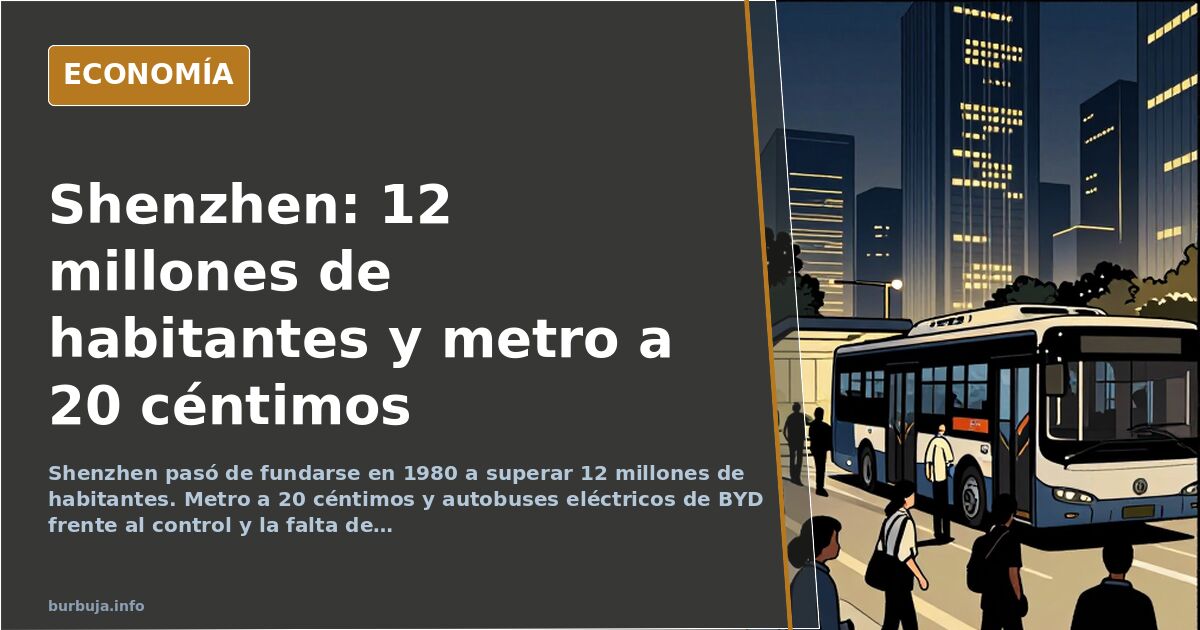
Shenzhen went from being founded in 1980 to surpassing 12 million residents. A 20-cent metro and BYD electric buses amid control and a lack of…
English · Original discussion in Spanish · Published
Shenzhen: from zero to 12 million residents in four decades
Shenzhen isn't a conventional city: it's an experiment with a start date. It was established in 1980 and today has more than 12 million residents, a leap that would short-circuit any European urban planner. Aerial videos are impressive, of course. But the scenery explains nothing: the useful question is who lives there, where, and in exchange for what.
And there the story splits in two. Some look at the drone and see the future. Others look at the same drone and see a corporate park with housing left out of frame.
What Shenzhen is and why drone videos are misleading
The city was founded in 1980 and in four decades has become one of the country's largest. The contrast with what it was then is, for anyone who has trinc it, more spectacular than today's skyline. There's a detail that often gets missed: many of the skyscrapers shown in the videos are not housing. It is argued that they are corporate headquarters and that the real city—where people eat, shop and sleep—is left out of frame.
That is probably the most repeated objection: no one disputes the buildings; what's disputed is what they show. And it's not a minor nuance, because everything else hangs on it. If what is being shown is a financial district, the enthusiasm for urbanism is only half the story.
A 20-cent metro and BYD electric buses
The most repeated fact is not visual. In Shenzhen all city buses are electric and they are made by a local company, BYD. The metro costs as little as 20 cents. An eye-catching comparison is circulating about air: a quality index of 63 in Madrid—with half the population on holiday—versus 65 in Shenzhen, a city twice as large and in full working activity. Poor air quality is concentrated, according to this analysis, in older cities like Beijing.
It should be taken with a pinch of salt, because these are one-off measurements from uncited sources. Even so, the logic holds: a city built from nothing in 1980 does not carry the industrial dead weight of others. The full breakdown of that comparison—what is measured, when and with which station—is exactly what is missing to settle it completely.
Surveillance, freedom and the model's price tag
The toughest front is not aesthetic. It is argued that the population is under surveillance and that noncompliance has practical consequences: there is talk of difficulties accessing rental housing or buying plane and train tickets. The most widespread label is that of a Brave New World-style future with a dose of 1984: no matter how many LED buildings there are, it is argued, nothing makes up for the absence of freedoms.
The reply comes from another angle. Cases are cited of respect for private property that are missed in Spain, such as homes that survive a highway expansion because their owners rejected compensation. In other words: the same system that restricts also protects, depending on which slice of life you look at.
The xiaoqu model and street life
Those who have been there describe something else. Compared with Beijing or Shanghai, Shenzhen appears calmer, with less brutal traffic, plenty of parks and real green spaces, and street life open almost 24 hours a day. The credit is attributed to the xiaoqu model: a gated development with an open, landscaped interior space designed for neighborhood use.
What it lacks, the same person admits, is an old town: in Shenzhen you don't jump 500 years in two metro stops, because there is no past to jump to. And there's an economic note that reinforces the thesis: the corridor it forms with Dongguan functions as China's Silicon Valley, with technology parks under construction.
What to expect
If the infrastructure and cost differential holds, the current that sees Asia as Europe's successor has arguments. So does anyone warning that a country can build twelve million residents in four decades without that answering the uncomfortable question. With reservations: the model will be judged by where people live, not by how it looks from above.
Shenzhen isn't a conventional city: it's an experiment with a start date. It was established in 1980 and today has more than 12 million residents, a leap that would short-circuit any European urban planner. Aerial videos are impressive, of course. But the scenery explains nothing: the useful question is who lives there, where, and in exchange for what.
And there the story splits in two. Some look at the drone and see the future. Others look at the same drone and see a corporate park with housing left out of frame.
What Shenzhen is and why drone videos are misleading
The city was founded in 1980 and in four decades has become one of the country's largest. The contrast with what it was then is, for anyone who has trinc it, more spectacular than today's skyline. There's a detail that often gets missed: many of the skyscrapers shown in the videos are not housing. It is argued that they are corporate headquarters and that the real city—where people eat, shop and sleep—is left out of frame.
That is probably the most repeated objection: no one disputes the buildings; what's disputed is what they show. And it's not a minor nuance, because everything else hangs on it. If what is being shown is a financial district, the enthusiasm for urbanism is only half the story.
A 20-cent metro and BYD electric buses
The most repeated fact is not visual. In Shenzhen all city buses are electric and they are made by a local company, BYD. The metro costs as little as 20 cents. An eye-catching comparison is circulating about air: a quality index of 63 in Madrid—with half the population on holiday—versus 65 in Shenzhen, a city twice as large and in full working activity. Poor air quality is concentrated, according to this analysis, in older cities like Beijing.
It should be taken with a pinch of salt, because these are one-off measurements from uncited sources. Even so, the logic holds: a city built from nothing in 1980 does not carry the industrial dead weight of others. The full breakdown of that comparison—what is measured, when and with which station—is exactly what is missing to settle it completely.
Surveillance, freedom and the model's price tag
The toughest front is not aesthetic. It is argued that the population is under surveillance and that noncompliance has practical consequences: there is talk of difficulties accessing rental housing or buying plane and train tickets. The most widespread label is that of a Brave New World-style future with a dose of 1984: no matter how many LED buildings there are, it is argued, nothing makes up for the absence of freedoms.
The reply comes from another angle. Cases are cited of respect for private property that are missed in Spain, such as homes that survive a highway expansion because their owners rejected compensation. In other words: the same system that restricts also protects, depending on which slice of life you look at.
The xiaoqu model and street life
Those who have been there describe something else. Compared with Beijing or Shanghai, Shenzhen appears calmer, with less brutal traffic, plenty of parks and real green spaces, and street life open almost 24 hours a day. The credit is attributed to the xiaoqu model: a gated development with an open, landscaped interior space designed for neighborhood use.
What it lacks, the same person admits, is an old town: in Shenzhen you don't jump 500 years in two metro stops, because there is no past to jump to. And there's an economic note that reinforces the thesis: the corridor it forms with Dongguan functions as China's Silicon Valley, with technology parks under construction.
What to expect
If the infrastructure and cost differential holds, the current that sees Asia as Europe's successor has arguments. So does anyone warning that a country can build twelve million residents in four decades without that answering the uncomfortable question. With reservations: the model will be judged by where people live, not by how it looks from above.
Summary of a discussion on Burbuja.info - Foro de economía, actualidad y política., translated from Spanish and reviewed before publication. Read the full discussion (234 replies).
More summaries
-
Luxembourg leads 2025 Quality of Life Rankings: Madrid Ranks 16th
According to Deutsche Bank, Luxembourg, Copenhagen, and Amsterdam lead the 2025 Quality of Life rankings. Madrid ranks 16th; Barcelona 43rd. Zurich and Geneva fall from the podium.
-
Vigo Leads Quality of Life in Spain While Madrid Drops to Eighth Place
Vigo ranks highest in quality of life, while Madrid falls to eighth. A university professor in Madrid claims poverty is imminent. Is the ranking reliable…?
-
Ciudad Lineal: Mother of 3-year-old twins falls from tenth floor
A 47-year-old woman falls from a tenth-floor apartment in Ciudad Lineal with her 3-year-old twins. Police rule out gender-based violence, while the press clashes over the narrative...
-
Córdoba Father Self-Immolates: Mental Illness or Societal Despair?
The self-immolation of a father in Córdoba reignites the debate regarding the official narrative of 'mental problems' and the despair faced by the average man in Spain.
-
Euthanasia in Old Age: Autonomy vs. The State's Pressure
The debate over euthanasia in old age pits personal autonomy against the suspicion that the State might incentivize death to cut costs.
-
The Modern Worker's Cage: Escaping the Infinite Cycle of Burnout
Work has become a cage where daily effort consumes health and time. Discover why we push ourselves so hard and how to break the cycle.