
Vigo Leads Quality of Life in Spain While Madrid Drops to Eighth Place
Vigo ranks highest in quality of life, while Madrid falls to eighth. A university professor in Madrid claims poverty is imminent. Is the ranking reliable…?
English · Original discussion in Spanish · Published
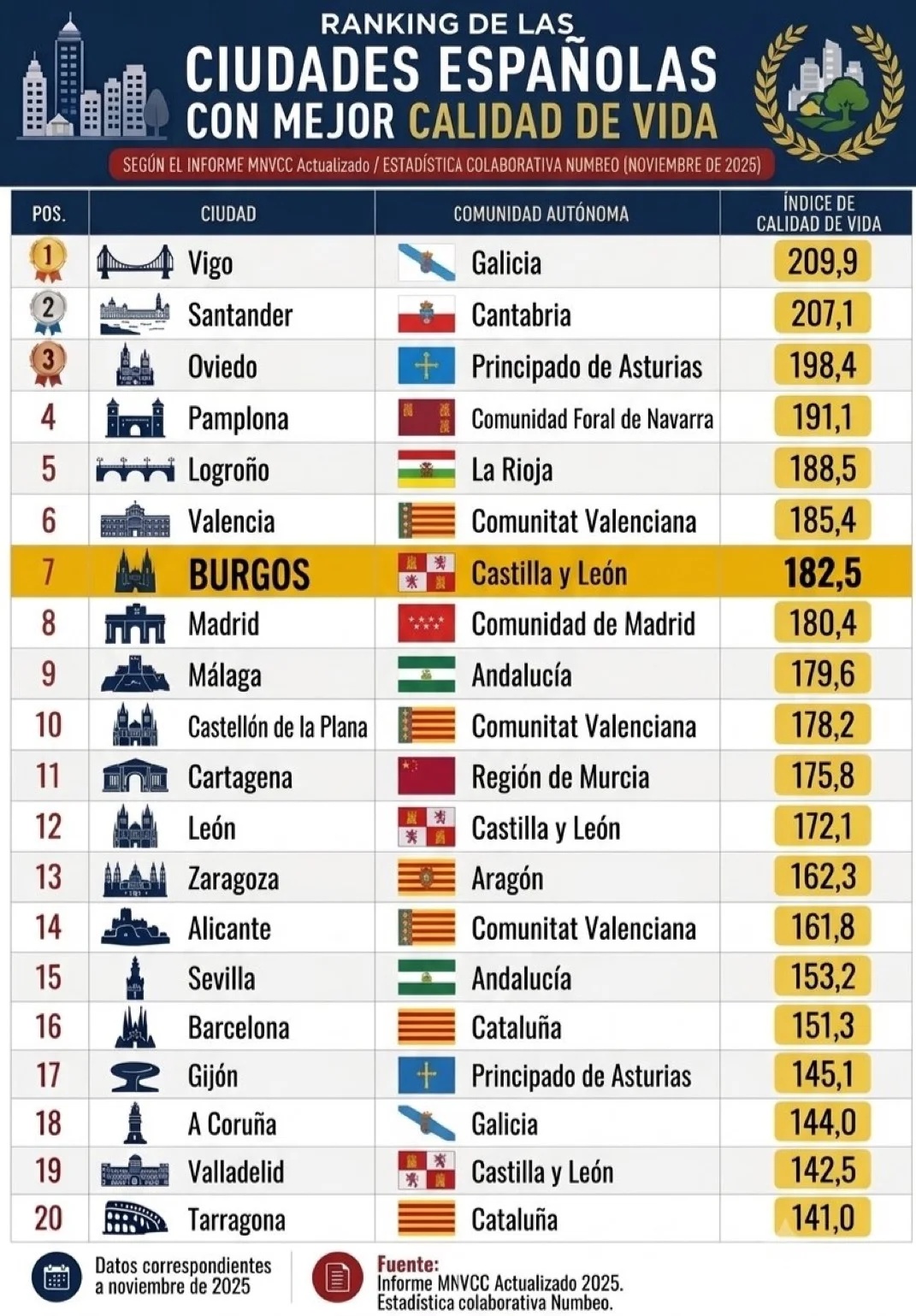
Vigo leads quality of life in Spain while Madrid drops to eighth place
It is, to say the least counterintuitive, that Vigo—a city experiencing seven months of rain a year and burdened by heavy industrial tradition—is ranked as the best in Spain for quality of life. The paradox is completed by Madrid, whose services and job market fail to place it higher than eighth.
These are the conclusions of a ranking that has caused controversy: defenders of the olive city praise its transformation over the last decade; detractors, many from Vigo itself, speak of uncontrolled immigration, unpleasant climate, and an economy that cannot support life.
The Price of Living in Madrid: The Professor Facing Poverty
The most illustrative case of this debate is that of a university professor in Madrid, a full-time civil servant with accreditation and years of experience, who claims to be 'on the brink of poverty.' His argument: with current cost of living, one needs an enormous salary to live well in the capital. If salaries don't keep up, quality of life collapses. This testimony explains why Madrid ranks low: housing and prices devour average incomes. The comparison with other cities is brutal: in San Sebastián de los Reyes, the average income is around 2,300 euros, compared to less than 1,500 in other areas. It is disposable income, not gross income, that matters.
The Questionable Ranking: Methodology or Interests
Skepticism is widespread. The appearance of Valencia as 'Valladelid'—an error or a poor joke—and the inclusion of cities like Cartagena (11th place) and Tarragona (20th) while Salamanca or Toledo are absent, raises doubts about the methodology. Some argue that these rankings rotate annually to favor destinations that pay to appear. Others question how quality of life can be measured without including the Basque Country, which usually occupies the top spots. The answer may be that these studies rely on surveys of expatriates, which weigh subjective factors.
What is Quality of Life? The Battle Between Objective and Subjective
The positions clash two views: those who believe quality of life is a balance between costs and income, services, and population density; and those who argue it is purely a matter of taste. On one end are lovers of the depopulated interior (la España vaciada), for whom a small town in Castilla y León has everything needed without overwhelming crowds. On the other end are urbanites, who see in Madrid an unparalleled cultural life, with tapas and atmosphere available at any hour. One user summed it up: you live well anywhere if you have money, especially in Madrid or Barcelona; without it, they are the worst.
Quality of life, like inflation (IPC), depends on who is asked about it.
The debate on immigration could not be absent. Some maintain that the increase in foreign population degrades coexistence and security, while others counter that this is a xenophobic perception. Some go further: the true indicator of quality of life should include a factor of 'homogeneity'—which dangerously approaches a criticism of diversity. However, the data does not support such a simplistic view: northern cities, with smaller migrant populations, continue to be rated highest.
Can a ranking capture the complexity of living well? The answer is no, or at least not in a single list. Objective data, such as average income, housing cost, or cultural offering, clashes with each individual's subjective experience. Meanwhile, the question remains open: Is Vigo truly the best city in Spain, or is it the result of a study that measures what its financier is interested in?
It is, to say the least counterintuitive, that Vigo—a city experiencing seven months of rain a year and burdened by heavy industrial tradition—is ranked as the best in Spain for quality of life. The paradox is completed by Madrid, whose services and job market fail to place it higher than eighth.
These are the conclusions of a ranking that has caused controversy: defenders of the olive city praise its transformation over the last decade; detractors, many from Vigo itself, speak of uncontrolled immigration, unpleasant climate, and an economy that cannot support life.
The Price of Living in Madrid: The Professor Facing Poverty
The most illustrative case of this debate is that of a university professor in Madrid, a full-time civil servant with accreditation and years of experience, who claims to be 'on the brink of poverty.' His argument: with current cost of living, one needs an enormous salary to live well in the capital. If salaries don't keep up, quality of life collapses. This testimony explains why Madrid ranks low: housing and prices devour average incomes. The comparison with other cities is brutal: in San Sebastián de los Reyes, the average income is around 2,300 euros, compared to less than 1,500 in other areas. It is disposable income, not gross income, that matters.
The Questionable Ranking: Methodology or Interests
Skepticism is widespread. The appearance of Valencia as 'Valladelid'—an error or a poor joke—and the inclusion of cities like Cartagena (11th place) and Tarragona (20th) while Salamanca or Toledo are absent, raises doubts about the methodology. Some argue that these rankings rotate annually to favor destinations that pay to appear. Others question how quality of life can be measured without including the Basque Country, which usually occupies the top spots. The answer may be that these studies rely on surveys of expatriates, which weigh subjective factors.
What is Quality of Life? The Battle Between Objective and Subjective
The positions clash two views: those who believe quality of life is a balance between costs and income, services, and population density; and those who argue it is purely a matter of taste. On one end are lovers of the depopulated interior (la España vaciada), for whom a small town in Castilla y León has everything needed without overwhelming crowds. On the other end are urbanites, who see in Madrid an unparalleled cultural life, with tapas and atmosphere available at any hour. One user summed it up: you live well anywhere if you have money, especially in Madrid or Barcelona; without it, they are the worst.
Quality of life, like inflation (IPC), depends on who is asked about it.
The debate on immigration could not be absent. Some maintain that the increase in foreign population degrades coexistence and security, while others counter that this is a xenophobic perception. Some go further: the true indicator of quality of life should include a factor of 'homogeneity'—which dangerously approaches a criticism of diversity. However, the data does not support such a simplistic view: northern cities, with smaller migrant populations, continue to be rated highest.
Can a ranking capture the complexity of living well? The answer is no, or at least not in a single list. Objective data, such as average income, housing cost, or cultural offering, clashes with each individual's subjective experience. Meanwhile, the question remains open: Is Vigo truly the best city in Spain, or is it the result of a study that measures what its financier is interested in?
Summary of a discussion on Burbuja.info - Foro de economía, actualidad y política., translated from Spanish and reviewed before publication. Read the full discussion (288 replies).
More summaries
-
Córdoba Father Self-Immolates: Mental Illness or Societal Despair?
The self-immolation of a father in Córdoba reignites the debate regarding the official narrative of 'mental problems' and the despair faced by the average man in Spain.
-
Euthanasia in Old Age: Autonomy vs. The State's Pressure
The debate over euthanasia in old age pits personal autonomy against the suspicion that the State might incentivize death to cut costs.
-
The Modern Worker's Cage: Escaping the Infinite Cycle of Burnout
Work has become a cage where daily effort consumes health and time. Discover why we push ourselves so hard and how to break the cycle.
-
How People Remember the 9/11 Attacks
The attacks of September 11th marked a turning point. Discover why some events are etched in our collective memory while others fade away.
-
Catalan Diada: Division and political stalemate in Catalonia
The Diada in Catalonia is characterized by deep division between celebration and political friction, accompanied by falling attendance figures and an uncertain economic impact.
-
Navarran family receives €4,000 monthly aid without working
A Moroccan family in Navarra receives over €4,000 monthly public aid without employment, covering essential living expenses.