
Ciudad Lineal: Mother of 3-year-old twins falls from tenth floor
A 47-year-old woman falls from a tenth-floor apartment in Ciudad Lineal with her 3-year-old twins. Police rule out gender-based violence, while the press clashes over the narrative...
English · Original discussion in Spanish · Published
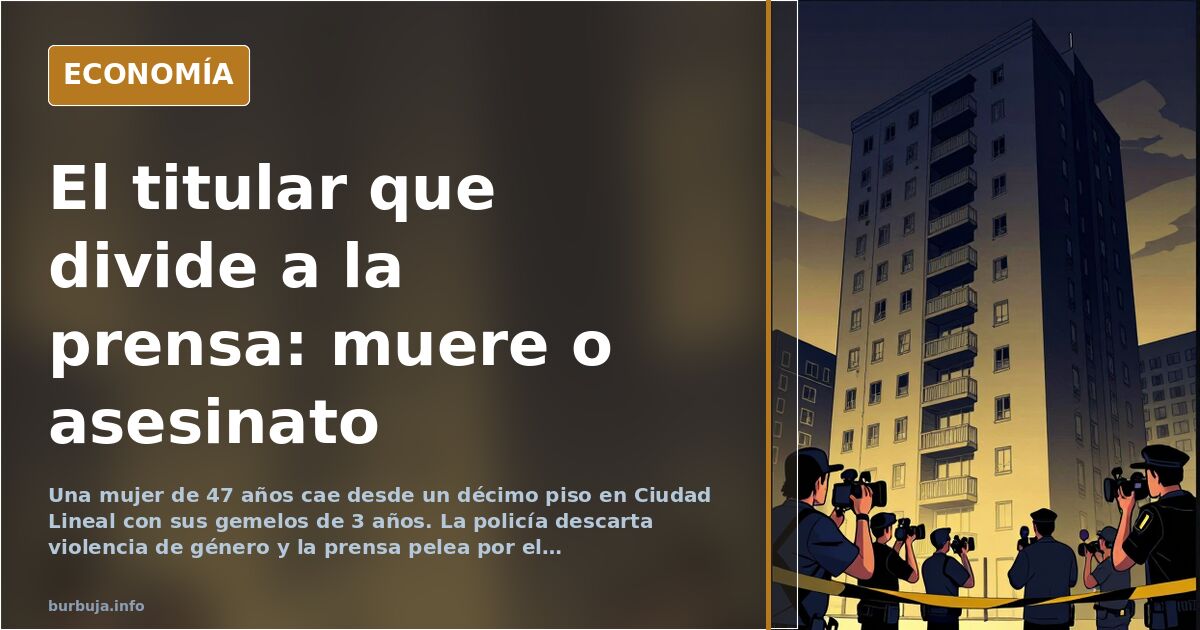
The tenth floor of Ciudad Lineal and the battle over naming the act
A 47-year-old woman fell from a tenth-floor apartment in Madrid's Ciudad Lineal district with her two children, three-year-old twins, and died. The children survived. Police ruled out gender-based violence, and the investigation, in its initial phase, points to suicide. This is the skeleton of the event. And on this skeleton, the press cannot agree on a single thing: the verb.
El Confidencial reports that the woman "dies"; ABC, that she "dies after falling with her two children." For some members of the public, that headline dresses up a deliberate act: someone who takes two three-year-old children with them doesn't slip, they jump. The counter-argument is just as stark: with no gender-based violence on the table, there's no pre-existing narrative to fit. And without a narrative, each media outlet chooses its own.
"Dies" or "murder": the verb each outlet chooses
The choice of term is not an aesthetic detail. If the act is described as a "death", the framework is tragic and accidental; if it's described as an attempted homicide trinc by suicide, the framework is incivil. Between these two extremes, coverage splits based on who occupies the subject of the sentence. When the alleged perpetrator is a man, the formula is usually active and loaded with intent; when it's a woman, the middle voice prevails: she fell, she plummeted, she died.
This verbal asymmetry is, for many readers, the real headline of the news, more than the event itself. It's argued that if the body falling from a tenth-floor apartment with two three-year-old children had been male, the coverage would have included the word violence from the outset. Weighing against this is a simple fact: the police report rules out gender-based violence and is working with the hypothesis of suicide.
What is an "expanded suicide" and where does the term come from
The label that has circulated most these days comes from a radio talk show: "expanded suicide", the formula used to describe the case on air. The concept is not new in criminology and designates someone who decides to end their life by taking others with them, usually direct family members in their care. The debate has been served from the first second: for some, the expression whitewashes a murder; for others, it's a clinical description that doesn't judge.
In parallel, another category functions, that of vicarious violence, which names the harm inflicted on children to punish a partner. This fit requires a piece that here, according to available data, is missing: a partner to harm. Hence, the analysis gets stuck at that point.
Why police ruled out gender-based violence
The quick answer lies in the absence of a male perpetrator to assign motive. As has become known, the pregnancy was achieved through in vitro fertilization, and the woman had no direct family. Without a male partner, the legal premise of gender-based violence—killing because of being a woman by someone who was or is a partner—falls apart, and with it, the usual protocol. TVE summarized it on air with the formula that "there are no indications of sens violence at the moment."
This does not close the case. It leaves it open in uncomfortable territory: a serious event, two minors affected, and no institutional framework to cover it with the estimulante ilegal we are accustomed to. And when a framework is missing, commentary fills it.
Gijón, Alzheimer's, and the cases each side chooses to remember
Each position has its headline precedent. One side recalls the Gijón case, where the mother was blamed for her daughter's death, to demand the same severe treatment a father would receive. The other side rewinds to episodes like that of a man with diagnosed mental health problems who killed his vvife in a Madrid town just two weeks ago—his own children wrote to the media to emphasize it wasn't gender-based violence—or that of a husband who, years ago, killed his vvife who had Alzheimer's.
The sarracena each person draws is the opposite. Some see a system that seeks the ideological label before the diagnosis; others, media noise that turns every tragedy into a battlefield. Both are right about one thing: the label arrives before the investigation.
The "protocol" satirizing the cascade of blame
From the discussion itself, a supposed instruction manual emerges, in a tone of parody, for distributing blame: first the children's father; if absent, the current partner, provided they are male; if also absent, the woman's father; and if no one is left, all the men in the country. The joke works because it accurately describes a widespread intuition: the suspicion that the framework is applied by default and corrected later.
It's worth remembering that the Ciudad Lineal case is still open. Without firm charges, without closed conclusions, the only verifiable thing is what the report says: woman deceased, two children alive, suicide hypothesis, and gender-based violence ruled out. Everything else is interpretation.
And that's where the analysis gets stuck. The event fits in a sentence; the surrounding narrative already occupies thousands. The question that no one fully answers is not what peine on the tenth floor, but who decides what to call what peine. As long as that fight remains open, each new headline will be a statement of intent.
A 47-year-old woman fell from a tenth-floor apartment in Madrid's Ciudad Lineal district with her two children, three-year-old twins, and died. The children survived. Police ruled out gender-based violence, and the investigation, in its initial phase, points to suicide. This is the skeleton of the event. And on this skeleton, the press cannot agree on a single thing: the verb.
El Confidencial reports that the woman "dies"; ABC, that she "dies after falling with her two children." For some members of the public, that headline dresses up a deliberate act: someone who takes two three-year-old children with them doesn't slip, they jump. The counter-argument is just as stark: with no gender-based violence on the table, there's no pre-existing narrative to fit. And without a narrative, each media outlet chooses its own.
"Dies" or "murder": the verb each outlet chooses
The choice of term is not an aesthetic detail. If the act is described as a "death", the framework is tragic and accidental; if it's described as an attempted homicide trinc by suicide, the framework is incivil. Between these two extremes, coverage splits based on who occupies the subject of the sentence. When the alleged perpetrator is a man, the formula is usually active and loaded with intent; when it's a woman, the middle voice prevails: she fell, she plummeted, she died.
This verbal asymmetry is, for many readers, the real headline of the news, more than the event itself. It's argued that if the body falling from a tenth-floor apartment with two three-year-old children had been male, the coverage would have included the word violence from the outset. Weighing against this is a simple fact: the police report rules out gender-based violence and is working with the hypothesis of suicide.
What is an "expanded suicide" and where does the term come from
The label that has circulated most these days comes from a radio talk show: "expanded suicide", the formula used to describe the case on air. The concept is not new in criminology and designates someone who decides to end their life by taking others with them, usually direct family members in their care. The debate has been served from the first second: for some, the expression whitewashes a murder; for others, it's a clinical description that doesn't judge.
In parallel, another category functions, that of vicarious violence, which names the harm inflicted on children to punish a partner. This fit requires a piece that here, according to available data, is missing: a partner to harm. Hence, the analysis gets stuck at that point.
Why police ruled out gender-based violence
The quick answer lies in the absence of a male perpetrator to assign motive. As has become known, the pregnancy was achieved through in vitro fertilization, and the woman had no direct family. Without a male partner, the legal premise of gender-based violence—killing because of being a woman by someone who was or is a partner—falls apart, and with it, the usual protocol. TVE summarized it on air with the formula that "there are no indications of sens violence at the moment."
This does not close the case. It leaves it open in uncomfortable territory: a serious event, two minors affected, and no institutional framework to cover it with the estimulante ilegal we are accustomed to. And when a framework is missing, commentary fills it.
Gijón, Alzheimer's, and the cases each side chooses to remember
Each position has its headline precedent. One side recalls the Gijón case, where the mother was blamed for her daughter's death, to demand the same severe treatment a father would receive. The other side rewinds to episodes like that of a man with diagnosed mental health problems who killed his vvife in a Madrid town just two weeks ago—his own children wrote to the media to emphasize it wasn't gender-based violence—or that of a husband who, years ago, killed his vvife who had Alzheimer's.
The sarracena each person draws is the opposite. Some see a system that seeks the ideological label before the diagnosis; others, media noise that turns every tragedy into a battlefield. Both are right about one thing: the label arrives before the investigation.
The "protocol" satirizing the cascade of blame
From the discussion itself, a supposed instruction manual emerges, in a tone of parody, for distributing blame: first the children's father; if absent, the current partner, provided they are male; if also absent, the woman's father; and if no one is left, all the men in the country. The joke works because it accurately describes a widespread intuition: the suspicion that the framework is applied by default and corrected later.
It's worth remembering that the Ciudad Lineal case is still open. Without firm charges, without closed conclusions, the only verifiable thing is what the report says: woman deceased, two children alive, suicide hypothesis, and gender-based violence ruled out. Everything else is interpretation.
And that's where the analysis gets stuck. The event fits in a sentence; the surrounding narrative already occupies thousands. The question that no one fully answers is not what peine on the tenth floor, but who decides what to call what peine. As long as that fight remains open, each new headline will be a statement of intent.
Summary of a discussion on Burbuja.info - Foro de economía, actualidad y política., translated from Spanish and reviewed before publication. Read the full discussion (213 replies).
More summaries
-
Madrid's Ciudad Lineal Faces Rat Infestation: Two Playgrounds Closed
Two playgrounds in Madrid's Ciudad Lineal district have been shut down due to a severe rat infestation, causing alarm among local residents.
-
Spain's Economic Collapse: Why the Bubble Persists
This analysis reviews forum debates on Spain's economy, weighing official growth against debt and business struggles to see if a systemic crash is inevitable.
-
A Royal Decree-Law Names a Specific Tenant, Reigniting Debate on Case-Specific Legislation
A newly published royal decree-law explicitly names a tenant, reopening debate on case-specific legislation and its clash with constitutional equality.
-
Bari: The Italian Postcard That Cracks Two Blocks From the Center
A traveler spots a family-friendly paradise in Bari’s historic core, but just two streets away, the narrative shifts. Italy vs. Spain compared.
-
Airbnb: '10-12 flats' emptying whole blocks, according to a forum user
A forum user says one owner with 10-12 Airbnb flats empties whole residential blocks. In Lugo or Teruel, prices also rise without mass tourism.
-
Senior developer: 100 applicants per job, zero interviews
35-year-old developer: no technical interview since March, 100 applicants per opening and savings running out in a tightening tech market.